
Stormont Safeguards
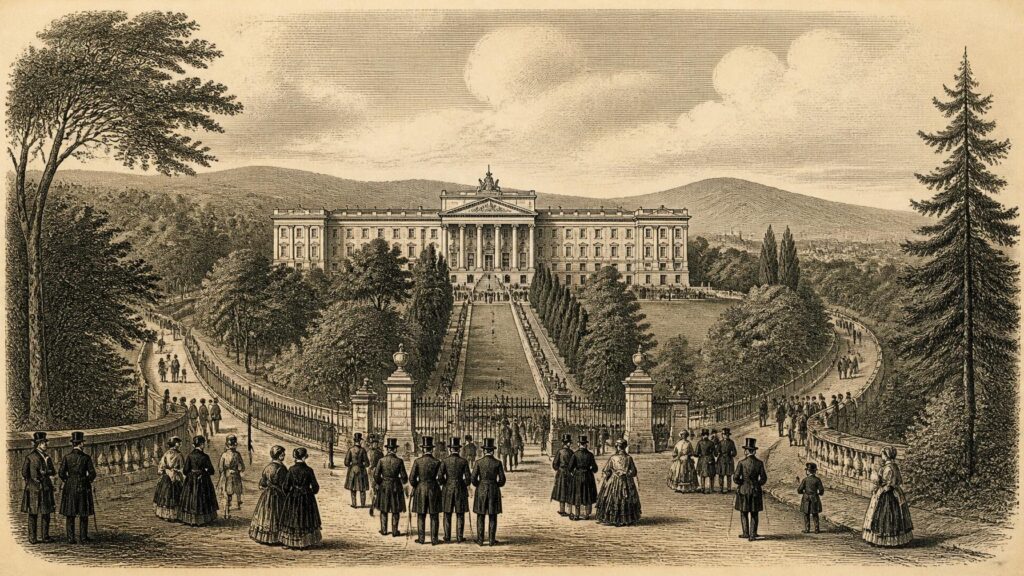
AI generated historical illustration, not a contemporary photograph.
At a Glance
The institutional reform debate of 2026 belongs to a longer Irish history: not a technical quarrel about parliamentary rules, but an argument over how a society marked by partition, conflict and competing national loyalties may govern itself without returning to coercion or exclusion. Northern Ireland’s Assembly and Executive were devised as instruments of peace. Their periodic paralysis has made reform a question not of abandoning the Belfast Agreement, but of deciding how its promise of partnership can be sustained under changed political conditions.
Constitutional Settlement
The institutions at Stormont emerged from the Belfast, or Good Friday, Agreement of 10 April 1998. That settlement was reached after decades in which Northern Ireland had experienced sustained political violence, grave divisions in public life and a profound failure of confidence in earlier constitutional arrangements. Its achievement was not simply to establish a devolved legislature. It created a framework in which the constitutional future of Northern Ireland would rest upon consent, in which British and Irish identities were to receive equal respect, and in which relations within Northern Ireland, across the island, and between Britain and Ireland were to be treated as connected rather than separate questions.
This threefold structure mattered. Strand One provided for the Northern Ireland Assembly and Executive. Strand Two established arrangements for North South co-operation, principally through the North South Ministerial Council and implementation bodies. Strand Three created institutions for East West relations, including the British Irish Council and the British Irish Intergovernmental Conference. The design recognised a central historical fact: peace could not rest solely on a majority governing a minority inside Northern Ireland. It required relationships capable of carrying unionist, nationalist and non-aligned interests at the same time.
The Northern Ireland Act 1998 supplied the principal legal machinery for the devolved settlement. The Assembly was elected by single transferable vote, a system intended to encourage representation across a plural society. Ministerial positions in the Executive were allocated through the d’Hondt formula, broadly reflecting party strength in the Assembly. Ministers took a Pledge of Office which joined ordinary standards of public duty to commitments to equality, non-discrimination, peaceful democratic politics and participation in the interlocking institutions of the Agreement.
Such arrangements are often described by political scientists as consociational: a system in which major groups share power and possess protections against domination. That language can make the arrangement sound bloodless. In historical terms, however, it was an answer to a much sharper problem. Previous structures of government had not commanded nationalist consent, while unionists feared that constitutional change could erode their place within the United Kingdom. The Agreement attempted neither to dissolve these identities nor to require a premature settlement of the constitutional question. It made democratic consent and partnership the conditions under which disagreement could be lived with.
The Agreement was endorsed in referendums held on 22 May 1998 and came into force on 2 December 1999. Its institutions were therefore never merely administrative conveniences. They were part of an internationally supported settlement between the British and Irish governments and the Northern Ireland parties. Any reform proposal must be understood against that background. It may change procedures, but it cannot be judged solely by whether it makes government more efficient. It must also be judged by whether it preserves confidence among communities whose willingness to share power has historically been fragile.
Fragile Design
The original institutions contained both strengths and vulnerabilities. Their strength lay in requiring political actors who had once treated one another as constitutional adversaries, and sometimes worse, to govern in common. The Assembly gave representation to parties across the spectrum; the Executive made it difficult for one tradition to monopolise power; and the wider Agreement connected domestic government to North South and East West relationships. In its better periods, Stormont demonstrated that former antagonists could administer departments, agree budgets and negotiate shared programmes.
Yet the system also gave leading parties formidable opportunities to stop government. Cross-community procedures were designed to ensure that important decisions could not be imposed by a simple communal majority. Members designated themselves as unionist, nationalist or other, and certain votes required support across the unionist and nationalist designations. The petition of concern, intended as a protection for minorities, could trigger a special voting threshold. The offices of First Minister and deputy First Minister, equal in authority despite their unequal titles, were held jointly: the departure of one office-holder brought the other down as well.
These safeguards were understandable in 1998. The negotiations had taken place in the shadow of recent violence and amid deep distrust. A structure that allowed either major tradition to be outvoted on a matter regarded as existential would have been unlikely to secure broad acceptance. Safeguards thus formed part of the settlement rather than an accidental flaw in it. It would be historically careless to treat every veto as evidence of irrationality or obstruction. For many people, they were assurances that participation would not mean surrender.
But a safeguard can become a lever. The executive’s dependence on the continued participation of the largest parties meant that withdrawal could halt collective government. Northern Ireland experienced repeated suspensions and collapses. The most prolonged recent interruptions were the absence of devolved government from January 2017 until January 2020, and again from February 2022 until February 2024. During such periods, civil servants continued essential administration within limited authority, while ministers were absent and politically contentious decisions were delayed, avoided or taken from Westminster.
These stoppages made a difficult distinction impossible to ignore. Power-sharing had helped make politics peaceful; it had not always made government dependable. That does not mean the first achievement should be discounted in favour of the second. The ending of widespread conflict was no small constitutional success. But ordinary public needs do not pause while institutions are absent. Health waiting lists, housing, school provision, infrastructure, public finances and environmental policy all demand decisions over years rather than months. A settlement that can secure peace but cannot reliably make decisions faces a problem of democratic credibility.
Changing Context
The political world for which the 1998 institutions were designed has changed. In the first years after the Agreement, the principal electoral contest was commonly understood through a unionist-nationalist axis. That axis remains important, particularly on questions of sovereignty, identity and the constitutional future. It is also reflected in the Agreement’s language and safeguards. But the electorate has become less easily contained by two communal blocks. Parties identifying as other, most prominently Alliance, have expanded their representation, while many voters hold identities and priorities that do not fit neatly into constitutional labels.
This development has produced a basic question of fairness. A member designated as other may vote and participate fully in Assembly life, but the formal architecture of some cross-community procedures gives special constitutional weight to unionist and nationalist designations. The concern is not that the historic position of those traditions should be ignored. Rather, it is that a settlement designed to prevent a two-community conflict from becoming tyrannical may unintentionally leave citizens outside the two principal designations with less influence over particular institutional decisions.
Demographic change has sharpened the debate without supplying an automatic answer. Census figures, election results and surveys are often deployed as if they deliver straightforward constitutional instructions. They do not. A change in religious background, nationality, identity or party preference does not mechanically determine a view of Irish unity, the Union, or institutional reform. The Agreement’s principle of consent exists precisely because constitutional legitimacy is to be measured democratically, not inferred from population categories. Still, changing electoral patterns make it harder to assume that institutions can remain indefinitely fixed in a form devised for the politics of the late twentieth century.
Brexit added another layer. Northern Ireland’s distinct post-Brexit trading arrangements made questions of East West commerce, North South co-operation and British Irish relations more politically immediate. The DUP’s withdrawal from the Executive in 2022 was connected to its opposition to the Northern Ireland Protocol and subsequent arrangements. The restoration of the Executive in February 2024 followed agreements between the party and the United Kingdom government. The episode showed that Stormont can be paralysed by disputes whose origins lie partly beyond devolved fields, even though the consequences are borne by the region’s public services.
The change in context should not be exaggerated into a claim that the Belfast Agreement has become obsolete. Its central principles—consent, parity of esteem, partnership, rights and non-violence—retain their force. The issue is whether every institutional mechanism devised to secure those principles still performs its intended purpose. Historical settlements endure by being interpreted, implemented and, where there is sufficient legitimacy, adapted. Treating the Agreement as untouchable can be as misleading as treating it as disposable.
Recent Repairs
Reform has not been wholly absent since 1998. The institutions have already been altered through negotiations and legislation. The St Andrews Agreement of 2006 changed the method by which the First Minister and deputy First Minister were selected. Instead of being elected jointly by a cross-community Assembly vote, the offices became tied to the electoral strength of the largest unionist and nationalist parties. That arrangement assisted the return of devolution in 2007, but it also concentrated influence in the two largest communal blocs and reinforced the joint offices’ capacity to bring government to an end.
Other changes reduced the number of Assembly members from 108 to 90 and cut the number of Northern Ireland departments and Executive ministers. An official opposition became possible for parties declining ministerial office, a notable shift in a system previously expected to include almost all significant parties in government. The petition of concern was also reformed through the New Decade, New Approach arrangements. It now requires support from at least thirty members drawn from two or more parties, has procedural restrictions, and cannot be used in the same way to frustrate certain matters of rights and equality.
These modifications are important because they rebut a simple story of constitutional immobility. Stormont has changed before. Its changes have generally emerged from moments of crisis or inter-party negotiation, often with the British and Irish governments playing essential facilitating roles. The difficulty is that reform has tended to be piecemeal and reactive. It has addressed a particularly visible abuse or a pressing breakdown, rather than providing a settled method by which the institutions can periodically consider their own operation.
The reforms to the petition of concern illustrate both promise and limitation. Evidence considered by recent researchers suggests that the device has been used less abusively since the changes. That is a meaningful improvement. But it does not resolve the more fundamental question of what occurs when a party leaves the Executive or refuses to nominate to the joint premiership. The most disruptive veto is not necessarily exercised on the Assembly floor. It can lie in the capacity to prevent an Executive from existing at all.
Nor can institutional design by itself cure every failure of government. The Renewable Heat Incentive scandal exposed weaknesses in scrutiny, ministerial accountability and administrative culture. Delays in appointing oversight figures, legal disputes concerning statutory duties and the long absence of an agreed Programme for Government have all fed public frustration. Rules can improve incentives and close loopholes; they cannot compel courage, mutual respect or competent administration. Any account of reform that promises otherwise mistakes constitutional engineering for political reconciliation.
Review Process
The reform discussion gathered formal momentum after the restoration of devolution. The House of Commons Northern Ireland Affairs Committee had already examined the effectiveness of the Belfast Agreement institutions in a substantial inquiry. It argued that the record justified serious consideration of change, while stressing that durable reform required engagement from the Northern Ireland parties, the British government, the Irish government and the public. Its central insight was historical as well as practical: the Agreement itself provided for review and remedial action when difficulties emerged.
In 2025 the Northern Ireland Assembly’s Assembly and Executive Review Committee began a further review into institutional reform. Its stated purpose was to consider measures capable of improving the functioning and stability of the Assembly and Executive. The committee invited evidence from political parties, academics, civic organisations and members of the public. It also drew on earlier Assembly work, parliamentary inquiries and a detailed report prepared by the Constitution Unit at University College London.
The significance of this process lies partly in its openness. Stormont’s most consequential changes have often been negotiated in private during periods of institutional emergency. Confidential bargaining is sometimes unavoidable in a divided society, but an exclusively elite process can make reform appear to be an arrangement among parties rather than a public constitutional conversation. The current review has allowed competing arguments to be stated plainly: some seek procedural adjustment, others advocate more extensive change, and others maintain that institutional revision may distract from unresolved constitutional disputes.
Assembly evidence during 2026 showed the breadth of disagreement. Some witnesses argued that the institutions were designed primarily to ensure participation after conflict and must now become more capable of delivering stable government. Others warned that no alteration of standing orders or voting thresholds can substitute for a genuine commitment to partnership and equality. These positions are not necessarily contradictory. A constitutional system needs both workable rules and participants willing to use them in good faith. The disagreement concerns where the most pressing obstacle lies and how much change can occur without unsettling the balance that made power-sharing possible.
The review also reflects a useful change in tone. It asks not whether the Good Friday Agreement should be discarded, but which reforms can plausibly remain faithful to its underlying principles. That is a more serious historical question. The Agreement was a package whose parts were negotiated in relation to one another. Altering a mechanism in Strand One can affect confidence in Strand Two and Strand Three. It can also influence how citizens understand parity of esteem, representation and the constitutional safeguards promised in 1998.
Reform Choices
The most prominent proposals concern Executive formation and survival. One possibility is to restore a form of open nomination for the joint leadership offices, allowing any eligible parties to put forward candidates for First Minister and deputy First Minister, subject to an agreed form of Assembly approval. Advocates argue that this would make it more difficult for a single party to hold the whole Executive hostage. Critics reply that it could weaken the guarantee that the largest unionist and nationalist mandates are reflected in the leadership, or simply move blockage to another stage.
A related proposal is to replace the titles First Minister and deputy First Minister with equal titles such as Joint First Ministers. The existing offices are legally co-equal, but the difference in nomenclature has symbolic consequences. It may suggest hierarchy where the legal arrangement intends parity. A change of title would not by itself prevent collapse, yet symbols have mattered throughout the peace process. They can either signal equality or preserve avoidable occasions for grievance. Equally, symbol alone cannot substitute for an agreed method of maintaining government when one partner withdraws.
Another group of proposals concerns community designation and cross-community voting. Reformers have suggested alternatives including weighted-majority votes, supermajority thresholds, or revised mechanisms in which support is measured across the whole Assembly rather than exclusively through unionist and nationalist designations. Such ideas seek to recognise voters and representatives who identify as neither. Their challenge is obvious: a weighted majority may feel more inclusive to some, but less secure to others if it seems capable of allowing a major constitutional tradition to be overridden on matters it regards as fundamental.
The petition of concern remains part of this debate. Because recent reforms have restricted its use, some may conclude that the issue has been solved. That would be premature. Its future depends on evidence about whether it operates as a serious minority safeguard, a device for party discipline, or both. Abolition might simplify Assembly procedure but remove a reassurance embedded in the original settlement. Retention without careful limits risks recreating the old difficulty. A more convincing approach is to distinguish ordinary political disagreement from genuinely rights-sensitive or identity-sensitive questions, while ensuring that the protection cannot become an all-purpose veto.
There are also proposals for contingency government. These would seek to preserve some democratic decision-making if the Executive again falls. Possibilities include enhanced Assembly scrutiny, temporary ministerial arrangements, limited caretaker powers or a clearer mechanism by which a party could leave government without bringing every other party down. Such plans confront a genuine dilemma. Westminster intervention can maintain public administration, but it reduces local democratic control. A substitute devolved arrangement might retain more local legitimacy, but it could be viewed as evading the power-sharing bargain. The correct choice cannot be inferred from administrative convenience alone.
Reformers have further looked to an improved opposition, stronger committees, more independent appointments, clearer duties for ministers and better procedures for cross-departmental strategy. These may sound modest beside arguments about the joint premiership, but they are relevant to everyday accountability. A legislature able to examine ministers effectively, an opposition equipped with time and resources, and public bodies led by promptly appointed office-holders can improve government even when the grand constitutional questions remain unresolved.
Public Mandate
There is a temptation to regard institutional reform as a matter for experts. The legal and procedural detail is indeed complex. Yet the legitimacy of constitutional change in Northern Ireland depends on more than expert design. The Agreement itself was submitted to popular endorsement. Its authority rests in part on the fact that people voted for a settlement which, however imperfectly, offered a route away from conflict. Major revision therefore requires public understanding and public participation, not merely agreement between party leaderships.
Recent academic research and deliberative exercises indicate considerable public dissatisfaction with the ability of a single party to close down devolved government. That dissatisfaction extends across communal backgrounds. It does not follow that there is public consensus for any specific replacement system. Citizens may want stability while disagreeing sharply about the safeguards that stability should retain. A survey finding is evidence of opinion at a particular time, not a blank cheque for constitutional redesign.
For that reason, the discussion of citizens’ assemblies has attracted attention. A carefully designed deliberative body could bring together people of differing identities, hear competing evidence, test trade-offs and articulate principles for reform. Its value would not lie in replacing the Assembly or the governments. It would lie in making visible the public reasoning that private negotiations often lack. Northern Ireland has a long record of political decisions being interpreted through suspicion. A transparent civic process could not eliminate suspicion, but it might establish whether there is common ground that parties have overlooked.
There are risks. A citizens’ assembly can become performative if its conclusions are ignored, or divisive if it is presented as a means of bypassing elected representatives. Selection, remit, expert evidence and governmental response would all require care. Still, the alternative is not neutral. Leaving constitutional discussion wholly to crises encourages the belief that reform occurs only when a party extracts a concession in exchange for returning to government. That pattern rewards brinkmanship and makes the institutions appear less like a common public inheritance than a series of conditional bargains.
Irish Dimension
Northern Ireland’s institutional future cannot be treated as a purely internal United Kingdom matter. This is not a rhetorical flourish; it is built into the constitutional settlement. The Irish government is a co-guarantor of the British Irish Agreement, and Strand Two connects Northern Ireland’s devolved administration directly with the Irish State. The North South Ministerial Council was intended to meet regularly and to develop co-operation in agreed areas. Its operation depends on functioning devolved institutions, just as the wider balance of the Agreement depends on confidence that all three strands are respected.
That Irish dimension is sometimes misrepresented as external interference, while the role of the British government is treated as self-evident. The Agreement rejects that asymmetry. It acknowledged the legitimacy of both British and Irish identities and set out structured roles for both governments. The purpose was not to erase Northern Ireland’s constitutional status, which remains subject to consent, but to create a framework in which relationships across the island could be conducted peacefully and practically.
This is why reform needs patient British Irish engagement. Neither government can credibly impose a new constitutional model over the heads of Northern Ireland’s people and parties. Conversely, both have responsibilities when the structures they jointly underwrote repeatedly fail to function. Their role is best understood as stewardship: providing support, facilitating dialogue, protecting the balance of the settlement and ensuring that reform is not reduced to the interests of whichever party happens to hold the strongest bargaining position.
The history of the peace process offers a warning and a resource. It warns that apparently procedural questions can carry immense symbolic weight. It also shows that difficult changes are possible when participants recognise that the existing arrangement is no longer sufficient and when governments help create space for compromise. The most successful reforms will therefore be those that combine constitutional care with a practical answer to the public demand for government that can remain in office and make decisions.
Historical Judgement
It would be wrong to write the history of Stormont since 1998 as a simple record of failure. The institutions were created in a society emerging from conflict, and their continued existence has itself carried meaning. They have enabled political leaders once separated by fundamental hostility to work within common democratic structures. They have supported co-operation with Ireland and Britain. They have embedded the principle that no constitutional future can be imposed without consent. These achievements are documented; they should not be obscured by understandable frustration at periods of breakdown.
It would be equally wrong to treat survival as a sufficient standard. The repeated absence of ministers has imposed costs on public administration and public trust. The ability of a party to suspend the ordinary operation of devolved government has become harder to defend when citizens experience its consequences in delayed decisions and weakened accountability. The historical purpose of the safeguards was to make government shared. If their practical effect is regularly to make government impossible, the case for careful adjustment becomes stronger.
Interpretation must remain distinct from evidence. The evidence shows recurring collapse, changes already made to the institutions, continuing concern about equality for those who identify as other, and an active Assembly review in 2026. The interpretation offered here is that reform is most likely to endure when it is framed as conservation of the Agreement’s central bargain rather than victory for one constitutional tradition. That is an argument, not an established fact. Reasonable people may conclude that stronger protections are necessary, or that more radical change is required.
Folklore and political shorthand should also be set aside. The claim that the Agreement froze Northern Ireland permanently in the politics of 1998 is not supported by the record: the institutions have been amended repeatedly. The contrary claim that reform is merely a matter of finding the right mathematical formula is equally unsound. Power-sharing depends upon rules, but also upon restraint, respect and a willingness to recognise opponents as legitimate participants in public life.
Future Threshold
The reform debate of 2026 has not yet produced a final constitutional settlement. Its importance lies in the fact that the question is being addressed before another complete institutional breakdown has forced hurried negotiation. The Assembly’s review, the evidence of scholars and civic bodies, and the continuing involvement of British and Irish institutions provide an opportunity to consider stability, representation and accountability together.
A durable outcome will probably not be dramatic. It may consist of several connected adjustments: stronger safeguards against indefinite collapse, fairer recognition of non-aligned representatives, clearer rules for exceptional circumstances, more effective scrutiny and a more systematic habit of review. Any one change may disappoint those seeking a comprehensive redesign. Yet constitutional history is often made through such accumulations, especially where the alternative is a settlement so rigid that pressure can only be released by crisis.
The enduring question is not whether Northern Ireland should choose between peace and effective government. Its people deserve both. The institutional legacy of 1998 is too important to be romanticised, and too hard won to be casually dismantled. Reform worthy of that legacy would retain the protections that made partnership possible while reducing the incentives and opportunities to abandon partnership when political disagreement becomes acute. Shared foundations, after all, require maintenance if they are to bear the weight placed upon them.


Stormont Safeguards identifies a central tension: safeguards designed to reassure unionist and nationalist communities can also make devolved government vulnerable when a party withdraws participation. Recent limits on the petition of concern appear to curb one form of obstruction, yet the joint leadership arrangements and community designations remain more difficult issues, particularly as non-aligned representation grows. The article also shows that Strand One reforms may affect North South and East West confidence. How could reform improve continuity, accountability and inclusion without weakening the partnership, consent and parity of esteem that underpin the Belfast Agreement and power-sharing settlement throughout Northern Ireland?