
Haughey’s Legacy
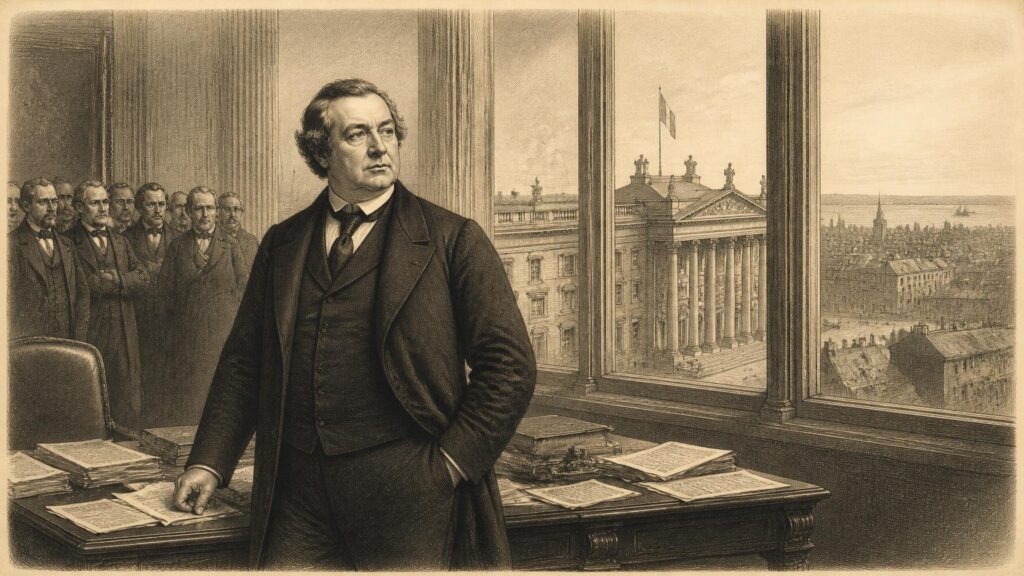
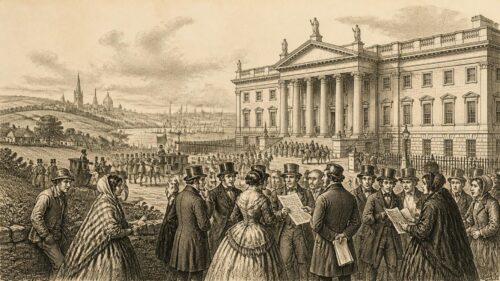
AI generated historical illustration, not a contemporary photograph.
At a Glance
Charles J. Haughey was among the most gifted, forceful and divisive political figures produced by independent Ireland. He served for decades in Dáil Éireann, held some of the State’s most influential ministries and led four governments as Taoiseach. Yet his career cannot be separated from the Arms Crisis, the bitter factionalism that transformed Fianna Fáil, the economic reversals of the 1980s, and the later findings concerning his finances. To write his history is therefore to confront both the possibilities and the failings of Irish public life in the late twentieth century.
Family Origins
Charles James Haughey was born in Castlebar, County Mayo, on 16 September 1925. His origins, however, were not simply Mayo ones. His parents, Seán Haughey and Sarah McWilliams, came from the Dungiven and Swatragh area of County Londonderry. Both had been involved in the revolutionary period, while Seán served in the Free State army after independence. This inheritance mattered. Haughey grew up within a family culture shaped by Irish republicanism, partition and the unsettled position of Northern nationalists after 1921.
When his father’s ill health made continued farming impossible, the family’s circumstances deteriorated. They moved from County Meath to Donnycarney in north Dublin in 1933. The later image of Haughey as a man of wealth, horses, country houses and metropolitan confidence has sometimes obscured this more constrained upbringing. The contrast was psychologically and politically important. He belonged to the generation that came of age during the Emergency: ambitious, educated and impatient with what it regarded as the modest horizons and inherited austerities of the young State.
He attended Scoil Mhuire in Marino and the Christian Brothers’ school in Fairview, before winning a Dublin Corporation scholarship to University College Dublin. At UCD he studied commerce, graduating in 1946. He qualified as a chartered accountant and was called to the Bar in 1949, though he did not practise as a barrister. His professional training supplied both a practical understanding of finance and an assurance in dealing with administrators, lawyers and businessmen. It also made the financial opacity of his later life especially consequential in the public mind.
Haughey joined the Local Defence Force during the Emergency and rose to lieutenant. He played Gaelic football for Parnell’s GAA club, where he won a county championship medal. These details were not incidental to his political formation. They located him in the associational world of north Dublin, a place where sport, parish, party organisation and personal loyalties overlapped. He later mastered that world more thoroughly than almost any contemporary Irish politician.
In 1951 he married Maureen Lemass, daughter of Seán Lemass, the senior Fianna Fáil minister who would become Taoiseach in 1959. The marriage connected Haughey to one of the Republic’s foremost political families, but it did not by itself create his career. He brought to Fianna Fáil formidable organisational energy, professional ability and a strong appetite for advancement. The relationship with Lemass gave him access; his own political skills supplied momentum.
Political Apprenticeship
Haughey entered active Fianna Fáil politics in the late 1940s. He worked in the influential Tomás Ó Cleirigh cumann in Dublin North East, alongside contemporaries including George Colley and Harry Boland. He was unsuccessful at general elections in 1951 and 1954 and at a by-election in 1956, but those defeats were part of an apprenticeship rather than a final rebuff. He served on Dublin Corporation and, within the party, helped investigate and rebuild local organisations after Fianna Fáil’s 1954 defeat.
His election to Dáil Éireann for Dublin North East in 1957 began an unbroken parliamentary career lasting thirty-five years. He would be returned at every subsequent general election until he retired in 1992. The institutional record reveals the breadth of his ascent: parliamentary secretary at Justice from 1959, Minister for Justice from 1961, Minister for Agriculture from 1964, Minister for Finance from 1966, Minister for Health and Social Welfare from 1977, and Taoiseach in 1979. He also became leader of Fianna Fáil, Leader of the Opposition during two periods, and Minister for the Gaeltacht during his final years in government.
Haughey’s early political style was recognisable from the start. He was intensely attentive to detail, restless for reform and confident that he understood modernity better than older political figures. Supporters saw energy, administrative capacity and a refusal to accept mediocrity. Critics saw impatience, self-dramatisation and a tendency to treat disagreement as disloyalty. Both perceptions contained elements of truth.
As a junior minister and then Minister for Justice, he participated in significant legal reform. The reforms associated with his department included legal-aid legislation, extradition measures, the restriction of capital punishment for most offences, and the Succession Act 1965, which strengthened protections for spouses and children in inheritance. His justice ministry also belonged to a less liberal side of the period. It occurred while the State was suppressing the IRA’s 1956–62 border campaign, and Haughey supported the use of the Special Criminal Court. He could therefore be both reforming and coercive: a pattern that recurred throughout his career.
During the Lemass era, Haughey represented a new political type. Along with figures such as Brian Lenihan and Donogh O’Malley, he projected polish, glamour and a readiness to embrace economic development. Their detractors called them the “men in mohair suits”. The phrase captured a wider cultural dispute. For Haughey’s generation, old republican frugality could appear defeatist. For its critics, their modernisation sometimes shaded into conspicuous display and undue intimacy between political power and private business.
Ministerial Reform
Haughey’s years in Agriculture and Finance demonstrated both the scale of his ambition and the sharpness of his methods. At Agriculture he confronted organised farmers at a time when the country was changing rapidly but farming remained economically and culturally central. He promoted a “new deal for the west”, intended to assist small farmers and modernise disadvantaged areas. He also favoured Ireland’s entry into the European Economic Community, calculating that the Common Agricultural Policy could provide support beyond the resources of the Irish Exchequer.
His relations with the National Farmers’ Association and milk suppliers were frequently hostile. The dispute was more than a disagreement over prices. It exposed a weakness in Haughey’s political manner: he often treated organised opposition as an assault on government authority, even when it expressed legitimate social or economic pressure. His impatience with intermediaries, protest and public criticism later became part of his larger reputation.
As Minister for Finance from 1966 to 1970, he presided over a period of expansion and introduced measures still remembered more favourably than much of his later record. Pensioners received free travel on public transport in 1967, along with support for electricity and fuel. Children’s allowances increased, poorer agricultural land was derated, and smaller farmers became eligible for seasonal unemployment relief. Such policies established Haughey’s enduring claim to have combined economic development with a practical social concern.
These measures came with costs and qualifications. They were financed in part through indirect taxation, while government borrowing helped fund capital expenditure. Haughey defended this as a developmental strategy. In the long term, however, his association with expansionist fiscal policy complicated his later image as the leader who restored financial discipline. His political life repeatedly involved movement between apparently contradictory positions: spending and retrenchment, militant republican language and pragmatic accommodation, national sovereignty and European integration.
It would be too simple to call every such movement cynical. Ireland itself changed greatly between the 1960s and the late 1980s, and many policies that had seemed plausible in one economic or political setting became untenable in another. Yet Haughey’s shifts were unusually personalised. He presented decisions not as reluctant adaptations but as demonstrations of command. That was politically effective when circumstances improved; it was corrosive when events exposed misjudgement.
Arms Crisis
The Arms Crisis of 1970 was the decisive rupture of Haughey’s early career. It arose in the aftermath of violence in Northern Ireland during 1969, when nationalist communities experienced attacks, displacement and fear. The Dublin government faced intense public pressure to assist Northern Catholics but had neither an agreed policy nor the military capacity for intervention. Within Fianna Fáil, a divided cabinet struggled to distinguish humanitarian relief, constitutional responsibility and clandestine action.
Haughey, then Minister for Finance, became involved with Neil Blaney and others in efforts connected to the purchase of arms intended, according to those involved, for the defence of nationalist communities in the North. Documentary evidence and subsequent proceedings establish that money earmarked for relief was handled within a confused political and administrative environment, and that plans were made for arms procurement. The precise extent of cabinet knowledge and authorisation has remained contested. Haughey’s defenders argued that senior ministers, including Taoiseach Jack Lynch, knew in broad terms what was occurring. Lynch and other ministers denied authorising the scheme.
What is not uncertain is that the crisis shattered collective responsibility. On 6 May 1970 Haughey and Blaney were dismissed from the government. They were later charged, along with Captain James Kelly and others, with conspiracy to import arms. The subsequent trial ended in acquittal. Acquittal did not settle the historical argument about political judgement, cabinet authority or the wisdom of clandestine initiatives. Nor did it erase the event’s impact upon Haughey’s career. For years he carried both the aura of a republican martyr among some supporters and the stigma of recklessness among opponents.
Historical interpretation must be cautious here. It is reasonable to observe that Haughey’s family background and personal experience predisposed him to a powerful anti-partitionism. It is also reasonable to infer that rivalry within Fianna Fáil influenced the crisis. It is not sound to reduce the episode to a single motive such as patriotism, ambition or conspiracy. The surviving evidence instead shows an unstable mixture of humanitarian alarm, republican conviction, personal competition and institutional failure.
Folklore has magnified the Arms Crisis into a story in which Haughey was either the sole fearless defender of Northern Catholics or the singular architect of a plot. Neither version adequately reflects the documented complexity. The affair involved ministers, military personnel, civil servants, political intermediaries and a government responding badly to a fast-moving emergency. Haughey’s responsibility lay not in acting alone but in participating in a course that bypassed clear cabinet control and risked dangerous consequences.
Leadership Struggle
After the Arms Trial, Haughey spent years on the political margins. He was not permanently excluded from Fianna Fáil, however, and Jack Lynch returned him to the front bench in 1975 as spokesman on health. The 1977 general election brought a large Fianna Fáil majority, and Haughey became Minister for Health and Social Welfare. In that office he pursued hospital building, public-health campaigns and further welfare improvements. He also piloted the Health (Family Planning) Act 1979 through the Dáil.
The family-planning law is revealing. Following the Supreme Court’s McGee decision, the State could no longer sustain an absolute prohibition on contraceptives. Haughey’s legislation allowed their sale on medical prescription to married couples. Its limitations attracted widespread criticism, and his phrase about an “Irish solution to an Irish problem” became emblematic of cautious social reform within a conservative Catholic political culture. Even so, he brought legislation through a party containing strong resistance to any change.
By 1979 the economic confidence of the 1977 government had broken down. Public finances were under severe pressure, and Fianna Fáil performed poorly in the first direct elections to the European Parliament. Lynch resigned as party leader. Haughey defeated George Colley for the leadership, ending a long personal and political rivalry. He became Taoiseach in December 1979.
His first government was short-lived and economically constrained. Haughey was a compelling campaigner, but the June 1981 election left Fianna Fáil without a majority and Garret FitzGerald formed a Fine Gael–Labour coalition. The years that followed were marked by repeated elections, minority governments and increasingly bitter conflict within Fianna Fáil. Haughey returned as Taoiseach in March 1982, supported initially by the arrangement known as the Gregory Deal, which offered social and economic commitments for Dublin’s inner city in exchange for Tony Gregory’s backing.
The second administration collapsed before the end of the year. Its period in office was overshadowed by governmental disorder and the “GUBU” affair, a phrase derived from Haughey’s description of a sequence of extraordinary events as “grotesque, unbelievable, bizarre and unprecedented”. The phrase endured because it seemed to capture not merely one scandal but a wider sense of political dysfunction.
Haughey’s opponents within Fianna Fáil increasingly saw him as a threat to party cohesion and public credibility. His supporters regarded the dissidents as a self-serving establishment unable to match his popular appeal. The conflict was unusually personal. It remade local party organisations, sharpened the importance of individual political machines and accelerated a tendency towards leader-centred politics. In 1985 Desmond O’Malley, one of Haughey’s most prominent critics, was expelled from Fianna Fáil; he helped found the Progressive Democrats soon afterwards.
Economic Reckoning
When Haughey returned to power after the general election of February 1987, Ireland faced a grave fiscal situation. Debt, unemployment, emigration and public expenditure dominated public debate. Fianna Fáil formed a minority government, and Haughey, with Ray MacSharry as a central ministerial figure, accepted and extended spending reductions associated with the previous Fine Gael–Labour government. It was a severe reversal for a leader once identified with expansionary measures and electoral promises.
The government’s approach rested on expenditure restraint, taxation reform, public-sector pay agreements and a wider attempt to restore confidence in the State’s finances. The Programme for National Recovery, agreed in 1987 between government, employers, trade unions and farmers, became the first major framework of what came to be known as social partnership. Its importance should neither be overstated nor dismissed. It did not by itself cause the economic growth of the 1990s, which also depended upon European integration, foreign investment, demographic change, education, global conditions and European structural funds. But it helped create a political and industrial framework for adjustment after years of instability.
Haughey also drove initiatives intended to modernise the financial machinery of the State. The International Financial Services Centre was established in Dublin’s docklands, while the National Treasury Management Agency was created to manage the national debt more systematically. Supporters later presented these developments as foundations of the growth that followed. That claim is partly justified, but historical judgement should retain proportion. Major economic change arose from many actors and decisions over a long period, not from one leader’s foresight.
The 1987–89 period showed Haughey at his most effective in conventional terms. He imposed cabinet discipline, benefited from Fine Gael leader Alan Dukes’s willingness to support measures considered necessary in the national interest, and presided over a government with a clearer economic purpose than his earlier administrations. Yet austerity imposed real hardship. Cuts fell especially heavily on public services, including health. The achievement of fiscal stabilisation must be understood alongside its social costs.
His practical adaptation extended to Northern Ireland. Haughey had fiercely criticised the Anglo-Irish Agreement of 1985 while in opposition, but once Taoiseach he accepted it. He also supported extradition measures after the Enniskillen bombing of November 1987 and authorised discreet contacts which, through figures including John Hume, Father Alec Reid and Martin Mansergh, formed part of the longer pre-history of the peace process. His contribution was real but preliminary. Albert Reynolds, John Hume, successive British and Irish governments, and many others would carry the process further.
Coalition Years
The 1989 election did not supply Haughey with the overall majority he wanted. Fianna Fáil lost seats, and he entered an unprecedented coalition with the Progressive Democrats, the party founded by his expelled former colleague Desmond O’Malley. The arrangement illustrated both Haughey’s flexibility and the altered nature of Irish politics. Coalition government had previously been associated with his opponents; now Fianna Fáil accepted it as the price of office.
The coalition years included continued economic management and a number of significant administrative decisions. They also exposed tensions in Haughey’s leadership style. He expected loyalty and control, while coalition partners required consultation and public credibility. His authority was weakened further by the so-called telephone-tapping controversy. It emerged that the phones of journalists Bruce Arnold and Geraldine Kennedy had been tapped in 1982 on the instruction of then Justice Minister Seán Doherty. The revelation implicated the political atmosphere of Haughey’s earlier government and revived wider concern about power, secrecy and accountability.
In November 1991 Doherty publicly alleged that Haughey had known about the taps. Haughey denied this. The dispute destabilised Fianna Fáil and prompted intense pressure on his leadership. By February 1992 he resigned as Taoiseach and leader of Fianna Fáil. He remained briefly a backbench TD before retiring from the Dáil in December 1992.
His resignation address included the phrase that he had “done the State some service”. It was an attempt at a final reckoning, and it has remained inseparable from his legacy. The words can be read as a defensible reference to social measures, economic stabilisation, public administration and aspects of Northern policy. They can also be read as a strikingly limited account of a career already damaged by the Arms Crisis, party conflict and serious questions concerning financial conduct. The ambiguity is precisely why the phrase has endured.
Financial Inquiry
The gravest reassessment of Haughey’s public life came after his retirement. In the late 1990s, the McCracken Tribunal and then the Moriarty Tribunal investigated payments to politicians and related matters. The Moriarty Tribunal, established by resolutions of the Oireachtas in 1997, examined whether substantial payments had been made to Haughey while he held public office, the sources of funds held for his benefit, and whether official acts or decisions had been influenced in return.
Its first report, published after Haughey’s death in 2006, was an official inquiry report rather than a criminal conviction. This distinction is essential. The tribunal explicitly stated that its conclusions were not findings of criminal or civil liability and that it had applied its own inquisitorial procedures. Nevertheless, its findings were severe and were based on sworn evidence, documentary material and extensive financial investigation.
The report found that Haughey had benefited from substantial secret payments and financial arrangements, including payments associated with businessmen and accounts held for his benefit. It rejected the suggestion that he had known little of his financial affairs merely because others, especially his accountant Des Traynor, managed transactions. It also found that the Fianna Fáil Leader’s Allowance account had been operated irregularly and used for Haughey’s personal benefit, though the full extent of personal drawings could not be quantified because records were incomplete.
Care is needed with the phrase “cash for favours”, which became common in public discussion. In some instances the tribunal found no evidence that a particular donor had sought or received a favour. Its conclusions varied according to each transaction and source of funds. The larger historical point is not dependent on a slogan: the tribunal documented a political culture in which private wealth, access, secrecy and public office were dangerously entangled. It also found special privileges extended to Haughey by a State-owned financial institution to be inappropriate, even where it did not classify them as benefits within the technical meaning of its terms of reference.
Haughey’s family and representatives contested aspects of the tribunal’s proposed and final findings, and historians should acknowledge that there were submissions in his defence. Yet the inquiry’s documented record fundamentally changed the terms on which his life could be assessed. The extravagant lifestyle that had long provoked speculation was no longer only a matter of press observation or political rumour. It became the subject of detailed official examination.
Lasting Legacy
Charles Haughey died on 13 June 2006 at Kinsealy, County Dublin. His death preceded the publication of the Moriarty Tribunal’s first report by several months, ensuring that the report entered public memory as a posthumous judgement. It did not erase the affection some constituents, party workers and beneficiaries of his policies retained for him. Nor did it remove the force of the evidence about his financial conduct.
His legacy is best approached as a contradiction rather than a verdict of simple praise or condemnation. He possessed high political intelligence, administrative drive and a capacity to identify emerging opportunities. He contributed to legal reform, social welfare measures, modern public-health initiatives, economic adjustment and a more pragmatic official approach to the Northern Ireland conflict. His final governments helped establish frameworks that outlasted him.
At the same time, he repeatedly placed personal authority above institutional restraint. The Arms Crisis demonstrated the dangers of informal power during a national emergency. His domination of Fianna Fáil intensified factional conflict. His public style encouraged a leader-centred political culture. The financial inquiries revealed conduct incompatible with the standards expected of a holder of high office. These are documented historical matters, not simply partisan accusations.
Popular memory has often converted Haughey into “Charlie”, “the Boss” or a symbol of an Ireland that was simultaneously ambitious, insecure, theatrical and compromised. Such labels contain a grain of insight but are not analysis. They flatten a career that crossed the Ireland of Lemass-era development, the violence of the Northern conflict, the recession and emigration of the 1980s, and the beginnings of the prosperity and peace process associated with the 1990s.
The fullest judgement is therefore necessarily double. Haughey helped reshape the Irish State and exposed some of its weaknesses. He could be innovative in office and reckless in power; socially reforming and personally secretive; nationally minded and institutionally damaging. His history remains indispensable because it asks a question that Ireland has repeatedly had to answer: whether democratic achievement can be separated from the ethical means by which power is acquired and exercised.

The article presents Haughey’s 1987–89 fiscal stabilisation as an important achievement, yet emphasises the hardship that spending cuts caused, particularly in public services. It also cautions against treating him as the sole architect of subsequent growth, since European integration, investment, education and demographic change mattered greatly. This tension raises a broader question about political credit and responsibility: leaders may shape the framework for recovery while communities bear uneven immediate costs. How should historians weigh Haughey’s role in establishing conditions for economic recovery against the social consequences of austerity, and what evidence could deepen understanding of their distribution across Irish society?