The Euro in Irish Hands2002 CE
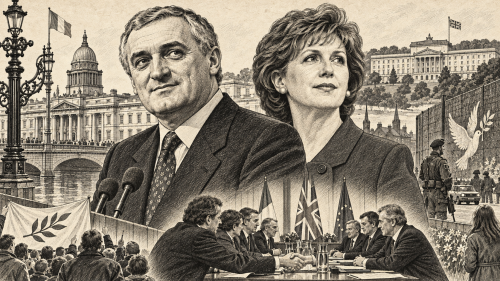
In 2002, euro notes and coins replaced the Irish pound, symbolising deeper European integration. Ireland’s Celtic Tiger economy remained strong in GDP terms, but weak GNP growth exposed dependence on foreign-owned firms. Census results recorded rapid population growth, immigration and Dublin-centred expansion, straining housing and services. Voters rejected tighter abortion provisions but approved the Nice Treaty, enabling EU enlargement. Bertie Ahern’s coalition won re-election. Clerical abuse controversies intensified scrutiny of Church authority. Northern Ireland’s institutions faltered despite IRA decommissioning, leading to suspension of devolved government. Ireland’s World Cup run provided national unity amid profound wider social, economic and constitutional change.
Dateline
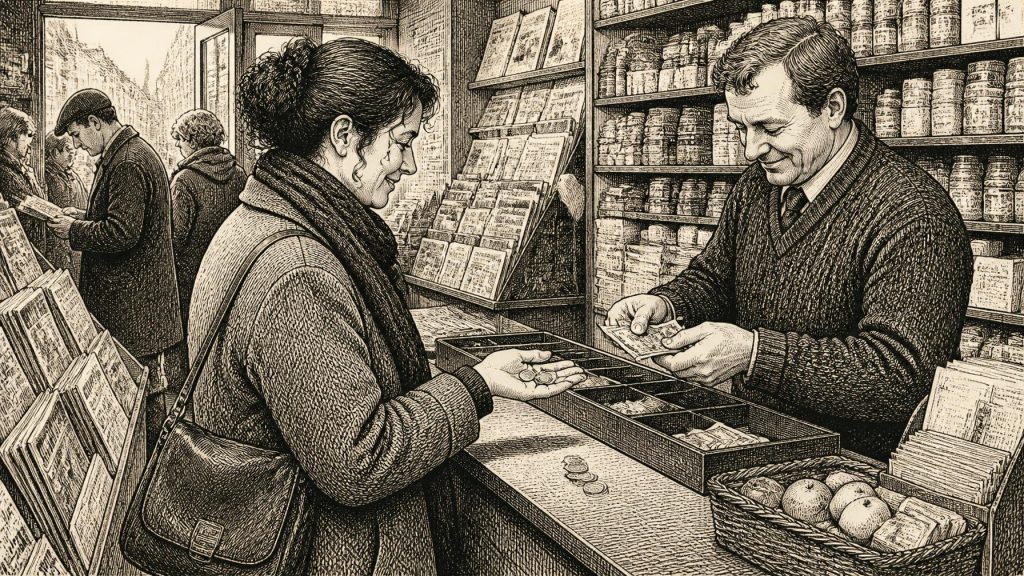
On New Year’s Day, the most immediate sign that Ireland had entered a new phase of European integration lay in purses, tills and cash registers. Euro notes and coins entered circulation on 1 January, replacing the familiar Irish pound in everyday use. The currency had already been irrevocably linked to the euro since 1999, but the arrival of physical cash made monetary union tangible. Shoppers encountered a shared European series of banknotes and Irish-issued coins bearing the harp: an international currency with a deliberately national face.
The practical changeover was swift. Retailers charged in euro from the beginning of the year, while Irish pounds remained acceptable during a short dual-circulation period. At midnight on 9 February, Irish pound notes and coins ceased to be legal tender. The Central Bank later recorded the withdrawal of 119.5 million notes and 686 million coins during the transition. For people accustomed to reckoning prices, wages, savings and debts in punts, the alteration was more than administrative. It required a daily recalibration of value, from the price of a newspaper to the cost of a home.
Prosperity and Its Pressures
The euro changeover came at a moment when the Republic was widely associated with the Celtic Tiger. The extraordinary export-led acceleration of the 1990s had slowed after the international technology downturn, yet Ireland remained a place of expansion, construction and inward migration. Subsequent national accounts measured real GDP growth in 2002 at 6.9 per cent. That impressive figure, however, concealed an important imbalance: real GNP, which excludes profits flowing abroad from multinational firms, grew by only 0.1 per cent. Chemicals and foreign-owned enterprise output were especially significant to the GDP result.
Thus the year offered both confidence and warning. Consumer spending rose, public expenditure increased strongly and building continued to reshape the edges of towns and cities. But the gap between GDP and GNP pointed to the unusual structure of an economy heavily dependent on internationally mobile capital. The boom was visibly changing the built environment before its longer-term fragilities were broadly understood. New estates, roads and commercial premises made growth physical, while rising prices made prosperity unevenly experienced.
The census taken on 28 April provides a particularly valuable snapshot of that transformation. It counted 3,917,203 people in the State, an increase of 291,116, or 8 per cent, since 1996. It was the strongest rate of growth since the 1970s. Natural increase mattered, but migration mattered greatly too: the intercensal figures imply that inward migration exceeded outward migration by more than 153,000 people between 1996 and 2002. A country long defined by emigration was becoming a destination as well as a place of departure.
Growth was regional as well as national. Leinster’s population passed two million for the first time, while the commuting belt around Dublin widened markedly. Fingal grew particularly rapidly; Kildare and Meath each added more than a fifth to their populations over the six-year census interval. Lucan-Esker almost trebled in size. Such figures do not mean that every change occurred solely in 2002, but the census made their cumulative scale visible that year. They recorded a society in which Dublin’s influence extended farther into surrounding counties, placing fresh demands on transport, schools, housing and local services.
Two Referendums, Two Arguments
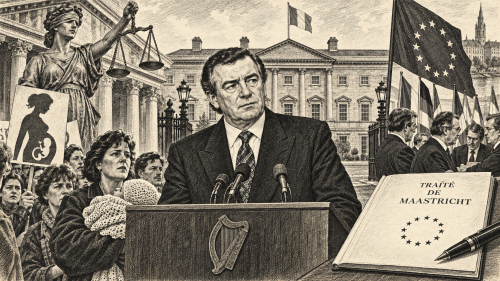
Constitutional politics brought two very different questions before the electorate. On 6 March, voters narrowly rejected the proposed Twenty-fifth Amendment on the protection of human life in pregnancy. The measure would have removed the risk of suicide as a ground for a lawful abortion under the constitutional position established after the 1992 X case, while also proposing a statutory definition of abortion and provisions concerning medical treatment necessary to save a pregnant woman’s life. Its defeat left the Constitution unchanged. The close result demonstrated both the continuing sensitivity of abortion in Irish public life and the limits of a settlement framed largely by government and parliamentary negotiation.
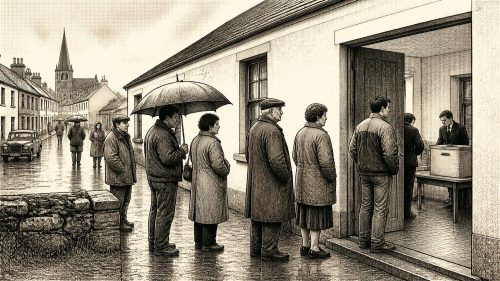
On 19 October, the electorate returned to the Treaty of Nice, which it had rejected in June 2001. The second referendum was held after the Government and other supporters had sought clearer assurances on neutrality, defence and Ireland’s constitutional position. This time the proposal passed decisively: 62.89 per cent voted Yes, on a turnout of 48.45 per cent. The Twenty-sixth Amendment enabled the State to ratify the treaty. Nice was closely linked to the European Union’s planned enlargement, whose institutional implications had made Ireland’s earlier rejection consequential far beyond the island.
The two votes revealed a Republic increasingly accustomed to deciding major constitutional and international questions directly. They also illustrated that European integration and social policy did not form a single ideological axis. A voter could endorse the institutional development of the European Union while rejecting a proposed change to abortion law, or take the opposite view. Referendums were becoming prominent occasions on which arguments about sovereignty, rights, religion, family and Ireland’s place in Europe were conducted in public rather than confined to party rooms.
Ahern’s Renewed Government
The general election of 17 May returned Bertie Ahern’s Fianna Fáil–Progressive Democrats coalition to office. Fianna Fáil won 81 of the 166 seats in Dáil Éireann and the Progressive Democrats eight, giving the partners a working majority. Fine Gael suffered a severe defeat, falling to 31 seats, while Labour won 21. The outcome gave Ahern a second term as Taoiseach and confirmed the resilience of the coalition that had governed since 1997.
When the Twenty-ninth Dáil met on 6 June, it nominated Ahern for appointment by President Mary McAleese and approved his new Government. The election had taken place amid expectations formed by years of economic growth: voters weighed expanding public services, infrastructure, taxation, housing costs and the management of prosperity. The renewed coalition promised continuity, yet the scale of development exposed a contradiction that would become increasingly significant. A State enjoying high revenues and low unemployment still struggled to provide housing and transport at the pace demanded by rapid population and economic change.
Church, Accountability and Public Trust
Religious authority was also under searching scrutiny. In early April, Brendan Comiskey resigned as Catholic bishop of Ferns amid controversy arising from clerical child sexual abuse in the diocese. On 1 April, Archbishop Seán Brady and Cardinal Desmond Connell issued a statement describing abuse by priests as a grave evil, apologising to victims and acknowledging the justified public outrage caused both by abuse and by the way allegations had sometimes been handled. The statement referred to existing Church child-protection procedures and reporting arrangements, but its language also reflected a crisis of trust that policies alone could not settle.
This was not simply an internal Catholic matter. The controversy reached parishes, families, schools and the wider public culture of a country in which the Church had long exercised substantial social influence. In 2002, the institutional response was still incomplete and many later inquiries lay in the future. What can firmly be said of the year is that abuse, accountability and the treatment of survivors had become unavoidable national questions, accelerating a broader reassessment of clerical power and of the relationship between religious institutions and civil society.
A Peace Process Interrupted
Across the border, the Good Friday Agreement’s institutions remained both productive and precarious. In April, the Independent International Commission on Decommissioning, led by General John de Chastelain, reported that the IRA had put a varied and substantial quantity of arms, ammunition and explosive material beyond use. This was its second such decommissioning event. It was welcomed by the British and Irish Governments and by pro-Agreement figures, but it did not remove unionist distrust or settle disputes over policing, security normalisation, paramilitary activity and the full implementation of the Agreement.
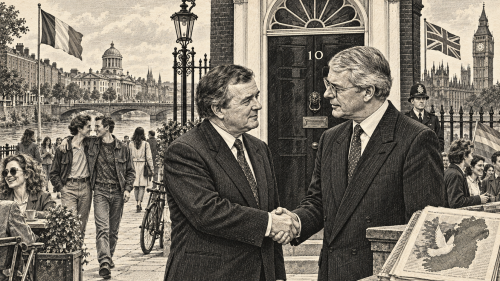
The crisis culminated on 14 October, when the British Government suspended the Northern Ireland Assembly and Executive. Secretary of State John Reid said the confidence required to sustain an inclusive power-sharing administration had broken down. Suspension took effect at midnight; responsibility for Northern Ireland departments reverted to the Secretary of State and his ministers, while the Assembly and its committees could no longer conduct business. The North/South Ministerial Council and British-Irish Council were also affected. For an island whose two governments had invested heavily in the Agreement, the return of direct rule was a grave reversal, even though the framework of the peace process survived.
Shared Attention
Sport supplied a contrasting moment of common attention. At the World Cup in Japan and South Korea, the Republic of Ireland drew with Cameroon and Germany, defeated Saudi Arabia 3–0 on 11 June and reached the last sixteen. Spain eliminated Ireland after a 1–1 draw and a penalty shoot-out on 16 June. The campaign was preceded by the highly public dispute that sent captain Roy Keane home from Saipan, yet the team’s performances under Mick McCarthy gave the tournament an exceptional presence in Irish life. Robbie Keane’s late equaliser against Germany and his penalty against Spain became defining images of the summer.
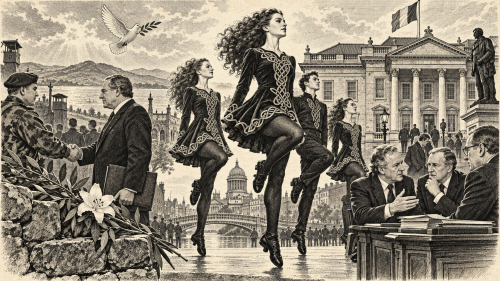
By the end of 2002, Ireland was therefore neither simply a success story nor a country moving along one settled path. Euro cash, a renewed Government, census growth and the Nice vote expressed confidence in an outward-looking Republic. The abortion referendum, the Church crisis, pressure on housing and services, and the suspension of devolved government in Northern Ireland exposed unresolved questions of rights, trust, capacity and constitutional belonging. The year’s most enduring image may indeed be the new coins changing hands: familiar Irish symbols carried within a wider European system, useful precisely because they captured both continuity and profound change.
Primary Sources
- Central Bank of Ireland 75th Anniversary Brochure
- The Irish Pound From Origins to EMU
- Old Irish Coins
- Protection of Human Life in Pregnancy
- Previous Referendums
- L&RS Note: Explaining the Outcome of Rejected Referendums
- Voters Accept Nice Treaty
- General Election — 2002: Results and Transfer of Votes
- Appointment of Taoiseach and Nomination of Members of Government: Motion
- Census 2002 Preliminary Report: Commentary
- Census 2002: Principal Demographic Results
- Census 2002 Principal Demographic Results
- National Income and Expenditure: Annual Results for 2002
- Population and Migration Estimates April 2018
- Profits and Gross Value Added Construction: A National Accounts Perspective
- Statement of Archbishop Seán Brady and Desmond Cardinal Connell
- Connell, Desmond
- CAIN: Chronology of the Conflict 2002
- CAIN: Irish Peace Process – Summary
- Suspension Main
- 14 October 2002: Northern Ireland Assembly Official Report
- The Northern Ireland Assembly – Chronology
- Many IRA Weapons Put Beyond Use, Says Arms Body
- 2002 Republic of Ireland Men Scores and Fixtures, World Cup
- FIFA World Cup 2002 in Japan/South Korea, Group E