

Sovereign Europe
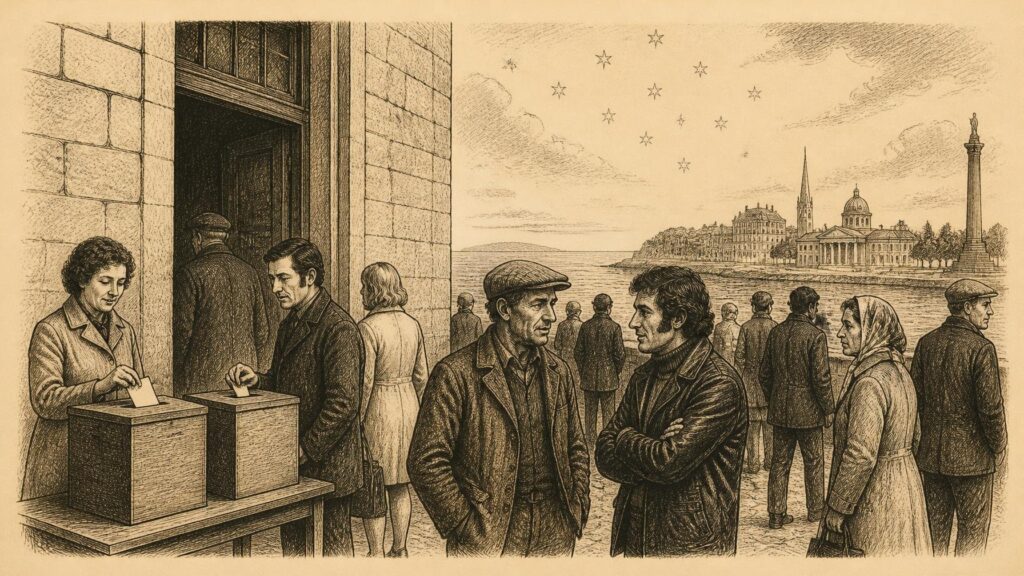
AI generated historical illustration, not a contemporary photograph.
At a Glance
Europe Day, marked on 9 May, is often presented as a civic festival of flags, open institutions and continental reconciliation. In Ireland, however, it has a more searching historical resonance. It invites consideration of a state which secured independence in the twentieth century, guarded its constitutional autonomy carefully, and nevertheless chose to join a European political and legal order in which decisions could have force within the State. The resulting history is neither a simple surrender of sovereignty nor an uncomplicated story of national advancement. It is a record of deliberate popular consent, constitutional bargaining, political argument and continuing uncertainty about where authority properly resides.
Commemorative Date
Europe Day commemorates Robert Schuman’s declaration of 9 May 1950. Speaking as French foreign minister in the aftermath of the Second World War, Schuman proposed placing coal and steel production under common authority. The scheme was practical in its immediate subject matter, but ambitious in its purpose: industries essential to armaments were to become matters of shared management, making another war between historic rivals materially and politically harder to wage. The declaration became a founding reference point for the successive European Communities and, later, the European Union.
The day is therefore not a commemoration of an Irish national event. Ireland was not among the six states that established the European Coal and Steel Community in 1951. Nor did the Irish State join the European Economic Community when the Treaty of Rome came into force in 1958. Yet the date has acquired a genuine Irish significance because it frames the political tradition Ireland eventually entered: a project built from treaties, common institutions and an assumption that interdependence could preserve peace while improving prosperity.
That origin matters because the language of Europe Day can otherwise obscure the difficult constitutional questions raised by membership. Celebration naturally favours a language of fellowship, opportunity and shared values. Sovereignty, by contrast, concerns power: who makes rules, who gives assent, who can prevent action, and whose courts decide disputes. Irish history is particularly revealing because the State’s entry into European integration was repeatedly made conditional on the explicit authority of the people under Bunreacht na hÉireann.
There is no need to invent an older folklore of Europe Day in Ireland. Its Irish history is well documented and comparatively recent. It lies in cabinet decisions, treaty negotiations, referendum campaigns, constitutional text, court judgments and the daily incorporation of European law into domestic administration. That documentary trail offers a more useful account than any retrospective claim that Ireland’s European vocation was either inevitable or alien to its national character.
Irish Distance
In the first decades after independence, Irish policy makers had strong reasons to treat continental integration cautiously. The State’s economy remained closely tied to Britain; partition shaped foreign policy; and neutrality during the Second World War had become an important element in the self-understanding of the independent State. Ireland participated in international organisations, but it had not joined the military alliances that dominated post-war Europe. The Communities initially appeared remote from immediate Irish concerns and were closely associated with the economic arrangements of continental industrial powers.
Distance did not mean indifference. Ireland watched the development of Western European institutions and understood that trading arrangements among the Six could affect Irish interests. But a government in Dublin could not view the Communities in isolation from the British market. The United Kingdom was Ireland’s principal trading partner, and the practical consequences of a customs union excluding Britain would have been severe. Irish applications for membership were accordingly bound up with British applications, even though Irish objectives and constitutional circumstances were not identical.
The failure of the first applications in the 1960s delayed accession, but it also allowed Irish public debate to develop. By the early 1970s, the question was no longer whether Ireland had some cultural affinity with Europe. Such broad claims were too vague to settle policy. The question was whether the State should enter treaty institutions possessing law-making, executive and judicial capacities that could affect agriculture, trade, competition, social policy and many other fields. The issue was made sharper by the wording of the Constitution, whose assertion of national sovereignty had been formed in a very different era.
Irish entry was therefore not an abandonment of the national project established after independence. It was a decision to pursue national interests through a new field of action. That distinction is important. States can exercise sovereignty by refusing commitments, but also by making commitments that they judge advantageous. The historical problem is whether the commitment remains controlled by constitutional means. In Ireland, the answer was sought not in a single doctrine but in a sequence of amendments, votes and legal challenges.
Economic Turn
The decision to seek membership came during a wider reorientation of Irish economic policy. The protectionist assumptions of earlier decades had been giving way to export-led development, foreign investment and a more open approach to trade. Membership of the European Communities offered access to a larger market, but it also promised participation in the Common Agricultural Policy at a time when agriculture retained great economic and social importance. For a rural country, the agricultural dimension was not peripheral: it was central to the practical case made for entry.
Economic expectations should not be confused with certainty. Membership involved adjustment as well as opportunity. Tariff arrangements, competition rules and common policies could bring pressure as readily as benefit to particular producers, firms and workers. Nevertheless, the Communities were understood by many advocates as a route away from excessive economic dependence on Britain. This was a significant national consideration. European participation did not erase the importance of Anglo-Irish trade, but it gave Ireland a wider institutional and commercial setting in which to conduct its affairs.
The enlargement treaty was signed in 1972, alongside arrangements for the United Kingdom and Denmark. Ireland’s constitutional position required more than the ordinary ratification process. The proposed amendment to Article 29.4 stated that the State might become a member of the three Communities and provided that laws, acts and measures necessitated by membership would not be invalidated by the Constitution, while Community acts could have force within the State. The proposed text was unusually direct about the domestic implications of membership.
That formula expressed a characteristic Irish balance. It did not say that the Constitution ceased to matter. On the contrary, the amendment was required precisely because the Constitution mattered. It supplied a specific constitutional licence for membership and for the domestic operation of measures arising from it. The practical effect was significant, but the method was equally significant: the change had to be presented to, and approved by, the electorate. European entry was made an act of constitutional self-authorisation.
Popular Mandate
On 10 May 1972, Irish voters approved the Third Amendment of the Constitution, commonly known as the accession referendum. The official result recorded 1,041,890 votes in favour and 211,891 against, on a turnout of 70.88 per cent. The margin was decisive. It gave the government a strong democratic mandate to proceed, and the President signed the amendment into law on 8 June 1972. Ireland entered the European Communities on 1 January 1973.
The scale of the vote should not be used to imply that every fear had vanished. Referendums settle a defined constitutional proposal, not every future question arising from it. Opponents raised concerns about economic dependence, national control and the consequences of common policies. Supporters stressed markets, farming, development and the chance to participate in European decisions rather than merely endure their effects. Those arguments were rooted in different assessments of the national interest, not simply in a contrast between enlightened Europeanism and narrow isolation.
What the result clearly documented was the electorate’s acceptance of a major constitutional change. The people approved membership of a supranational legal order at a time when the State’s political culture still placed great value on recently won independence. This is the first essential fact for any discussion of Europe Day and Irish sovereignty. The European commitment began with a popular vote, not with a quiet administrative adjustment or an executive act alone.
Accession also altered the meaning of independence in practice. For an independent state, control is not measured only by the capacity to act alone. It is also measured by the capacity to shape rules made with others. Ireland gained representation in the Council, elected members to the European Parliament, appointed commissioners over time, and acquired access to the Community’s legal and political machinery. Such influence was limited by the State’s size and by the rules of collective decision-making, but it was real. The alternative was not a world without external constraint; it was a world in which Ireland had fewer formal means to affect rules beyond its borders.
Constitutional Licence
Article 29 became the constitutional home of Ireland’s European relationship. Its development demonstrates that Irish membership has been understood as an authorised exception within a sovereign constitutional order, rather than as an unlimited transfer of authority. The original accession provision addressed membership of the European Coal and Steel Community, the European Economic Community and Euratom. It also dealt with the domestic legal effects of obligations necessitated by membership.
This language has often led to loose statements that Ireland simply gave away sovereignty in 1972. That is an inadequate description. The amendment allowed particular consequences of membership which might otherwise have conflicted with constitutional norms, but it did not create an open-ended permission for every possible future development of European integration. The question of scope would become crucial when the Communities changed through later treaties.
Irish constitutional practice also preserved a distinction between the external act of entering international commitments and the incorporation of those commitments into domestic law. Article 29 provides for international relations, while the Oireachtas remains central to law-making within the State. European membership complicated that familiar division because regulations and other European measures could have legal effects in Ireland under the constitutional authorisation. But the constitutional framework remained active, and its boundaries could be tested in court.
The Constitution as it stands contains detailed provisions reflecting later European treaties. It affirms Ireland’s commitment to the European Union, authorises the ratification of the Treaty of Lisbon, provides for specified options and decisions subject to prior approval of both Houses of the Oireachtas, and states that Ireland shall not adopt a European Council decision establishing a common defence that would include the State. Such detail is not decorative. It records a history in which European integration was repeatedly translated into the language of Irish constitutional consent.
Crotty Judgment
The decisive turning point came with Raymond Crotty’s challenge to the proposed ratification of the Single European Act in 1987. The case is frequently reduced to a slogan that European treaties require referendums in Ireland. The real legal position is more precise, and more historically important. Crotty challenged the government’s ability to ratify the treaty without a constitutional amendment. The Supreme Court’s decision distinguished between different elements of the Act and examined whether the original constitutional authority for accession extended to them.
The Court accepted that the 1972 constitutional provision could accommodate changes within the essential scope and objectives of the Communities. It did not hold that every treaty adjustment required a referendum. However, a majority found that the provisions on European Political Cooperation involved an impermissible restraint upon the State’s freedom of action in foreign policy unless the people first authorised it by constitutional amendment. The Government could not, by treaty action alone, bind the State beyond the authority conferred by the Constitution.
The judgment mattered far beyond the immediate treaty. It placed the people at the constitutional centre of certain decisions about European integration. It also confirmed that foreign affairs, though ordinarily conducted by government, are not immune from constitutional review. A later referendum was held on 26 May 1987, and the Tenth Amendment enabling ratification of the Single European Act was approved by 755,423 votes to 324,977.
Crotty is sometimes portrayed either as a nationalist rebuke to Europe or as a technical legal inconvenience overcome by referendum. Neither account does justice to it. The case was a statement about constitutional method. It held that an independent people had not silently authorised every future extension of external commitment when they voted in 1972. Yet it also left room for Ireland to participate in the evolving Communities where the constitutional licence was adequate or where a new amendment was approved. In that sense, Crotty did not halt European membership; it constitutionalised its future development.
Referendum Republic
After Crotty, treaty referendums became a defining feature of Ireland’s European history. The referendum on the Maastricht Treaty in June 1992 approved the Eleventh Amendment by 1,001,076 votes to 448,655. Maastricht formally established the European Union and widened the framework of cooperation. The Irish electorate did not merely endorse an abstract idea of Europe; it approved a particular constitutional amendment authorising the State to ratify the treaty and become a member of the Union.
Subsequent treaty votes reinforced the pattern. The Amsterdam Treaty was approved in 1998. The Treaty of Nice was rejected in 2001 and approved after a second referendum in 2002. These outcomes were politically important because they demonstrated that a referendum was not a ceremonial ratification. Electors could reject a proposal, and governments then had to respond through further negotiation, declarations, explanation and a renewed popular vote. The process could be frustrating to governments and unsettling to European partners, but it was also evidence that consent remained active.
The language of sovereignty was prominent in these campaigns, though it was rarely used in a single sense. For some, sovereignty meant the State’s capacity to determine foreign and defence policy without outside direction. For others, it meant the citizen’s power to decide constitutional questions directly. For still others, it meant Ireland’s ability to advance its interests at European level rather than having policy shaped by larger states elsewhere. These meanings could conflict, and campaigns often brought them into sharp contention.
The referendum system did not guarantee a calm or fully informed public discussion. Treaty texts were complex, campaign claims could be partisan, and questions of institutional procedure were difficult to turn into accessible public choices. But the system created occasions when political leaders had to explain why a treaty mattered and what constitutional power it would authorise. Europe Day’s celebratory language is best understood against that more demanding democratic history.
Neutrality Debate
Military neutrality has remained one of the most persistent subjects in Irish discussion of European integration. Ireland’s policy of military neutrality was shaped by the experience of the Second World War and by the State’s distinctive geopolitical circumstances. It was never identical to non-membership of international organisations, nor did it prevent Irish participation in United Nations peacekeeping. Yet it acquired wide symbolic force as an expression of independent foreign policy.
European treaties raised recurring questions about whether closer cooperation in foreign, security and defence matters might compromise that policy. The debate was particularly visible around Nice and Lisbon. Official declarations and constitutional provisions sought to reassure voters that Ireland was not bound by a mutual defence commitment and that the State would not enter a common defence without the necessary constitutional authority. The constitutional text now expressly prevents adoption of a European Council decision establishing a common defence that would include Ireland.
Historical accuracy requires care here. Neutrality is a policy and political tradition, not a magical constitutional wall separating Ireland from all security cooperation. Ireland has participated in aspects of the European Union’s Common Security and Defence Policy and has cooperated with partners in areas consistent with government policy and domestic procedures. Equally, participation in such arrangements has not made Ireland a member of a collective-defence alliance. Arguments that describe Ireland as either wholly detached from European security or already stripped of neutrality are both too absolute.
The deeper issue is the relationship between practical cooperation and national choice. The Irish constitutional approach has attempted to preserve choice through treaty-specific authorisation, parliamentary approval and political commitments. Whether that arrangement is always satisfactory is a matter for legitimate contemporary debate. Historically, however, it shows that sovereignty in Ireland has been defended less through permanent abstention than through procedures designed to ensure that significant changes receive domestic assent.
Lisbon Reckoning
The Lisbon Treaty produced the most dramatic recent illustration of this process. On 12 June 2008, voters rejected the proposed Twenty-eighth Amendment by 862,415 votes to 752,451. The result interrupted the government’s plan for ratification and attracted intense attention across Europe. It also demonstrated the independence of the Irish electorate. Ireland was not voting on behalf of other states, but its constitutional requirements meant that an Irish result had wider consequences for a treaty requiring unanimous ratification.
The reasons for the rejection were varied. Campaigns involved concerns about institutional change, military neutrality, taxation, social issues, democratic accountability and the perceived complexity of the treaty. No single explanation can adequately account for every vote. It is therefore unsound to claim that the result represented one clear popular verdict on Europe as a whole. It did, however, represent a clear rejection of that constitutional proposal at that moment.
Following further discussion at European level and a series of assurances and declarations, a second referendum was held on 2 October 2009. This time the amendment passed by 1,214,268 votes to 594,606. The revised Article 29.4 incorporated a detailed authorisation for Lisbon, provisions concerning Irish participation in specified areas, requirements for prior parliamentary approval in designated cases, and the protection concerning common defence.
The two Lisbon votes are sometimes invoked as proof either of democratic correction or of undue repetition. History supports a more restrained interpretation. The people were asked twice about related constitutional proposals in changed political and explanatory circumstances; they gave different answers. One may criticise or defend the political process, but the constitutional record is plain: the 2008 amendment was defeated, and the 2009 amendment was approved. The episode shows both the contingency of public consent and the capacity of constitutional democracy to revisit an issue without pretending that the earlier vote never occurred.
Shared Authority
The phrase “loss of sovereignty” remains powerful because membership does alter where and how decisions are made. European law can constrain national legislative choices in fields allocated by the treaties. Ministers negotiate and vote with counterparts; national governments do not possess unilateral control over every outcome; and the Court of Justice of the European Union has an essential role in interpreting Union law. These are substantial features of membership and should not be minimised by ceremonial rhetoric.
Yet sovereignty is not exhausted by unilateral action. Ireland participates in the appointment and work of European institutions, elects Members of the European Parliament, sends ministers to the Council, and exercises rights under the treaties. The State may build alliances, negotiate exemptions and opt into or out of particular measures where treaty arrangements permit. As a smaller member state, Ireland’s influence is necessarily limited, but membership supplies formal channels of influence that isolation would not provide.
The Irish Constitution’s European provisions make this point in a distinctive way. They acknowledge that acts of Union institutions may have force in the State, but they do so through provisions enacted by the Irish people. The authority is therefore mediated rather than erased. The Constitution does not deny that European law has consequences; it specifies the domestic foundation on which those consequences stand.
This arrangement does not dissolve political disagreement. People may reasonably differ about whether a particular treaty, policy or institutional development serves Ireland well. But a historical account should separate that judgement from the claim that membership is constitutionally illegitimate. The record shows repeated popular and parliamentary authorisation. The continuing dispute concerns the desirable extent of shared authority, not whether Ireland entered European integration without any constitutional warrant.
Northern Dimension
Ireland’s European history cannot be separated from Northern Ireland. The European Communities did not cause the Northern conflict, nor did they resolve it alone. But shared membership of the European framework by Ireland and the United Kingdom created practical and political settings in which cooperation could develop. European funding, cross-border programmes and the habits of ministerial and official contact formed part of the wider environment in which the peace process matured.
The Good Friday Agreement of 10 April 1998 was principally the work of the parties in Ireland and Northern Ireland, and of the British and Irish governments, supported by international partners. Its constitutional changes were approved by referendum in both jurisdictions. It would be historically wrong to recast the agreement as an achievement of the European Union alone. Nevertheless, the European context mattered. It made the border less central to many economic and social activities and encouraged practical cooperation across it.
The United Kingdom’s departure from the European Union brought the constitutional and economic complexities of the border into new relief. The negotiations that followed revealed how deeply European membership had become intertwined with the peace settlement’s institutional balance. For Ireland, this was a reminder that sovereignty is not only a question of Dublin and Brussels. It also concerns relationships across these islands, the protection of the Agreement, and the practical ease with which communities live and trade across a historically sensitive border.
Europe Day can therefore carry a particular Irish meaning beyond continental symbolism. It recalls an order in which Irish and British representatives could meet as fellow member states, even when national interests diverged. That circumstance did not abolish disagreement, but it supplied forums, legal structures and habits of cooperation that proved valuable. The historical lesson is not that institutions replace politics; it is that institutions can make difficult politics more manageable.
Historical Balance
A balanced interpretation of Europe Day in Ireland begins with a simple fact: the State joined the European Communities by an overwhelming referendum vote in 1972. It continues with an equally important fact: Irish voters have not treated European treaties as automatic endorsements. They have approved, rejected, reconsidered and qualified major steps in integration. The courts, above all in Crotty, have insisted that constitutional power cannot be presumed merely because participation is politically desirable.
That record challenges two comforting myths. The first is that Irish sovereignty ended when Ireland entered Europe. It did not. The State retained its Constitution, elected institutions, courts, international personality and the capacity to decide, through constitutional procedure, whether to authorise new commitments. The second is that sovereignty can be kept intact only by refusing durable commitments to others. Ireland’s history shows a state using constitutional independence to choose interdependence where it judged that choice advantageous.
Europe Day is consequently neither an occasion for uncritical celebration nor a reminder of national eclipse. It is an invitation to examine a democratic experiment in shared authority. Ireland entered Europe for reasons of trade, agriculture, development and influence. It remained engaged because membership became embedded in the country’s economy, law and public life. But it also retained a habit of demanding that consequential changes be explained and authorised at home.
That is the lasting Irish significance of 9 May. The Schuman Declaration proposed that peace and prosperity might be advanced through concrete solidarities. Ireland’s subsequent history adds another proposition: solidarity must be reconciled with constitutional self-government. The reconciliation is never complete, and the arguments surrounding it will continue. Yet the documentary record of referendums, legislation and judicial decisions shows that Irish participation in Europe has been shaped not by the disappearance of sovereignty, but by repeated efforts to define its democratic exercise.


The article presents Irish European membership not as sovereignty surrendered, but as sovereignty exercised through constitutional consent, parliamentary approval and judicial scrutiny. Crotty seems significant because it transformed accession from a one-off decision into an ongoing question about the limits of treaty-making power. Yet referendums may both deepen legitimacy and make complex institutional change difficult to debate, as the Nice votes illustrate. Ireland’s neutrality adds a layer, since participation can expand influence while provoking concern about independent foreign policy. How far has Ireland’s referendum-centred constitutional approach enabled citizens to shape European integration more meaningfully than systems relying on parliamentary ratification?