

Public Relief
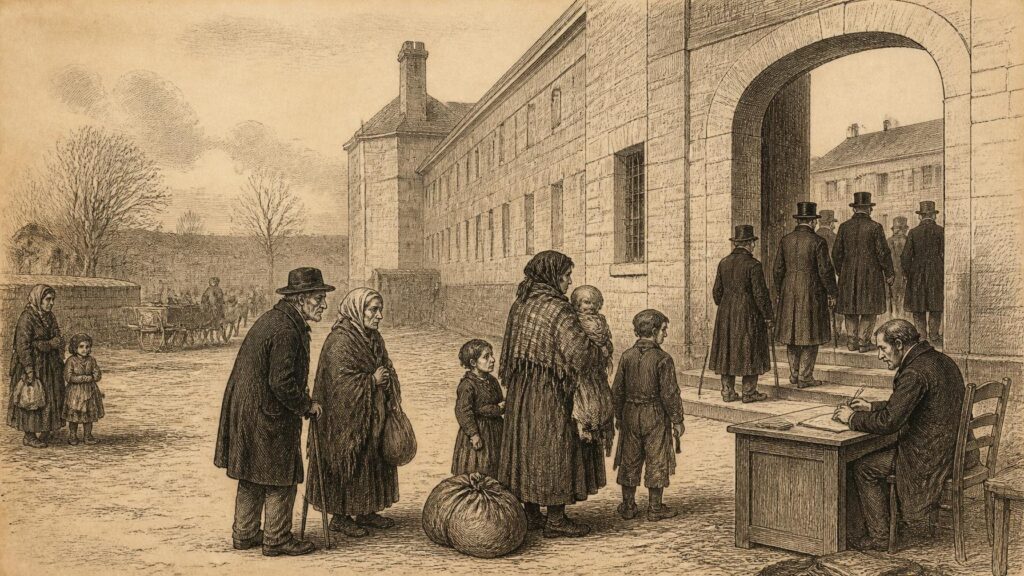
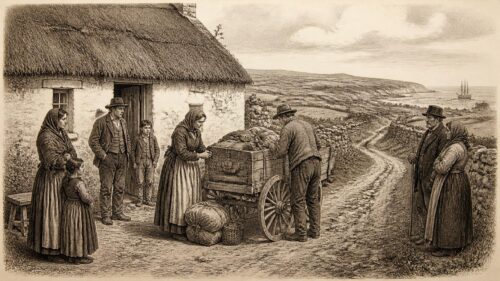
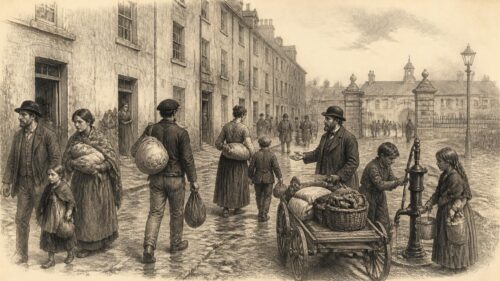
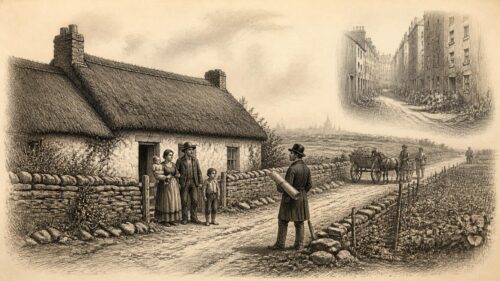
AI generated historical illustration, not a contemporary photograph.
At a Glance
Social welfare in Ireland was never simply a story of government generosity or of private charity filling a public void. It was a changing and often contested arrangement through which communities, churches, landlords, local authorities and, increasingly, the State addressed destitution, illness, old age, unemployment and the costs of raising children. Its history is inseparable from colonial government, the Great Famine, partition, emigration, religious institutions and the continuing expectation that families should carry much of the burden of care.
Defining Welfare
In modern usage, social welfare commonly suggests cash payments, public services and legal entitlements administered by the State. That definition is useful, but it is too narrow for a long Irish history. Before the twentieth century, people facing hardship might turn to relatives, neighbours, a parish priest or minister, charitable societies, a landlord, a hospital, a local dispensary, a house of industry or, in the last resort, a workhouse. These forms of help were neither equal nor reliable. They depended upon local resources, status, religion, family connections and the judgement of those providing assistance.
The word “welfare” can also conceal conflict. Relief was intended to prevent starvation and abandonment, but public authorities frequently designed it to discourage dependency, reduce local expense, discipline labour or distinguish between people considered deserving and undeserving. The Irish record therefore requires attention not only to what was given, but to the conditions imposed on those who asked. A pension paid at home, a meal supplied by a charitable kitchen and admission to a workhouse were all forms of support, yet they carried very different meanings for recipients.
For historical purposes, social welfare in Ireland is best understood as a mixed economy of provision. Families were central. Religious and voluntary bodies remained influential long after public departments acquired larger responsibilities. Local institutions administered important services even when legislation came from London or Dublin. The balance between these providers changed over time, but no single institution entirely displaced the others. This continuity helps explain why Irish welfare policy has often combined public income support with a strong reliance on unpaid family care and voluntary service provision.
There is also a geographical qualification. Before 1921, much legislation considered here applied across Ireland as part of the United Kingdom. Partition then produced two jurisdictions. Northern Ireland developed within the United Kingdom’s social-security and health-service framework, while the Irish Free State, and later the Republic of Ireland, created its own system. Their shared nineteenth-century inheritance remained important, but their subsequent paths cannot be treated as identical.
Customary Supports
Long before a formal welfare state, Irish people possessed traditions of mutual obligation. Extended households, neighbourhood exchange, seasonal labour, credit at local shops and support from kin abroad all helped families survive uncertain harvests, illness and bereavement. Such arrangements left few of the orderly records produced by later government departments, yet letters, memoirs, estate papers, parish collections and court material make clear that poverty was not met solely by official institutions.
Medieval Irish legal traditions are sometimes invoked as proof that ancient Ireland possessed a comprehensive welfare system. That claim needs care. Surviving early legal texts do contain rules concerning rank, fosterage, injury, hospitality and obligations within kin groups. They illuminate social values and forms of responsibility, but they are not evidence of a modern national scheme of income maintenance. Nor can their provisions be assumed to describe everyday practice uniformly across centuries. The documented history of public relief begins much later and under very different political conditions.
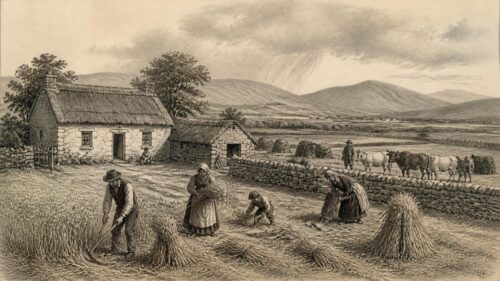
By the eighteenth and early nineteenth centuries, poverty relief commonly rested on a patchwork of local initiatives. Dublin and other towns had charitable institutions, hospitals, orphanages and houses of industry. Religious congregations and lay associations raised funds, visited poor households and ran schools or infirmaries. Rural areas relied heavily on informal support, seasonal employment and the limited resources of landlords or clergy. These arrangements could be humane, but they were vulnerable during widespread crisis. A bad harvest, falling agricultural prices or disease could overwhelm the resources of precisely those communities expected to provide aid.
Government intervention before the Poor Law was episodic rather than systematic. During distress, public works, food measures and emergency loans sometimes appeared. The National Archives preserves administrative papers showing how crop failure, unemployment and epidemic disease drew officials into local Irish conditions during the early nineteenth century. Such interventions were important precedents, but they did not establish a right to subsistence. Assistance remained conditional, temporary and shaped by contemporary assumptions about moral conduct, work and local responsibility.
Later folklore often portrays pre-Poor Law rural society either as a realm of seamless communal solidarity or as a landscape abandoned entirely to suffering. Neither extreme is adequate. Mutual aid existed, and so did harsh inequality, dependence and exclusion. The evidence points to resourceful family and local networks, but also to a society in which the poorest people could be exceptionally exposed when those networks failed.
Colonial Relief
The Poor Relief (Ireland) Act of 1838 marked a decisive institutional change. Enacted by the Westminster Parliament, it established a centrally supervised system intended to provide relief for destitute people in Ireland. The legislation was modelled on the English Poor Law of 1834, though Irish conditions differed markedly from those in industrialising England. Ireland had a much larger rural population, extensive dependence on small holdings and seasonal labour, and widespread poverty that could not readily be treated as an individual failure to find work.
The Act divided the country into Poor Law unions, each centred on a workhouse. A board of guardians managed each union, combining elected guardians with appointed local magistrates. The system was financed largely through local poor rates, while commissioners exercised central control and issued regulations. In principle, the workhouse offered institutional relief to people unable to support themselves. In practice, it embodied a deliberate deterrent. Conditions were intended to be less attractive than the position of the poorest independent labourer, so that admission would be a last resort rather than an alternative to paid work.
The law’s language reveals its assumptions. It referred to the relief of the “destitute poor”, authorised boards to govern workhouses and made provision for the management of houses of industry and other institutions. It also reflected the expectation that families should support one another where possible: adult children could be held liable to contribute towards the maintenance of impoverished parents. The law thus combined public intervention with a legal reinforcement of family obligation.
Initially, the Irish system placed emphasis on indoor relief: support within the workhouse rather than money or food supplied to people in their own homes. This made the institution central to the experience of poverty. Admission could mean the separation of husbands, wives and children into designated wards, the surrender of ordinary domestic routines and life under a strict schedule. Residents performed work where able, while the sick, aged, children and disabled people were grouped according to rules that varied in detail but shared the wider purpose of administration and control.
The workhouse was not, however, merely a prison in another name, as later popular memory sometimes suggests. It was a relief institution containing people with very different needs: abandoned children, elderly people, unemployed labourers, people with disabilities, sick patients and families in acute distress. That complexity should not soften the coercive features of the system. It does show why the surviving minute books, admission registers, medical records and correspondence are invaluable. They reveal institutions that were at once punitive, protective, bureaucratic and desperate.
Workhouse System
The National Archives records that the 1838 system initially divided Ireland into 130 Poor Law unions, each with a workhouse at its centre. This scale is significant. The Poor Law created a countrywide administrative map, a network of officials and a routine of record-keeping that reached into many localities. Boards of guardians discussed contracts, diets, staffing, hospital arrangements, deaths, admissions and expenditure. For historians, these records make the poor more visible than they had often been in earlier sources, although they show them through the administrative gaze of officials.
Construction proceeded in the early 1840s. Many workhouses were built to a standardised plan associated with the architect George Wilkinson. Their austere appearance has become a powerful visual symbol of the era. Yet architecture alone does not explain their role. A workhouse could also contain infirmary accommodation, fever wards and administrative offices; later many became hospitals, county homes or other public buildings. The institutions were embedded in a wider system that increasingly touched public health, registration, sanitation and housing.
Local variation mattered. Some unions possessed stronger rate bases than others. Guardians differed in political outlook, religious affiliation and willingness to spend. Rural unions confronted scattered populations and agricultural poverty; urban unions dealt with overcrowding, casual employment and migration. The poor rate was especially contentious because it placed part of the cost of destitution upon local property. Landlords and ratepayers therefore had an interest in controlling expenditure, while poorer residents had limited influence over the system’s early governance.
The workhouse did not replace charity. Religious orders, parish groups, philanthropic societies and private benefactors continued to operate schools, hospitals, orphanages and relief schemes. The coexistence of public and voluntary provision was not accidental. It arose from limited public finance, religious diversity, political suspicion of expansive state action and the practical need for institutions capable of delivering care. That mixed structure became one of the most enduring characteristics of Irish social provision.
It is tempting to describe the workhouse system as an unchanging failure. It certainly failed to prevent mass suffering during the famine years, and its deterrent design imposed grave hardship. Yet it also became a major apparatus of local government and public health. A historical judgement must retain both facts: the system was founded on restrictive principles, and it subsequently performed functions far broader than its founders envisaged.
Famine Crisis
The Great Famine transformed the meaning and capacity of poor relief. The potato blight that emerged in the mid-1840s struck a population for whom the potato was a crucial food source, especially among the rural poor. Existing relief mechanisms proved wholly inadequate to a catastrophe of this scale. Public works, soup kitchens, charitable collections, landlord aid, emigration and Poor Law institutions all formed part of the response, but none removed the terrible consequences of hunger, disease, eviction and displacement.
Workhouses, designed for a small proportion of the population, were overwhelmed. The National Archives notes that the system had originally been intended to support about one per cent of the population, roughly 80,000 people. By March 1851, nearly four per cent of the population had been forced into workhouses. The rise demonstrates both the severity of the crisis and the inadequacy of a regime designed to deter applicants. Buildings became overcrowded; fever and other diseases spread; guardians confronted impossible financial and logistical decisions.
Under pressure, the legal framework changed. Outdoor relief, once resisted because it was thought to undermine the workhouse test, expanded during the emergency. Soup kitchens fed large numbers for a limited period. Assistance nevertheless remained shaped by official judgements about eligibility, local finance and labour. The central state did intervene more extensively than the doctrine of laissez-faire might suggest, but intervention was inconsistent and often disastrously late or insufficient. Historians continue to debate the relative weight of ideology, administrative incapacity, fiscal caution and political calculation in explaining policy failure.
The human consequences were not confined to those admitted to institutions. People travelled long distances seeking relief. Families were fragmented by death, migration, workhouse admission and emigration. The distinction between home and institution, already severe in the Poor Law, acquired a new force when entering a workhouse could mean leaving a collapsing rural community. Mortality in particular workhouses varied, and local records are essential for tracing it. Broad national narratives cannot substitute for the evidence preserved in individual union minute books and registers.
Famine memory has understandably given the workhouse an exceptional place in Irish historical consciousness. That memory is grounded in real suffering, but it can simplify chronology. The Irish Poor Law predated the famine; it survived it; and its role changed thereafter. The famine did not create the workhouse system, nor did the closing of the worst emergency years end poverty. Its lasting importance lies partly in the way it exposed the limits of a relief regime premised on deterrence and local funding during a national calamity.
Changing Functions
After the famine, Poor Law unions continued, but their functions broadened. The National Archives notes that, over the nineteenth century, they acquired responsibilities in health, housing and sanitation. Their connection with medical care deepened as dispensary arrangements and workhouse infirmaries assumed greater importance. From the 1860s, workhouse hospitals became more accessible to the general public. This development complicates a simple picture of the workhouse as only a place for destitution: it was also part of the evolving infrastructure of healthcare.
The Local Government (Ireland) Act of 1898 altered the political setting. It created elected county councils and widened participation in local administration, including Poor Law governance. The reforms did not erase class differences or the stigma attached to relief, but they changed who could influence local institutions. Women householders and occupiers gained a local-government franchise, a significant development in a system whose earlier decision-making had been dominated by property and magistracy.
At the same time, new forms of social protection appeared. The Old Age Pensions Act of 1908 introduced a non-contributory pension across the United Kingdom of Great Britain and Ireland. Cormac Ó Gráda’s study of Irish pensions shows the importance of this measure as an early form of publicly provided old-age social security. It did not create retirement security in the modern sense: eligibility involved a means test and age verification could be difficult in a country where civil registration had begun only in the nineteenth century. Still, regular state income for older people was a major departure from reliance on adult children, charity or the workhouse.
National Insurance legislation followed in 1911, offering sickness and unemployment protection to particular categories of workers through contributions. Coverage was selective and linked to paid employment. Agricultural labourers, domestic workers, women and people in irregular employment did not necessarily experience these measures equally. Nevertheless, the combined arrival of pensions and insurance began to loosen the Poor Law’s monopoly over public support. Poverty did not disappear, but assistance increasingly included payments received outside an institution.
This transition should not be overstated. Poor relief remained available, and many people continued to depend upon family care and voluntary organisations. Yet the conceptual change was significant. Assistance was beginning to be framed not only as relief for destitution, but as protection against predictable life risks: old age, sickness and unemployment. That language would become central to twentieth-century welfare states.
Partitioned Paths
Partition in 1921 reshaped welfare administration. Northern Ireland remained within the United Kingdom and consequently became part of the British system of social insurance, family benefits and, after the Second World War, the National Health Service. The six counties also inherited particular industrial, urban and sectarian conditions that distinguished their social history from that of the south. A single all-Ireland narrative after 1921 can therefore obscure substantial institutional differences.
In the Irish Free State, established in 1922, the new government inherited legislation, local bodies and institutions formed under British rule. It also inherited a constrained fiscal position, a predominantly rural population and high emigration. Much social provision continued through local authorities, religious bodies and families. In the early years, the State did not undertake a wholesale reconstruction of welfare. Cost, administrative continuity and political priorities all encouraged gradual change.
The old Poor Law system was reduced in the south during the 1920s. Most unions outside Dublin were abolished, workhouses closed or were adapted for other purposes, and aspects of their work passed to county authorities or new arrangements. Some buildings became county homes, hospitals or institutional settings for people regarded as aged, infirm or otherwise dependent. The material survival of many workhouse sites is a reminder that institutions can outlive the laws that created them.
The two jurisdictions also shared social pressures without sharing one administrative solution. Emigration could act as an escape from unemployment and low wages, while remittances from relatives abroad supported households left behind. Rural households often depended upon unpaid labour and care within the family. In both north and south, welfare cannot be understood through statute alone; migration, labour markets, family formation and religious institutions were equally important.
Free State
The Free State’s welfare development was incremental rather than revolutionary. Old-age pensions continued, and the State retained forms of insurance and public assistance inherited from the United Kingdom. The economic strains of the interwar period made unemployment a central concern. The introduction of unemployment assistance in 1933 was an important step because it recognised that insurance alone could not meet the needs of people without sufficient contribution records or stable employment histories.
Unemployment assistance also displayed a persistent feature of Irish welfare: means testing. Eligibility depended not simply on unemployment, but on an assessment of resources and household circumstances. Such tests directed limited funds towards people judged most needy, but they also subjected applicants to investigation and discretion. The distinction between insurance, based on contributions, and assistance, based on need, became fundamental to the architecture of the system.
The 1930s saw other extensions. The Widows’ and Orphans’ Pensions Act of 1935 provided contributory and non-contributory forms of support. Its detailed provisions show both an acknowledgement of family vulnerability and the assumptions of the period. Welfare legislation was often written around the male breadwinner household, with wives and children identified as dependants. This did not mean women were absent from welfare; indeed, women frequently managed scarce household resources and engaged directly with institutions. It did mean that public policy commonly treated their entitlements as mediated by marital status, motherhood or a husband’s employment.
These measures should be placed alongside, rather than separated from, the role of the churches and religious congregations. Catholic social teaching, voluntary action and institutional care were influential in the Irish Free State. Hospitals, schools, residential homes and services for children often depended on religious providers supported in varying ways by public funds. To describe this simply as state withdrawal would be misleading, since public authority regulated, financed or referred people into many such services. Yet it would be equally misleading to describe it as a fully public welfare state. Responsibility was distributed, sometimes ambiguously, between government, local authorities, families and voluntary bodies.
Historical interpretation is important here. Some scholars stress Ireland’s limited public expenditure and residual, means-tested character. Others emphasise the distinctive combination of public measures, land policy, family support and church-linked service provision. These approaches are not necessarily incompatible. They point to a welfare order in which the State mattered, but did not consistently guarantee a comprehensive standard of care independent of family, market or charitable provision.
Family Provision
The Children’s Allowances Act of 1944 was a landmark because it recognised the recurrent cost of children as a matter for public payment. The legislation provided allowances in respect of children under sixteen, initially with conditions and a phased regional implementation. In historical terms, it represented a shift from relief directed solely at destitution towards support for ordinary family maintenance. It also acknowledged that low wages or insecure work could leave larger households vulnerable even when a breadwinner was employed.
Family allowances carried complex implications. They could improve household income and reduce pressure on charitable relief, but they were not neutral. Decisions about who received payment, which children qualified and how household dependency was defined reflected assumptions about family life. In many welfare systems, including Ireland’s, cash benefits could simultaneously recognise caregiving and reinforce expectations that women’s economic security should be tied to marriage and motherhood.
The Second World War emergency intensified concerns about prices, food, employment and living standards. Although Ireland was neutral, the economic and social effects were substantial. Policymakers faced pressure to coordinate a collection of pensions, insurance arrangements, allowances and assistance schemes that had grown piecemeal. The answer was not an immediate reproduction of Britain’s postwar welfare settlement. Irish institutions developed according to different resources, political alliances and expectations about public and voluntary responsibility.
Family support also remained deeply connected to migration. In a country marked by long-term emigration, financial help from relatives overseas could supplement, replace or delay recourse to public assistance. This was a private form of social security, but an uneven one. It depended on having family members able and willing to send money. Its importance underlines a broader point: household survival could rest on transnational connections as much as on a local office, parish or public department.
Insurance Settlement
The creation of the Department of Social Welfare in 1947 gave greater coherence to an expanding field. Previously, schemes had been administered across several departments and the Revenue Commissioners. The Social Welfare Act of 1948 consolidated and amended existing provisions concerning old-age pensions, health insurance, unemployment insurance, unemployment assistance and widows’ and orphans’ pensions. The legislation did not begin from nothing; its significance lay in coordination, extension and the formation of a more recognisable social-welfare administration.
The Social Welfare Act of 1952 went further in establishing a coordinated system of social insurance. Its long title expressly connected insured persons and contributions with benefits, while also incorporating old-age pensions, national health insurance, unemployment insurance, unemployment assistance and widows’ and orphans’ pensions. The Act’s categories are revealing. They organised risks through employment, contribution history, age, marital position and dependency. They also show that assistance and insurance continued alongside one another rather than one replacing the other.
The 1952 Act preserved gendered assumptions visible in its definition of an adult dependant. A married man’s wife was generally treated as his dependant if maintained by him; a married woman’s husband qualified only in specified circumstances of incapacity. Such clauses were not peculiar to Ireland, but they demonstrate how legislation could build a particular family model into entitlement. Subsequent reform would challenge elements of that model, yet its influence endured in policy and public expectations.
The new settlement improved administrative order and extended coverage, but it did not eliminate hardship. Ireland in the 1950s experienced persistent economic weakness and substantial emigration. Research associated with the Economic and Social Research Institute has noted the contrast between Britain’s more developed safety net and the limited protection available in Ireland at the time. For many people, leaving remained a practical response to unemployment or low income. Welfare history must therefore be read alongside the history of departures: a payment system can influence whether people remain, seek work elsewhere or depend upon relatives abroad.
Later Transformation
From the 1960s onwards, social welfare payments and services expanded in scale and complexity. Economic modernisation, rising employment, European integration, changing family patterns and greater public expectations all altered the setting. Payment rates rose over time, new benefits were introduced, and the administrative system became increasingly professionalised. Yet improvement was uneven. The extent to which a benefit protected a household depended on inflation, housing costs, family size, work opportunities and access to health or care services.
The later twentieth century also brought greater scrutiny of institutional care. Residential settings associated with poverty, disability, childhood, unmarried motherhood and old age came under historical and public examination. Here it is particularly important to distinguish evidence from generalisation. Not every institution had the same rules, funding, religious management or experience, and personal testimony must be considered alongside records of policy and administration. What is beyond doubt is that welfare in Ireland often operated through institutions that could provide shelter, education or treatment while also restricting liberty, separating families and exposing residents to unequal power.
By the 1990s, poverty became more explicitly measured and discussed through national strategies. The first national anti-poverty strategy was launched in 1997, reflecting a stronger policy focus on income poverty, exclusion and the effect of social transfers. This language differed markedly from the nineteenth-century vocabulary of pauperism and destitution. It did not mean that older distinctions vanished. Debates about means testing, work incentives, family responsibility and deservingness remained familiar features of public discussion.
Across the same period, the relationship between welfare and work became more complicated. A system designed only to provide emergency relief could not adequately address long-term unemployment, lone parenthood, caring responsibilities, disability or an ageing population. Social welfare increasingly involved activation, training, childcare, pensions, income supports and services, as well as traditional cash benefits. The concept widened, even as disputes continued over its cost and purpose.
Historical Legacy
The history of Irish social welfare is not a straight march from cruelty to compassion. It is a record of changing protections, recurring limits and durable compromises. The Poor Law created an administrative structure intended to relieve destitution while deterring reliance. The famine exposed the catastrophic inadequacy of that structure in a national emergency. Pensions, insurance, unemployment assistance and family allowances gradually shifted support away from the workhouse and towards payments associated with age, employment and family circumstances.
Yet older principles remained visible. Means tests retained the distinction between need and entitlement. Family obligation continued to be assumed in law and policy. Religious and voluntary organisations retained an important place in service delivery. Local institutions and inherited buildings carried the physical legacy of the Poor Law into later health and care systems. Even when official terminology changed, the question of who should bear the costs of vulnerability remained unresolved.
Documentary evidence permits a firm outline of this transformation: legislation created institutions and payments; archives preserve the work of guardians, officials and departments; scholarly research traces the system’s development and limits. Interpretation enters when historians decide how to weigh coercion against care, colonial policy against local agency, or public provision against family and voluntary support. Folklore and family memory add another dimension. They may preserve truths about fear, stigma, endurance and loss that formal records understate, but they should not be used uncritically to replace documented evidence.
For that reason, social welfare deserves attention not as a technical branch of administration but as a central part of Irish history. It reveals how poverty was understood, how citizenship was graded, how gender and family were regulated, and how people negotiated institutions during moments of private and public crisis. The movement from the workhouse gate to the welfare office was profound, but incomplete. Ireland’s welfare history remains the history of an enduring argument over dignity, obligation and the proper reach of public responsibility.
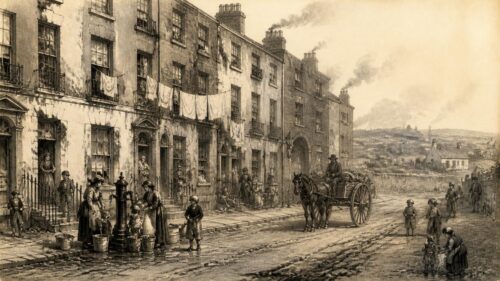
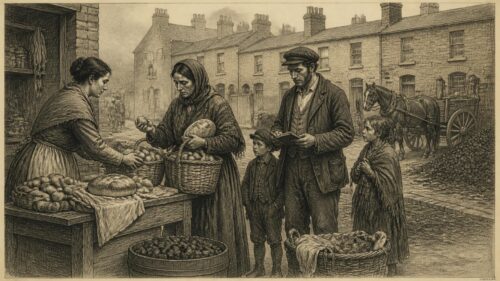
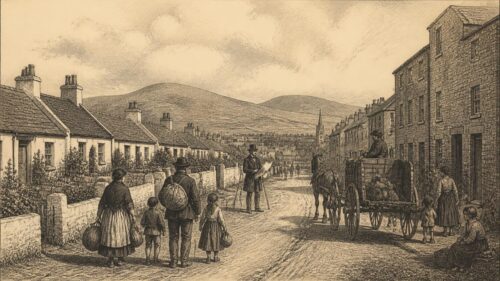
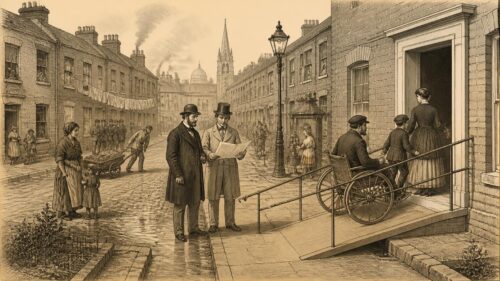
The article’s portrayal of Irish welfare as a durable mixed economy is striking. Even as pensions, insurance and local government expanded, families, religious bodies and voluntary organisations continued to provide care, while the legacy of Poor Law institutions influenced how support was experienced and remembered. Partition created divergent routes, yet neither jurisdiction escaped reliance on non-state provision. This raises an important interpretative question about continuity: did twentieth-century state welfare reduce dependence on family and voluntary care, or did it reorganise that dependence through payments, services and expectations? What evidence from Northern Ireland and the Republic would best illuminate the balance?