
Leabhar Breac
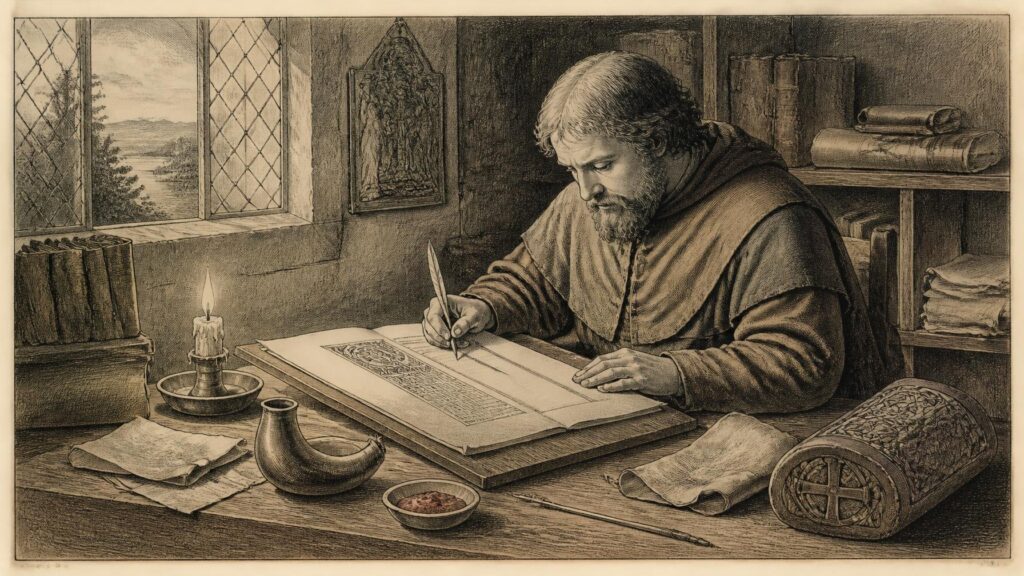
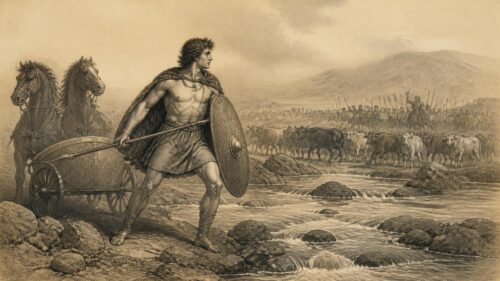
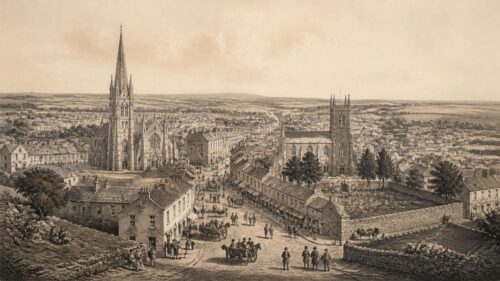
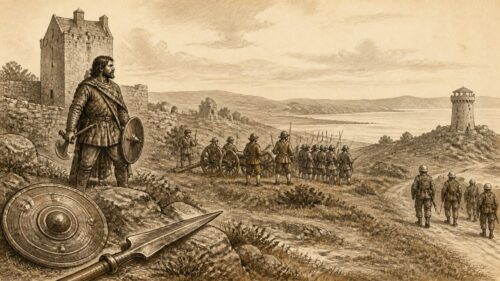
AI generated historical illustration, not a contemporary photograph.
At a Glance
Leabhar Breac, conventionally rendered “the Speckled Book”, is among the most revealing survivals of late medieval Irish learning: a vellum manuscript of religious instruction, hagiography, biblical narrative, calendar lore, genealogy and occasional secular writing, assembled during the early fifteenth century. It is not simply a container for old texts. Its handwriting, decoration, marginal notes, altered arrangement and long chain of custody preserve evidence of the learned people, institutions and journeys through which Irish books were made, read, protected and reinterpreted.
Material Witness
The manuscript now known as Leabhar Breac is held by the Royal Irish Academy in Dublin as MS 23 P 16. It survives as 142 folios, or leaves, and is now bound in two volumes. The physical object is comparatively modest in size, yet its documentary importance is immense. It is a vellum codex: animal-skin parchment prepared for writing, folded into gatherings, ruled and filled largely in double columns. The Academy catalogue, as presented through Irish Script on Screen, records uneven, sometimes translucent vellum, ink visible through thin membranes, repaired leaves, fire or damp damage in places, and a complicated series of old page and leaf numbers. These details matter. A medieval manuscript is not an abstract text; it is a worked object which accumulated the marks of manufacture, use, rearrangement and survival.
Its familiar English title can obscure that complexity. “Speckled Book” is a later conventional name, and it is not the only one associated with the manuscript. It has also been called Leabhar Mór Dúna Doighre, the Great Book of Duniry, and has been linked in older usage with the Mac Aodhagáin, or MacEgan, learned family. The manuscript itself bears evidence for the Duniry name, while the designation “Leabhar Breac” does not occur straightforwardly upon the surviving codex. This is a useful warning against treating manuscript titles as fixed medieval labels. Books acquire names through owners, cataloguers, antiquaries and editors as well as through their original makers.
The manuscript’s present appearance also reflects modern intervention. It was rebound, and its leaves had been placed in a different order at more than one point after entering institutional custody. The nineteenth-century facsimile provided a stable pagination used by later scholarship, yet the Academy catalogue carefully records earlier foliations and the complications they cause. Such disturbances do not reduce the manuscript to confusion; rather, they make its history visible. The book has had several lives: first as a working medieval compilation, later as a treasured hereditary possession, then as a vulnerable object dispersed into portions, and finally as a catalogued national manuscript.
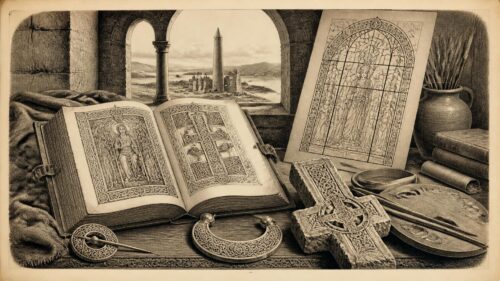
Its visual programme is restrained but purposeful. Vermilion was employed freely in parts of the first volume; some initials have intricate interlace and zoomorphic forms; a Crucifixion drawing appears within the manuscript; and the scribe or artist incorporated natural irregularities in the vellum into decoration. Other sections, especially the second volume, are far plainer. This unevenness is not necessarily evidence of failure or decline. It suggests a manuscript made for serious textual use, in which visual emphasis was directed towards particular openings, texts or functions rather than distributed uniformly for display.
Scribal Journey
The date of Leabhar Breac is usually placed between about 1408 and 1411, with 1411 serving as the conventional completion date in catalogues. The identification of its principal scribe has evolved. Older cataloguing expressed caution, noting that no surviving signature can be securely identified as that of the original scribe and that tradition associated the book with the Mac Aodhagáin. Later palaeographical research, especially the work of Tomás Ó Concheanainn, identified the hand with Murchadh Riabhach Ó Cuinnlis. That attribution is accepted in subsequent specialist discussion, including scholarship on the Félire Óengusso. It should nevertheless be stated accurately: the identification rests on comparison of handwriting and scribal practice, not on an intact medieval colophon declaring the scribe’s name.
Murchadh Riabhach Ó Cuinnlis belonged to the professional scribal world that connected legal, ecclesiastical and literary learning in late medieval Ireland. He also contributed to the Book of Lecan, another great Gaelic manuscript compilation. The importance of the proposed attribution lies not in attaching a modern notion of authorship to the codex, but in recovering the practical labour behind it. A book of this scale required access to exemplars, vellum, ink, accommodation, patronage and a network willing to preserve and circulate learned material. The scribe was a trained professional operating within that infrastructure.
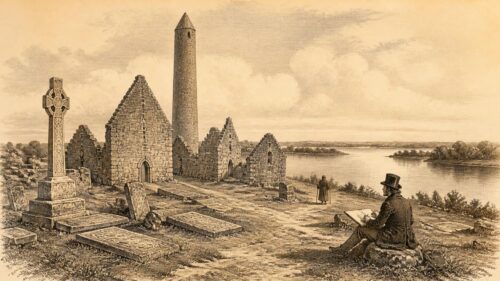
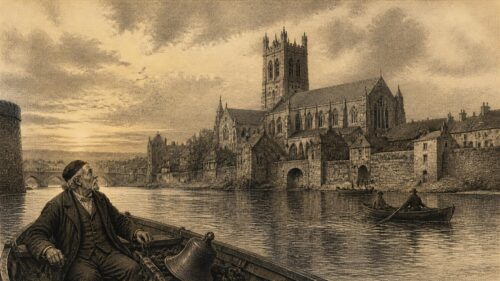
Marginal entries provide unusually rich evidence of movement during compilation. Scholarly reconstruction places the scribe’s principal activity at Cluain Leathan in Múscraige Tíre, in north County Tipperary, while also connecting individual copying episodes with Clonmacnoise, Clonsast in County Offaly, Mag Ua Farga and Baile Riccín. One note places writing at Loch Riach, or Loughrea, in County Galway; another comments on rough weather on the lake between Michaelmas and Samhain. These are not romantic inventions imposed upon the manuscript. They are the sparse but vivid remnants of a writer’s working circumstances, preserved because a medieval scribe occasionally allowed immediate surroundings to enter the margin.
The itinerary makes Leabhar Breac a corrective to any picture of Gaelic learning as isolated within a single monastery or fixed school. Texts, scribes and patrons travelled. Books could be copied at places where older exemplars were accessible, where a learned household offered support, or where political and religious connections made temporary residence possible. The manuscript’s production therefore maps a network across the Shannon and the midlands rather than a single point of origin. The precise sequence of every stage cannot be recovered, but the cumulative evidence strongly supports a mobile process of compilation.
This mobility was not unusual in a manuscript culture. Professional scholars depended on access to books, and books were valuable enough to be guarded, lent and moved. Yet Leabhar Breac is particularly valuable because the evidence is internal. Its notes allow historians to move from general statements about medieval intellectual networks to particular places, weather, residences and copying activity. The book records not only inherited knowledge but the conditions through which that knowledge was reproduced in fifteenth-century Ireland.
MacEgan Stewardship
The Mac Aodhagáin, usually anglicised MacEgan, were a distinguished learned family associated with legal scholarship. Leabhar Breac’s later medieval and early modern history is closely bound to them, though that should not be confused with unquestioned proof that a MacEgan originally wrote the manuscript. The family’s names appear in marginal entries, and the codex was in MacEgan hands during the sixteenth century. Its association with their residence at Duniry in County Galway accounts for the alternative title, the Great Book of Duniry.
The connection has sometimes encouraged a simplified description of the codex as “the Book of the MacEgans”. It is a useful shorthand only if its limits are remembered. The book was not merely a family record, nor is it chiefly a law-book despite its association with a legal kindred. Its contents are predominantly devotional and ecclesiastical. The MacEgan connection is historically important because it shows how professional learned families could possess, preserve and use religious as well as juridical material. The worlds of law, genealogy, religious learning and manuscript copying overlapped substantially in Gaelic Ireland.
A marginal notice concerning the plundering of the law school at Cluain Leathan gives the manuscript’s later movements particular force. The Academy catalogue considers it probable that the manuscript was moved to Duniry for safety after that disruption. The exact circumstances and date of every transfer remain uncertain, and historians should resist turning probability into a fully narrated escape story. What can be said is that the manuscript’s survival was shaped by deliberate custodianship. Its removal from a threatened learned centre, whether immediately after a particular raid or through a more gradual process, was fortunate.
During the seventeenth century the manuscript was kept for a substantial period at the convent of Cenél Féichín, also known as Kinalehin, in County Galway. This is supported by a dated connection with Brother Mícheál Ó Cléirigh, who copied part of it there in 1629. The link is significant in the wider history of Irish scholarship. Ó Cléirigh belonged to the Franciscan learned milieu that gathered, copied and organised Gaelic historical and religious materials in an era of severe political and social change. Leabhar Breac thus remained useful long after its original compilation: it was consulted, copied and valued as a repository of inherited texts.
That later history also demonstrates why “survival” is not passive. The manuscript endured because readers and custodians judged it worth preserving, even as the institutional world that had produced such books was transformed. A note calling it a great treasure may be rhetorical, but the conduct of its owners is more persuasive evidence of esteem. It passed through schools, residences and a convent; it was copied from in the seventeenth century; and its scattered portions were eventually recognised and reunited. The history of custody is part of the book’s meaning.
Sacred Contents
Leabhar Breac is above all a religious miscellany. It contains homilies, passions, saints’ lives, biblical and apocryphal material, devotional poems and instructional texts. In this respect it represents a late medieval Irish habit of compilation: older materials, sometimes themselves translated or adapted over generations, were gathered into a new codex shaped by contemporary devotional needs. The manuscript does not offer a single linear argument. Its unity is practical and spiritual, created by the range of material it makes available to a learned reader or religious community.
The Irish Script on Screen catalogue identifies the Rule of the Céile Dé and the Félire Óengusso, the Martyrology of Óengus, among its important contents. The latter is particularly revealing. The Félire is a verse calendar of saints’ feasts, surrounded in the manuscript by copious glosses and scholia. Its layout was adapted to leave generous space for this commentary: the principal text occupies the upper left area of the page, allowing margins to carry explanatory material. The result is a visual declaration that the poem alone was not sufficient. Knowledge lay in reading the old text alongside accumulated interpretation.
The martyrology’s calendrical apparatus also demonstrates use rather than mere antiquarian preservation. The manuscript includes dominical letters and Roman calendrical indicators in the margins, aids for locating Sundays and dates within the church year. Such additions make the page operational. The book could support the ordering of devotion and commemoration across the annual cycle, while the commentary supplied historical, linguistic and hagiographical explanation. It was a learned religious tool, not simply a prestigious anthology.
The passions and homilies have received sustained editorial attention. The University College Cork CELT edition shows both the scale of this component and the methodological problems it presents. Many homilies are bilingual, juxtaposing Latin passages with Irish renderings or related Irish text. The relationship between the two languages is not always mechanically translational. Latin held authority as the language of scripture, liturgy and international learning; Irish made doctrine, narrative and moral instruction available within the vernacular learned culture. Leabhar Breac preserves their interaction on the page.
Modern readers should not assume that every narrative classed as apocryphal was understood in the medieval world as fiction in the modern sense. Biblical expansions, saints’ lives and accounts of marvels were transmitted as material capable of devotion, instruction and moral reflection. Historical method must distinguish the date and purpose of a text’s copying from the truth of the events it narrates. A fifteenth-century witness to a saint’s miracle is strong evidence that the story circulated and mattered then; it is not by itself proof that the miracle occurred. This distinction does not diminish the manuscript. It allows its real historical value to emerge: it records the religious imagination, reading habits and authoritative texts of its compilers and users.
Secular Traces
Although overwhelmingly devotional, Leabhar Breac is not exclusively so. The catalogue identifies a prose history of Philip and Alexander the Great, the comic narrative Aislinge Meic Conglinne, and Sanas Cormaic, Cormac’s glossary, among its contents. These works matter because they reveal the breadth of the learned world in which the manuscript was made. Classical and pseudo-classical history, comic imagination, lexical scholarship and religious teaching could coexist within one codex without apparent contradiction.
The presence of Alexander material should not be read as evidence that fifteenth-century Irish scholars possessed modern historical knowledge of Macedon. Medieval Alexander narratives were part of an international tradition in which the ancient conqueror was reshaped through romance, moral exemplum and universal history. Their inclusion shows Gaelic Ireland’s participation in wider European intellectual currents, mediated through Latin and vernacular transmission. It is evidence of connection, adaptation and reading, rather than a transparent window upon antiquity.
Aislinge Meic Conglinne offers a different kind of insight. It is celebrated for comic excess, satire and dream vision. Its survival in a religious miscellany can surprise readers who imagine medieval devotional books as solemn in every respect. Yet medieval textual culture did not organise sacred and secular material according to modern library categories. Humour, satire, learning and morality could be entangled. The inclusion of a comic narrative in Leabhar Breac does not make the book secular; it instead reveals a learned culture sufficiently capacious to preserve multiple literary modes.
Sanas Cormaic is equally important. A glossary is evidence that language itself had become an object of learned study. Its presence points to the interpretation of difficult vocabulary, inherited tradition and the authority of old texts. In a culture where centuries-old Irish compositions remained central to scholarship, glossaries and commentary were indispensable bridges between linguistic stages. They enabled later readers to approach wording that was already archaic or obscure. Leabhar Breac therefore preserved not only narratives and doctrines but also apparatus for understanding the language in which cultural memory was stored.
These secular traces are too few to alter the central character of the manuscript, but they prevent a narrow account of it. The book is best understood as a devotional compilation made within a broad learned environment. It does not divide medieval Irish knowledge into sealed compartments. Its makers could copy saints’ passions, lexical lore, calendars, historical narrative and satire because all belonged, in different ways, to the equipment of an educated Gaelic reader.
Learning Practices
Leabhar Breac provides unusual evidence for the methods of late medieval Irish scholarship. Its principal texts were often much older than the manuscript itself. Copying was therefore an act of transmission across time, not fresh composition in the usual modern sense. A scribe selected, obtained and transcribed material from exemplars; glosses were copied alongside their base texts; and linguistic, liturgical and historical information was carried forward through repeated reproduction. The manuscript is both early fifteenth-century and much older in intellectual texture.
The comments in its margins make the labour of copying visible. They locate work, preserve ownership marks, record later interventions and sometimes speak in the first person. Such notes can be difficult to date or attribute, which makes caution essential. Not every inscription belongs to the original scribe; some are later hands, while others are damaged or only partly legible. Nevertheless, their very density shows that the book was not sealed at the moment of completion. It remained a site of interaction for generations.
The manuscript’s bilingualism is another feature of its learned practice. Irish vernacular writing did not replace Latin; nor was Latin merely a foreign ornament. Both languages performed distinct and overlapping tasks. In homiletic material, Latin could preserve scriptural or doctrinal authority while Irish rendered, developed or explained it for readers trained in Gaelic literary culture. This is not a simple opposition between elite Latin and popular Irish. The intended users of a manuscript like Leabhar Breac were themselves highly educated, capable of navigating both traditions.
Its compilation also illustrates the continuing vitality of vernacular religious writing in late medieval Ireland. Scholarship has noted a marked expansion of devotional texts in Irish in the fifteenth century, with themes such as Christ’s Passion, Mary, sin, judgment and repentance becoming prominent. Leabhar Breac belongs to that broader environment, though it should not be treated as proof of a single institutional programme. It is safer to say that its contents are consonant with a religious culture in which vernacular teaching and devotion had deep roots and were being actively renewed.
Interpretation must proceed in degrees. The manuscript’s contents document what was copied; marginal notes can document particular acts of reading, movement or ownership; similarities with wider devotional trends support contextual interpretation. They do not automatically prove that a named friary commissioned every text, or that every reader reacted in the same way. The distinction is important because Leabhar Breac is often invoked as an emblem of Gaelic learning. It is indeed an exceptional witness, but it is not a statistical sample of all late medieval Irish belief or literacy.
Margins Materiality
The margins of Leabhar Breac are among its most eloquent features. Medieval readers did not always respect the modern boundary between text and blank space. Margins received glosses, corrections, ownership statements, memoranda and comments that could become historically crucial. In Leabhar Breac, they help trace the manuscript’s geographical movement and changing custodians. They also disclose a culture in which writing was responsive: a page could be completed, annotated, repurposed and revisited.
Physical imperfections were likewise incorporated into use. The Academy description notes that natural defects in vellum were fitted into decoration in at least one instance. Elsewhere, thin skin allowed ink to show through, and certain leaves were repaired with thread whose colouring seems to have been made visually sympathetic to the page. Such observations bring the practical craft of manuscript production into view. Medieval scribes worked with variable material, not factory-standard sheets. The book’s appearance was negotiated between textual intention and the particular qualities of each skin.
Damage tells another story. Some leaves show worm damage, some have suffered damp, and some may have been affected by exposure to fire. These scars should not be dramatised beyond the evidence. It is usually impossible to assign every mark to a named event. Yet they demonstrate the precariousness of preservation. A vellum manuscript could endure for centuries, but only through repeated handling, storage and repair. Its survival is remarkable precisely because so many opportunities for loss, fragmentation and decay lay along its route.
Modern editorial work adds a further layer. The nineteenth-century lithographic facsimile made a much wider scholarly readership possible, but a facsimile is not identical with the manuscript. Later editors have had to compare editions, transcripts and images, while openly acknowledging places where the original was not directly consulted or where earlier editors silently emended difficult readings. The CELT editorial statement is particularly valuable for its candour about such limits. Textual scholarship advances not by pretending that uncertainty has vanished, but by marking where a reading is supplied, corrected or disputed.
This is why material study and textual study cannot be separated. A contraction mark, a faded letter, an interlinear addition or a leaf displaced in rebinding can alter interpretation. The manuscript’s vellum, ruling, ink, decoration and binding history are not decorative background to its “real” contents. They are evidence that determines how those contents can be read. Leabhar Breac rewards attention to both the written word and the vulnerable surface that carries it.
Later Travels
The route from medieval learned households to the Royal Irish Academy was long and incomplete. The manuscript was still associated with MacEgan ownership into the opening years of the seventeenth century. Its presence at the Cenél Féichín convent for much of that century is supported by the work of Mícheál Ó Cléirigh in 1629. By 1732 it was in the possession of Éamann Ó Ceallaigh of Tonalig, County Roscommon. Thereafter the record becomes clearer in the antiquarian world of the eighteenth century, though not every transfer can be reconstructed with equal confidence.
In 1789 Cornelius Ó Dálaigh of Mitchelstown sold the principal portion to Charles Vallancey for the Royal Irish Academy, reportedly for three guineas. At that point the manuscript was in loose sections, and separate leaves were not all recognised as belonging together. Some leaves passed through the collection of the Chevalier O’Gorman and were acquired later. The history is instructive and uncomfortable. Institutional preservation secured the survival and accessibility of the manuscript, yet the process followed an earlier dispersal in which a unified medieval book had become physically divided.
The Academy’s eventual acquisition of the parts did not immediately solve all problems. The nineteenth-century binding and arrangement caused concern among scholars, and later rebinding aimed to restore a more appropriate order. The manuscript’s current two-volume form is therefore not its medieval original state. Researchers must distinguish the codex as it was first assembled from the object as it now survives. That distinction is common in manuscript studies, but Leabhar Breac makes it unusually concrete through its multiple visible paginations and documented history of leaves.
Its nineteenth-century reproduction was a major event in Irish scholarship. Joseph O’Longan prepared the transcript used for the lithographic facsimile, which sought to reproduce lines, abbreviations and the visual character of the original with considerable fidelity. The facsimile opened a manuscript previously available only to those able to consult it in Dublin. It also fixed a page sequence that remains useful for reference, even though the modern scholar must remain aware that printed and lithographic reproductions are interpretations of a manuscript object.
The later journey of Leabhar Breac is therefore not merely a story of rescue. It is a story of changing regimes of value: from working learned book, to hereditary treasure, convent resource, antiquarian acquisition, national collection and digitised research object. Each stage expanded some possibilities while constraining others. Digitisation now enables wider inspection of pages, but cannot wholly substitute for direct examination of material qualities. The manuscript continues to be both local Irish inheritance and international scholarly evidence.
Scholarly Legacy
Leabhar Breac has mattered to editors because it preserves witnesses to texts whose histories are older than the codex itself. It has been used in the study of Irish hagiography, homiletics, language, martyrology, historical narrative, lexicography and literary prose. Its importance is not that it always offers the earliest or best version of every work. Rather, it is a major, carefully transmitted witness whose readings, glosses and arrangement can illuminate the development of texts across centuries.
The study of its scribe illustrates how scholarship can revise inherited assumptions. Earlier descriptions relied substantially on the MacEgan association and lacked a secure named scribe. Comparative palaeography later linked the principal hand to Murchadh Riabhach Ó Cuinnlis, placing the manuscript within a wider scribal network that includes the Book of Lecan. The revision is a model of historical method: tradition is neither accepted uncritically nor discarded merely because it is traditional; it is tested against handwriting, textual associations and documentary context.
Digital resources have increased access while also teaching valuable caution. Irish Script on Screen provides manuscript description and images through an institutional collaboration involving the Royal Irish Academy and the Dublin Institute for Advanced Studies. CELT makes a major edited body of passions and homilies available with editorial notes explaining its textual basis. The online Félire Óengusso project brings specialist attention to one important segment of the book. Together, these resources allow a wider public to see how manuscripts generate evidence, rather than receiving a polished text detached from its source.
For Irish history, Leabhar Breac is especially valuable because it links regions that are too often studied separately. North Tipperary, Offaly, Clonmacnoise, Galway, Roscommon, Cork and Dublin all enter its documented history. Its paths show the durability of Gaelic learned networks across political change and geographical distance. The manuscript does not stand for an unchanging Ireland; its notes and provenance instead reveal adaptation, movement and institutional transformation.
Its legacy should not be confined to a celebratory national narrative. The manuscript is important not because it proves a timeless essence, but because it preserves difficult, specific and human evidence: a scribe copying inherited learning in several places; readers adding notes; families and religious houses protecting a valued book; antiquaries separating and collecting leaves; and scholars working carefully to reconstruct damaged textual and material histories. Its greatness lies in that density of evidence.
Historical Caution
Leabhar Breac invites imaginative reconstruction, but it also requires restraint. It is reasonable to picture scribes at work in learned centres and to recognise the devotional seriousness of its contents. It is not reasonable to invent their daily routines, emotions or patrons where the manuscript is silent. A weather note at Loughrea tells us that weather was recorded; it does not supply a full diary of the scribe’s life. A family association documents custody and learned affiliation; it does not establish authorship without further evidence.
Likewise, the manuscript’s medieval narratives must be read on their own terms. Saints’ miracles, apocryphal episodes and visions are essential evidence for religious culture, but they should not be presented as verified events merely because a respected manuscript preserves them. Folklore, hagiography and historical record may overlap in medieval sources, yet they are not identical categories. The historian’s task is to identify what kind of claim a text makes, when the surviving witness was copied, and what the act of copying reveals about belief and learning.
The same care applies to titles. “Speckled Book”, “Great Book of Duniry” and “Book of the MacEgans” belong to different layers of naming and interpretation. The manuscript has been confused with a lost annalistic book cited by Geoffrey Keating under a related MacEgan title. Modern readers should not collapse them into one. Names can preserve real memories of place and ownership, but they can also travel between books and generate later misunderstandings.
What remains after such cautions is not a diminished manuscript but a more compelling one. Leabhar Breac is securely a major Irish codex of the early fifteenth century; it is materially complex, predominantly religious, connected with professional learned culture, associated with the MacEgan legal family, and preserved through a traceable series of custodians. Its pages retain the labour of a scribe identified by modern scholarship as Murchadh Riabhach Ó Cuinnlis, while its margins reveal later readers and movements. In that combination of certainty, probability and unanswered question, it offers one of the richest surviving records of medieval Irish intellectual life.

Leabhar Breac’s mixture of saints’ lives, calendrical tools, glosses, satire and Alexander material suggests that late medieval Gaelic learning did not separate devotion, language study and literary entertainment as sharply as modern classifications. Its annotated pages imply understanding depended on inherited commentary, not merely copying revered texts. This raises an intriguing question about how readers used such a miscellany across generations, especially as it travelled between learned centres and custodians. To what extent should Leabhar Breac be viewed primarily as a practical religious reference book, a record of broad scholarly culture, or something whose function changed with communities preserving it?