
Betha Colaim
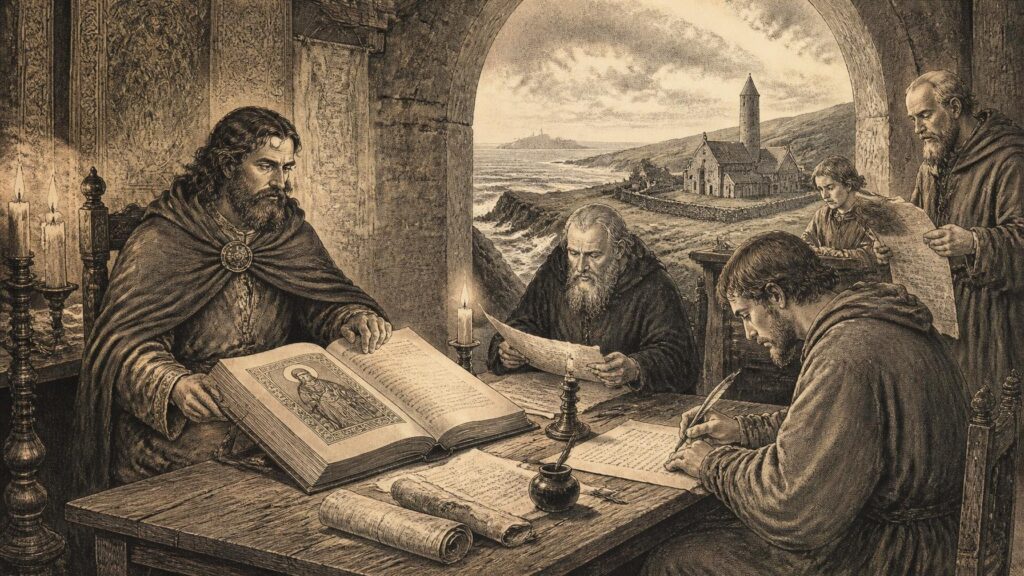
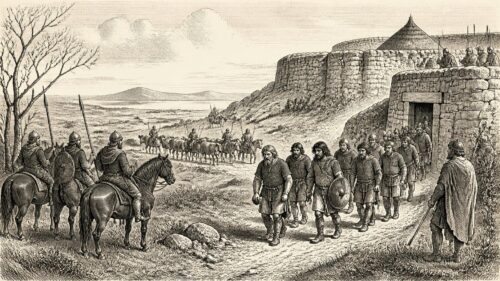
AI generated historical illustration, not a contemporary photograph.
At a Glance
Betha Colaim Chille, the Life of Colum Cille compiled in 1532 under the direction of Manus Ó Domhnaill, is at once a saint’s life, a treasury of Irish learning, a political statement from Gaelic Donegal, and an act of cultural preservation. Its subject was a sixth-century saint; its own historical moment was the unsettled sixteenth century. To read it merely as biography is to miss its larger achievement: it recast Colum Cille as ancestor, protector, scholar, exile, wonder-worker and patron for a community seeking authority in a changing Ireland.
Names Explained
The title requires some care, because closely related names have sometimes been applied to different works. Betha Colaim Chille is the early modern Irish compilation associated with Manus Ó Domhnaill, lord of Tír Chonaill, and dated by its own framing material to 1532. It is normally translated as Life of Columcille. “Betha” means life, while “Colaim Chille” is a grammatical form of Colum Cille’s name.
It should not be casually collapsed into the separate Middle Irish Betha Choluim Chille, a homiletic life preserved in the Leabhar Breac, now Royal Irish Academy MS 1230. That earlier vernacular work survives in a medieval manuscript and is conventionally assigned to the Middle Irish period. It is one of the principal materials later drawn into the Columban tradition. The resemblance of the titles reflects continuity of devotion and language, but the texts belong to different stages in the making of Columba’s memory.
This distinction is historically important. The Middle Irish life belongs to the long development of native Irish hagiography. Manus Ó Domhnaill’s work belongs to sixteenth-century learned culture and deliberately gathers older authority into a new, capacious book. Both are Irish witnesses to the saint’s cult, but each reveals the needs of its own age.
Columban Memory
Colum Cille, often Latinised as Columba, was among the most influential saints in Irish and Scottish Christian tradition. Later sources make him a member of the northern Uí Néill kin-group, associated especially with Cenél Conaill and the north-west of Ireland. His name links him inseparably with Irish places and institutions: Derry, Kells, Swords, Durrow and the Donegal landscape all entered the broad Columban world. Iona, off the west coast of present-day Scotland, became the most celebrated centre associated with him.
The historical Columba cannot be recovered in full from saintly writings. The earliest substantial narrative is Adomnán of Iona’s Latin Vita Columbae, composed more than a generation after Columba’s death. It is indispensable evidence, but it is hagiography: a literary form intended to manifest sanctity, commemorate a religious community and strengthen a saint’s cult. Its miracles and prophecies cannot simply be treated as modern historical reportage. Yet its geography, social networks, political horizons and assumptions about monastic life are profoundly valuable.
Over ensuing centuries, Irish and Latin writers added poems, anecdotes, genealogies, miracle stories and local traditions. Colum Cille became more than the remembered founder of particular churches. He was represented as a guardian of communities, a figure of learning, a mediator in disputes, a kinsman of rulers and a saint whose power extended across the Irish Sea. The richness of this inheritance made him ideal material for later compilers.
Manus Patron
The compiler or patron traditionally named in connection with the book was Manus Ó Domhnaill, also rendered Maghnas Ó Domhnaill. He was born into the ruling family of Tír Chonaill, a Gaelic lordship centred in much of modern County Donegal. The Dictionary of Irish Biography describes him as a learned Gaelic scholar and poet as well as a political leader. This dual identity matters. In a Gaelic political order, power did not stand apart from genealogy, legal knowledge, patronage and the custody of learned tradition.
The text’s own account presents Manus as actively assembling the work. It says that he sought material in old books, caused Latin material to be translated into Irish, had difficult older Gaelic rendered into more accessible language, and then brought these elements together. Such a statement need not be accepted in every literal detail to establish the book’s programme. It portrays its maker as a ruler capable of commanding scholarship and rescuing dispersed knowledge from obscurity.
Manus was not yet lord of Tír Chonaill when the work was completed. He succeeded his father in 1537. The chronology gives the project a particular force. Betha Colaim Chille was completed while Manus’s public standing and future position were still being established. The Life honoured a saint regarded as closely connected with the dynastic world of Cenél Conaill; in doing so, it also articulated the standing of the Ó Domhnaills as patrons and inheritors of that northern tradition.
Donegal Setting
Sixteenth-century Tír Chonaill was neither culturally isolated nor politically tranquil. It was a region where hereditary lords, ecclesiastical houses, professional learned families and military forces all exercised influence. English royal power was expanding unevenly across Ireland, while Gaelic and Hiberno-Norman lordships retained considerable autonomy and competed with one another. Manus navigated this world through warfare, diplomacy, administration and cultural patronage.
The annals record that following the death of his father in 1537, Manus was inaugurated by the successors of St Columbkille, with the consent and advice of the nobles of Tír Chonaill. This is a striking piece of evidence for the political importance of Columban ecclesiastical authority. It does not prove that the 1532 Life mechanically secured Manus’s succession, nor should literary patronage be reduced to propaganda. It does show, however, that the saint’s successors had a recognised ceremonial role in the lordship’s political life.
In this setting, writing a comprehensive Life of Colum Cille was an intervention in public culture. It offered a learned account of a saint who linked local territory to sacred history, dynastic ancestry to Christian legitimacy, and Donegal to Ireland, Scotland and the wider world of Latin Christianity.
Composite Design
The book is not a simple translation and not an original narrative in the modern sense. It is a composite. Its fabric includes material drawn from Adomnán’s Latin Life, Irish vernacular hagiography, genealogical lore, local narrative and traditions circulating in manuscripts. The resulting work is expansive because its purpose is expansive: it seeks to make the saint’s whole remembered career available in contemporary Irish.
This method explains both its value and its difficulty. Where a passage closely parallels Adomnán, it may preserve a sixteenth-century Irish reception of an early medieval Latin text. Where it reproduces or reshapes a Middle Irish episode, it may illuminate the transmission of vernacular hagiography. Where it includes a local Donegal story, it may preserve a tradition known in Manus’s time. None of these possibilities automatically takes the reader back to the sixth century.
The work should therefore be read in layers. A story set in Columba’s lifetime may derive from an early source, from later medieval elaboration, or from a sixteenth-century local tradition. The textual setting in 1532 is secure; the age of every individual anecdote is not. This is not a defect in the work. It is the very reason that it is so important: it records how a late medieval and early modern Irish learned community organised the past.
Source Gathering
The prefatory account of gathering material is among the most revealing features of the compilation. Manus is represented as dissatisfied with partial, scattered and linguistically difficult accounts. The answer was not to abandon inherited learning but to translate, modernise, compare and consolidate it. Such activity shows the continuing strength of Irish manuscript scholarship in an age sometimes misleadingly imagined as one of simple cultural decline.
Translation was central to this process. Latin remained a language of religious and learned authority, while Irish was the medium through which the compiler wished the saint’s Life to speak. Older Gaelic, meanwhile, could itself require interpretation. The text thus imagines a chain of transmission between Latin, difficult earlier Irish and contemporary learned Irish. It is an unusually explicit statement of linguistic mediation within Gaelic literary culture.
The project also suggests a wide network. To collect relevant books “throughout Ireland”, as the tradition has it, required access to ecclesiastical and learned circles beyond one household. The claim may be rhetorical in scale, but its rhetoric is meaningful. It locates Tír Chonaill within an island-wide republic of manuscripts, clerics and hereditary scholars, and it makes Colum Cille’s Life a shared Irish inheritance rather than a merely local possession.
Saintly Portrait
The Colum Cille of Betha Colaim Chille is emphatically holy, but he is not a colourless ideal. He is learned and commanding, capable of tenderness, anger, grief and decisive intervention. He counsels rulers, protects followers, rebukes wrongdoing and performs miracles. Hagiography did not aim to offer psychological realism in a modern biographical manner. Rather, it sought to show the saintly person as a channel of divine power within the ordinary hazards of society: illness, travel, war, famine, conflict and death.
Some episodes have become especially familiar in later popular retelling. They include traditions of a copied psalter, conflict and battle, departure from Ireland, encounters with rulers, voyages and extraordinary foreknowledge. In historical discussion these stories demand discrimination. Their presence in a sixteenth-century Life demonstrates that they formed part of Columban memory by then. It does not, by itself, establish every incident as a sixth-century fact.
That distinction need not diminish their significance. Folklore and hagiography reveal what communities thought holiness could accomplish. A saint who calmed danger at sea, named a hidden sin, safeguarded a territory or foretold political change answered real social and spiritual concerns. The stories are historical evidence of belief, place-making and communal identity even where their miraculous claims are beyond ordinary historical verification.
Exile Traditions
Columba’s departure from Ireland has long invited powerful interpretation. Later tradition connected his exile with conflict, penitence and the shedding of blood. The famous story concerning the copying of a book and the battle of Cúl Dreimne belongs principally to this later explanatory tradition. It has often been repeated as though it were a straightforward legal case with a settled verdict and an equally settled motive for exile. The evidence is more complex.
Early sources do not provide a single uncomplicated account from which every later detail follows. The story developed in the context of Columban commemoration, legal imagination and political memory. In Betha Colaim Chille, as in related traditions, the episode contributes to a moral portrait in which learning, kinship, conflict and penitence are tightly intertwined. The saint can be formidable without ceasing to be holy; remorse and authority can coexist.
The enduring strength of the exile story may tell us as much about later Ireland as about sixth-century events. It allowed readers to think about the dangers of pride, the cost of violence, the value of books and the possibility of redemptive departure. It also supplied a dramatic bridge between Columba’s Irish origins and his island career. Historical caution is appropriate, but so is attention to the story’s literary and ethical work.
Territorial Worlds
The Life’s landscape is not mere background. Sites in Donegal and elsewhere acquire significance because the saint visits them, blesses them, predicts events there or becomes attached to their people. Such narratives help make sacred geography. A place is not holy simply because it contains an ancient monument; it becomes holy in tradition because remembered actions, liturgy, pilgrimage and story attach a saint to it.
This territorial quality was especially meaningful for Tír Chonaill. Colum Cille’s traditional association with Cenél Conaill made him a potent figure in the cultural geography of Donegal. Local traditions embedded in the compilation could validate the antiquity and Christian distinction of particular communities. Yet the book is not narrowly provincial. Its saint moves through a wider Ireland and into Scotland, making the north-west a centre connected to a broader Columban world.
One must avoid treating every place-name episode as ancient documentary proof. Some traditions may have been shaped by later local devotion; some may reflect changing names and settlement patterns; others may have circulated orally before entering writing. Their historical importance lies in the relationship they construct between land, memory and authority. The Life turns geography into inheritance.
Dynastic Claims
The work’s relationship with Ó Domhnaill power has been a central concern of modern interpretation. Manus’s family had strong reasons to cherish Colum Cille as a dynastic patron. Kinship with the saint, whether expressed through medieval genealogical conventions or political memory, gave sacred depth to lordship. Patronage of his Life demonstrated not merely piety but competence in the learned obligations expected of a Gaelic ruler.
It would nevertheless be too crude to call the book a political tract in religious disguise. Its compilation required genuine antiquarian effort, linguistic skill and reverence for a major saint. It preserves much that cannot be reduced to immediate Ó Domhnaill interests. The better interpretation is that piety, scholarship and politics were mutually reinforcing rather than separate spheres. A ruler’s devotion to a dynastic saint could be sincere, culturally prestigious and politically useful at the same time.
The book also reminds readers that political legitimacy in Gaelic Ireland could be narrated. It was performed in inauguration, upheld by alliances, demonstrated in war and hospitality, and articulated through histories, genealogies and saints’ lives. Betha Colaim Chille is part of that narrative infrastructure. It makes a past in which the Ó Domhnaill lordship appears within a sacred and intellectual order.
Manuscript Survival
The text known to modern readers depends on manuscript survival and editorial labour. The standard printed edition by A. O’Kelleher and Gertrude Schoepperle was based on Bodleian Library manuscript Rawlinson B. 514 and presented Irish text with an English translation, introduction, notes, glossary and indexes. The National Library of Ireland catalogue records the work’s bibliographical history and its basis in the Oxford manuscript.
That edition is itself a historical artefact. Early twentieth-century editors made a large early modern Irish work more accessible to scholars, but editorial decisions necessarily shape the form in which a text is encountered. Digital resources now allow readers to consult transcriptions and translations more readily, especially through University College Cork’s CELT project. Such access is valuable, but it does not remove the need to understand variant manuscripts, scribal practices, source layers and the limits of translation.
The manuscript tradition also corrects any idea that the Life was a fixed monument from the moment of composition. Like many Irish texts, it lived through copying, selection, excerpting and later reading. Its survival is part of the history of Irish scholarship: a sequence of custodians, scribes, collectors, librarians and editors ensured that Manus’s ambitious compilation could continue to shape knowledge of Colum Cille.
Folklore Boundaries
Modern readers sometimes ask whether the Life is history or legend. The most useful answer is that it is hagiography, a genre with its own purposes and truth claims. It contains material that can support historical investigation: names of places, memory of institutions, patterns of patronage, literary borrowing, political relationships and the cultural priorities of its compiler. It also contains miracles, prophecies and inherited narratives that historians cannot verify by ordinary documentary methods.
To distinguish evidence from folklore is not to create a hierarchy in which only the verifiable is worth reading. Folklore demonstrates the social life of a saint. A miracle tale can reveal the anxieties of seafarers, the prestige of a church, the claims of a locality or the moral imagination of a community. What it cannot automatically do is prove that a miracle happened exactly as narrated.
Likewise, the presence of an ancient-looking motif does not establish an ancient date for a particular form of the tale. Hagiographical stories travel, combine and change. Manus’s compilation preserves them at a known sixteenth-century moment, sometimes drawing on demonstrably older sources, sometimes preserving traditions whose earlier path cannot be securely reconstructed. Explicit uncertainty is therefore more faithful to the evidence than confident reconstruction.
Literary Achievement
Betha Colaim Chille deserves recognition as a literary achievement in its own right. Its scope gives it the character of a compendium, but compilation was not passive copying. Selection, arrangement, translation and reformulation impose meaning. The book creates a coherent Columba by gathering materials that originated in different genres and centuries. It makes earlier scholarship usable for a new readership while displaying the authority of the learned world that produced it.
Its Irish prose also belongs to a living sixteenth-century language. The desire to render difficult older material intelligible indicates confidence in contemporary Irish as a vehicle for theology, history and narrative. The work therefore stands against assumptions that Gaelic Ireland possessed only oral culture or that learned writing had ceased before political transformation. It demonstrates an active manuscript civilisation able to conserve its past while remaking it.
The Life further reveals that the boundaries often drawn between medieval and early modern Ireland are imperfect. In 1532, Manus Ó Domhnaill could mobilise ancient saints, medieval texts, Latin learning and local tradition for a contemporary purpose. The past was not remote antiquity. It was a usable inheritance, preserved in books and renewed through patronage.
Lasting Importance
The continuing importance of Betha Colaim Chille lies in this layered quality. For historians of religion, it records the resilience and adaptability of Columban devotion. For literary scholars, it offers a major example of early modern Irish prose drawing creatively upon older textual worlds. For historians of Donegal, it illuminates the cultural ambitions of the Ó Domhnaill lordship. For readers interested in folklore, it preserves a rich body of traditions without allowing us to mistake every tradition for direct evidence about the sixth century.
Its greatest lesson may be methodological. A saint’s Life is never only about the saint. It is also about the people who copied, adapted, believed, disputed and sponsored the story. The Colum Cille of Manus Ó Domhnaill’s book is a sixth-century holy man seen through centuries of accumulated memory and then deliberately presented to a sixteenth-century Gaelic audience.
That is why the work remains so revealing. It shows Irish learned culture not as a residue from an earlier age but as an active force, capable of translation, criticism, preservation and self-definition. In recasting Colum Cille, Manus Ó Domhnaill and the scholars around him also recast the meaning of Tír Chonaill: a lordship with a sacred past, a learned present and a claim upon the future.



Betha Colaim Chille is intriguing when read as a layered act of memory rather than an account of Colum Cille’s life. Its 1532 compiler gathered Latin, older Irish, genealogical and local traditions, allowing devotion, linguistic preservation and Donegal political identity to reinforce one another. This raises a productive uncertainty: should its miracle narratives be approached chiefly as inherited religious belief, evidence of local place-making, or deliberate expressions of sixteenth-century cultural authority? Comparing the compilation with Adomnán’s Vita Columbae and the earlier Middle Irish Life, how might we distinguish continuity in Columban memory from reinterpretation shaped by Manus Ó Domhnaill’s world?