
Storm Floods
At a Glance
Weather Notices
The annalistic notices are extremely compressed. One entry records a rainy summer, followed immediately by a great sea-flood in October, while another gives violent thunder and wind and lightning on the eve of Saint Patrick's day, with many deaths. The language is bare and cumulative: weather condition first, then effect. These notices do not pause to explain causes, and they do not elaborate on duration beyond the season or the night named. [6]
A different pattern appears in the entry that calls the year a storm of great war in Ireland. The wording places the storm image beside political and clerical movement, saying the successor of Patrick had to be away from Ard Macha for a month and a year pacifying the men of Ireland. The passage keeps the storm phrase and the administrative consequence in the same short entry, without further narrative detail. [2]
Flood Passage
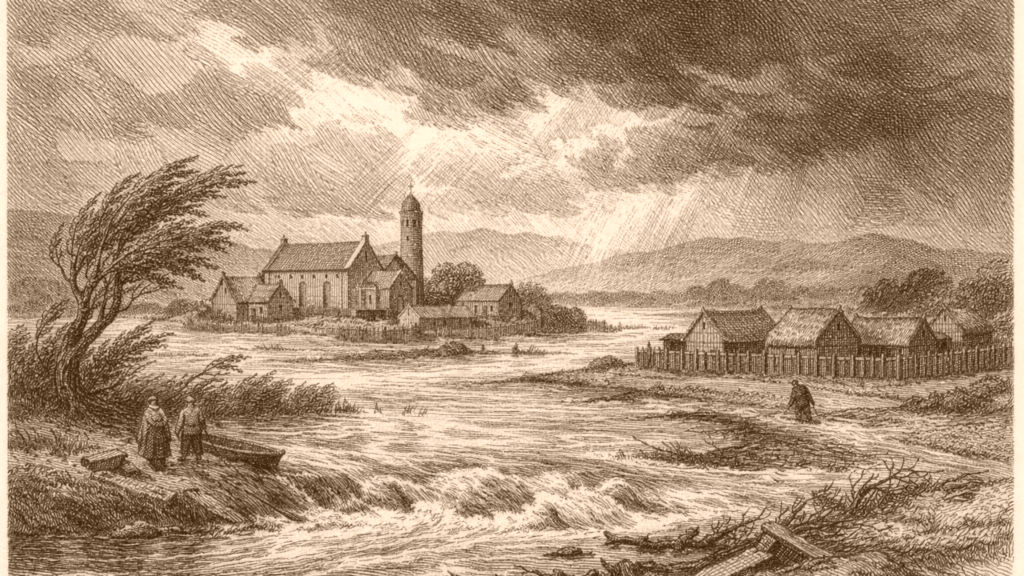
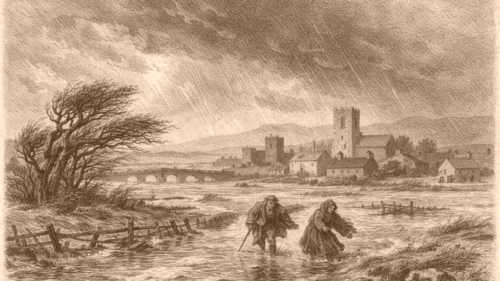
Flooding appears in several forms. In one entry, a river swelled against a group attempting to cross it, and they were unable to pass because of the greatness of the flood. The notice is embedded in a broader sequence of conflict and burial, but the flood itself is presented as a physical barrier. Nothing in the passage states that the water destroyed land or buildings; its direct effect is obstruction. [3]
The Chronicon Scotorum entry for a rainy summer and a great sea-flood offers a larger watery setting than the river crossing. The sea-flood is named after the seasonal rain and before later notices in the sequence. By contrast with the river swelling, this entry does not specify who was hindered or harmed. It gives an atmospheric description rather than a personal incident, showing two different scales of flooding in the same tradition. [6]
Storm Damage
Some entries connect weather with death directly. The notice of violent thunder and wind and lightning says that many persons were killed on the night before Saint Patrick's day, including one thousand and ten in Corcu Baiscinn. This is the most explicit casualty figure among the passages here. The entry keeps the cause, the time, and the toll in one short sentence, with no explanatory expansion. [6]
The Annals of Ulster do not give a casualty total for weather, but they do preserve storm language in a political context. The phrase storm of great war in Ireland is paired with the successor of Patrick's absence from Ard Macha and his work pacifying the men of Ireland. The text therefore links a storm image with disruption in movement and order, yet it stops short of describing a natural storm or any bodily damage. [2]
Local Effects
The flooding notices differ in how locally they are framed. The river in the flood passage is specific enough to block a crossing, while the great sea-flood belongs to a seasonal note without a named place in the same entry. The contrast is observable in the wording alone. One passage gives a physical obstacle at a crossing point; the other identifies a broader environmental condition, but not its immediate victims. [3] [6]
The same kind of local compression appears in the Ulster notice of Corcach Mór of Mumu with its church was burned. Although this is not a storm or flood entry, it sits beside the weather notices and shows the same terse method: place, building, and event in one line. Its relevance is formal rather than causal, because it helps show how weather and other harms are recorded in similar brief units. [2]
Comparative Language
Across the passages, the wording moves between literal weather and figurative storm. Rainy summer, great sea-flood, and violent thunder and wind and lightning are direct descriptions of conditions. Storm of great war is metaphorical, yet it still conveys turbulence and disruption. The annalistic style does not mark that difference with commentary; the distinction must be inferred from the phrasing itself and from the surrounding verbs or consequences. [2] [6]
The flood text and the storm text also differ in how much consequence they name. The river swell simply prevents crossing. The lightning entry names deaths, while the great sea-flood entry records no outcome beyond the event itself. That unevenness is a visible feature of the corpus. Some notices preserve an effect; others preserve only a striking natural condition and leave the result unstated. [3] [6]
Textual Scope
The surviving material consulted here comes from several annalistic texts and editions listed in the electronic corpus, including the Annals of Ulster, the Annals of the Four Masters, and Chronicon Scotorum. That listing shows that the entries belong to a wider edited collection of Irish historical texts, but the weather notes themselves remain brief and isolated. The evidence available in these excerpts is selective rather than comprehensive. [1] [4] [5] [7]
Within that limited set, the centring of weather is clear enough. The annals preserve rain, flood, thunder, wind, lightning, and storm language, but they do so only in short annual entries. No single excerpt here develops a full narrative of a storm or flood, and no excerpt explains meteorology. What appears instead is a repeated habit of recording extraordinary weather as a memorable yearly occurrence. [2] [3] [6]
Source References
Hover over a number to see the source. Select it to open the source.

How do selected Irish annalistic entries describe storms, rain, thunder, and flooding, and what observable patterns of wording and setting appear across the passages?