
Theobald Tone
At a Glance
Early Life
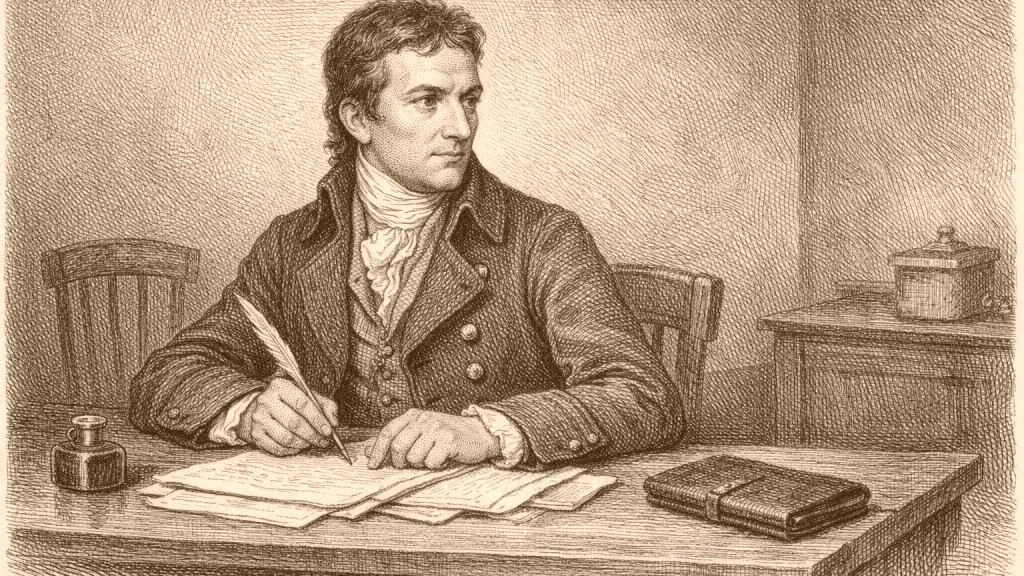
The surviving descriptions place Theobald Wolfe Tone in Dublin at birth, on 20 June 1763, and identify him as a United Irishman, political publicist, diarist, and French army officer. They also state that he was born at 27 St Bride's Street, near Dublin Castle, and that his family soon moved to Stafford Street, later renamed Wolfe Tone Street. One account adds that he came from a modest Protestant middle-class family and was the eldest of sixteen children. [1]
The same record says he studied law at Trinity College Dublin and graduated in 1786 before turning toward politics. A separate Trinity College page identifies a manuscript extract from his diaries among materials relating to the rebellion of 1798, while the National Library of Ireland describes Wolfe Tone as one of the notable political figures represented in its manuscript holdings. These references show that his personal papers and later historical presence are both preserved in major Dublin repositories. [1] [3] [4]
Political Turn
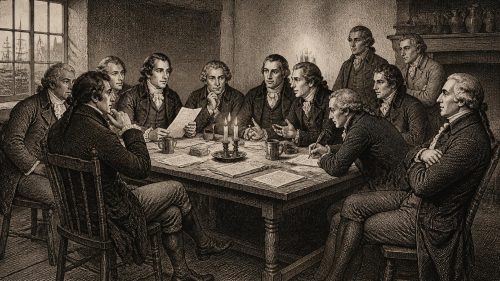
One account states that in October 1791 Tone helped found the Society of the United Irishmen with Thomas Russell, Napper Tandy, and others, and that he helped draft its declaration calling for equal representation in Parliament. The same source places this activity against the background of strained relations between Britain and revolutionary France and later notes that Tone denounced limited Catholic relief as partial and illusory. These details mark him as a visible figure in reform politics before open conflict intensified. [1]
The same source says that after war with France began, Dublin Castle cracked down on reformers, that the Volunteers were proscribed, elected conventions were banned, and some United Irishmen were tried for seditious libel. Another modern summary describes Tone as helping found the United Irishmen and pushing it toward equal rights for all Irishmen. The two accounts differ in emphasis, but both present him as tied to the society's founding and public agitation. [1] [2]
Exile Abroad
The archival summary says Tone was permitted political exile in America in 1795 and was then sent to France, where he joined the army in the following year. A museum summary similarly states that he fled Ireland in 1795 to escape capture for sedition, briefly settled in Philadelphia, and then went to France to seek military support for the United Irishmen. Both accounts agree on exile first, then movement to France, though they describe the intermediate stay in America differently. [1] [2]
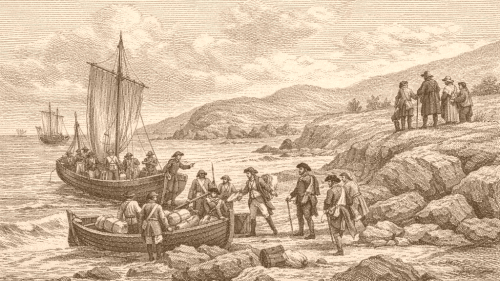
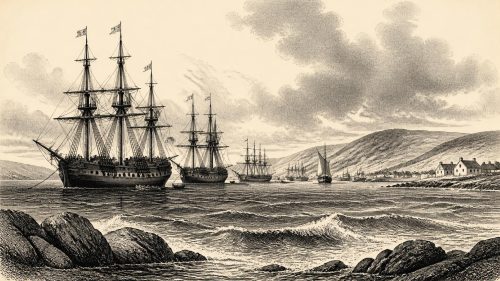
The same archival account says that his secret negotiations with the French led to his return to Ireland with an invasion force, while the museum summary says he helped lead an unsuccessful French invasion of County Donegal in 1798. The details align in showing him connected to French military help and to the Irish expedition of 1798, though one text names the landing place and the other frames the episode more generally as a return with the force. [1] [2]
Capture Trial
According to the archival summary, British forces captured Tone at Lough Swilly in Donegal, after which he was taken prisoner and tried for treason for his involvement in the 1798 Irish Rebellion. The museum account likewise states that the British captured him after the Donegal expedition. These descriptions are consistent in tying his arrest to the failed French-backed attempt and in identifying treason as the charge brought against him. [1] [2]
The archival record adds that during the trial he did not deny the facts alleged by the prosecution, though he objected to being called a traitor, and that he sought permission to address the court. It reports that he declared himself a separatist and said he had enlisted in the enemy's army to obtain French help for his project. It further notes that his request to be shot rather than hanged was denied, and that he was sentenced to die as a traitor. [1]
Final Days
The archival summary states that Tone died on 19 November 1798 at the age of 35 and was buried at Bodenstown graveyard, County Kildare, on 21 November 1798. A museum object page gives a slightly different detail, saying that on 11 November 1798 he wrote his last words in a pocketbook and later that night slit his own throat in jail, hours before his execution for treason, dying a week later in Dublin. The dates and wording do not fully match, but both accounts place his death in late 1798. [1] [2]
The same museum page explains that his father preserved the bloodstained pocketbook as a reminder of his sacrifice for Irish liberty, and that the object later entered the National Museum of Ireland in 1936 through Éamon de Valera's efforts. Another Trinity College page lists a death mask of Wolfe Tone among historical objects held by the library. These items show that memory of Tone survives through manuscripts and physical relics as well as biography. [2] [5]
Recorded Legacy
The available records consistently identify Tone as a figure whose writings and papers were preserved. The Trinity College archive entry describes a collection of diaries, correspondence, and autobiographical papers in eleven volumes, with creation dates running from 1763 to 1798. The National Library of Ireland states that it houses manuscripts of political, social, economic, and labour history, including the papers of notable figures such as Wolfe Tone. In these catalogues, he appears not only as a rebel leader but also as a documentary subject. [1] [4]
A Trinity historical-objects page lists his death mask alongside those of Jonathan Swift and Edmund Burke, placing him among other represented Irish figures in the college collection. Another source at Trinity notes that there is a variety of material relating to the rebellion of 1798, including papers connected with Tone. These references do not interpret his legacy, but they do show that his name remains attached to archives, manuscripts, and objects in major Irish institutions. [3] [5]
Source References
Hover over a number to see the source. Select it to open the source.

- [1] Wolfe Tone papers - Irish Archives Resource
- [2] United Irishmen- Theobald Wolfe Tone - Museum of the American Revolution
- [3] Rebellions - The Library of Trinity College Dublin - Trinity College Dublin
- [4] Manuscripts | National Library of Ireland
- [5] Historical Objects - The Library of Trinity College Dublin - Trinity College Dublin
What do the surviving records identify about Theobald Wolfe Tone’s life, roles, and final days?