
Tricolour Commemoration
At a Glance
Flag Presentation
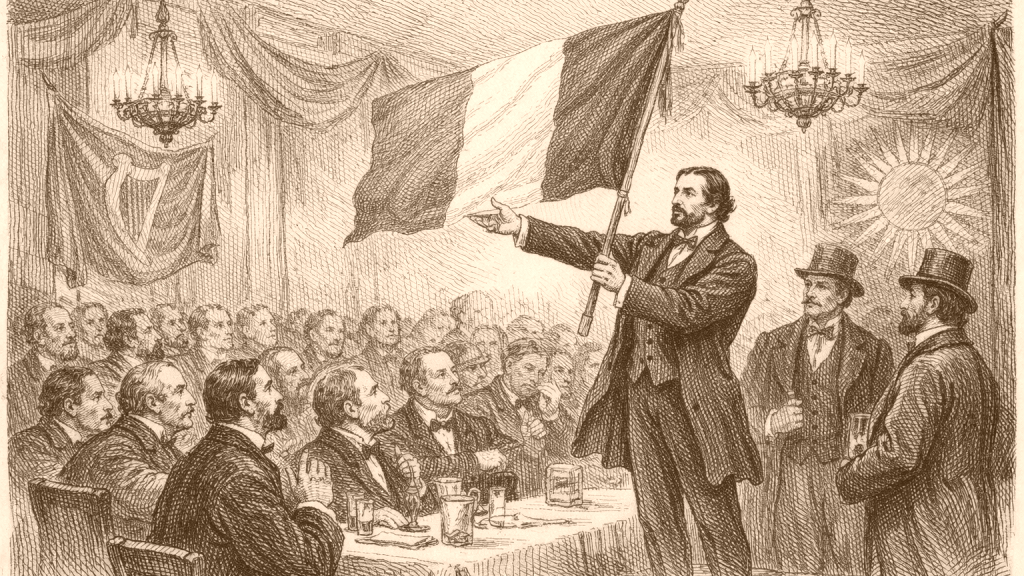
The earliest directly described commemorative setting here is the 1848 Dublin banquet account of Thomas Francis Meagher’s presentation of the Irish tricolour. The text says the deputation had returned from France, that Meagher presented a tricolour through the banquet president to the citizens of Dublin, and that he treated the flag as a symbol of a new life. It also places the act at a named gathering rather than in a later retrospective account. [7]
The same passage gives a direct explanation of the flag’s colours. Meagher says the white in the centre signifies a lasting truce between orange and green, and he links that truce to the clasping of Protestant and Catholic hands in brotherhood. The excerpt also records his warning about what might happen if the flag were used to fan conflict, so the speech contains both conciliatory and martial language within the same commemorative presentation. [7]
French Echo
Meagher’s speech also connects the Irish flag to France in explicit terms. The passage names Paris as the city of the tricolour and the barricade, and it recalls scenes of liberty trees, wounded men, and funeral mourning before returning to the Irish presentation. Those details make the French setting part of the speech’s imagery, and the Irish flag is introduced after that sequence as something borne from Paris to the native land. [7]
The rhetoric of commemoration in this excerpt is therefore located in a single performed occasion. It describes the audience at the banquet, the French source of the flag’s imagery, and the act of gifting the banner to Dublin. The text does not provide any later reception history in the same excerpt; it records only the presentation itself and the meaning that Meagher attached to the colours at that moment. [7]
Civic Display
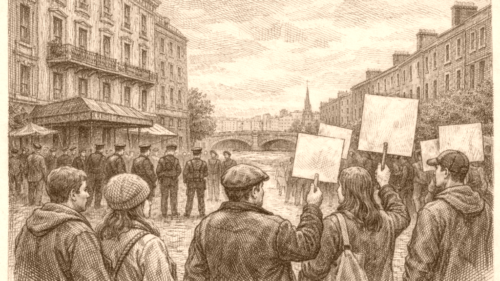
A different kind of commemorative display appears in the 2008 newspaper report on Belfast. There the Sinn Féin lord mayor unveiled a tricolour in his official parlour, said he was trying to act inclusively, and explained that he had inherited an office with a union flag already in it. He chose to place the Irish tricolour beside it. The report also notes that unionist critics objected to the action. [6]
The same report gives a further civic comparison by referring to Belfast’s first Sinn Féin lord mayor, elected in 2002, who also placed a tricolour in his parlour next to the union flag. It adds that the 2008 unveiling was attended by Gerry Adams and other party figures and that the parlour was then temporarily located in docklands offices while City Hall was being restored. These are all details of the reported event, not of any broader pattern. [6]
Archive Context
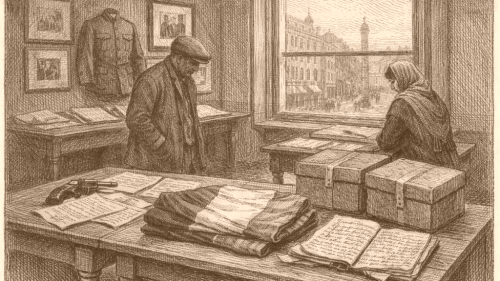
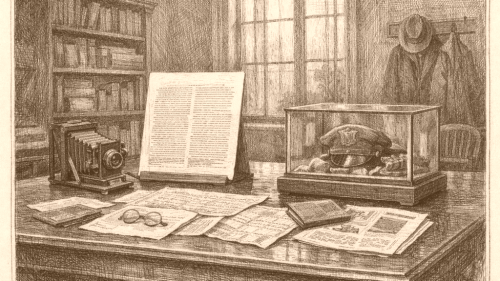
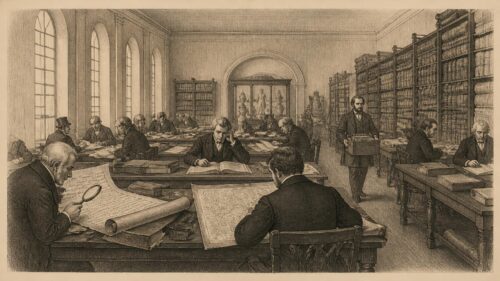
Institutional collections place flags and related materials within larger historical holdings. The National Museum of Ireland says its Historical Collections Online cover Irish military and political history from the sixteenth to the twentieth centuries and include uniforms, flags, letters, photographs, firearms, and personal relics. It also says that many of the objects had not previously been on public display and were presented online to coincide with the centenary of the 1916 Rising and the Decade of Commemorations. [1]
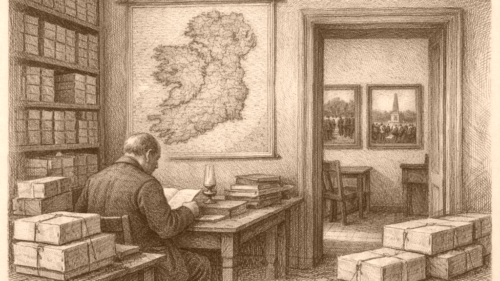
The National Library of Ireland pages give a parallel archival setting. They describe official publications from Irish, British, and international sources, with some material from the seventeenth century onward, and say many items have been digitised and are searchable through eResources. The same pages list newspapers, digitised books, manuscripts, maps, and official publications among the resources available to registered readers in the reading rooms. [2] [3]
Public Art
The President of Ireland’s public art project shows a commissioned commemorative setting rather than a speech or a museum entry. The page says that in late 2015 President Michael D. Higgins and Sabina Higgins invited artists to propose a suitable 1916 commemorative piece for the grounds of Áras an Uachtaráin. It states that the work was intended as a permanent tribute to the men and women whose effort and sacrifice contributed to Irish freedom and as an inspiration toward a true republic. [4]
The same page records the process and outcome. Fourteen artists responded, five were invited to make more detailed proposals, and Rachel Joynt’s Dearcán na nDaoine, or People’s Acorn, was selected and unveiled in December 2017. The excerpt also says the project was funded under the Government’s Ireland 2016 Commemorations Programme, with a stated budget of €160,000. [4]
Memory Ethics
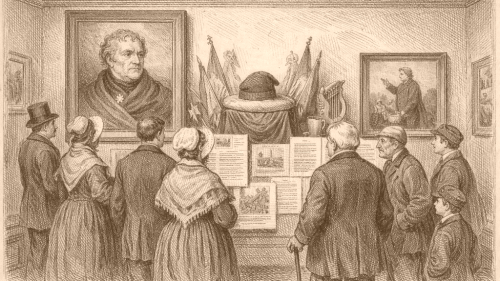
A presidential speech from 2015 places these commemorative concerns in an explicitly reflective frame. The address says it was fitting to gather in Glencree to consider how to reflect on the legacy of 1916, and it describes the centre as a place for dialogue among people across the island and across religious and political divisions. It also says the Presidency coincided with the Decade of Commemorations and names several anniversaries that had already prompted reflection. [5]
The same speech also uses the language of ethical remembering. It says the challenge of remembering ethically was part of the Ethics Initiative and that the speaker turned to writers including Hannah Arendt, Paul Ricoeur, Avishai Margalit, and Richard Kearney. These details belong to the speech itself; they show that commemoration here is treated as a subject for deliberate reflection rather than as a single image or object. [5]
Source References
Hover over a number to see the source. Select it to open the source.

- [1] Historical Collections Online | National Museum of Ireland
- [2] Official Publications | National Library of Ireland
- [3] eResources | National Library of Ireland
- [4] Public Art Project | President of Ireland
- [5] Media Library | Speeches | President of Ireland
- [6] Sinn Féin mayor places Tricolour in office – The Irish Times
- [7] Presentation of the Irish Tricolour – Cartlann
How do these records present the Irish tricolour in commemorative contexts across presentation, civic display, institutional collection, and presidential remembrance?