

Ulster Hound
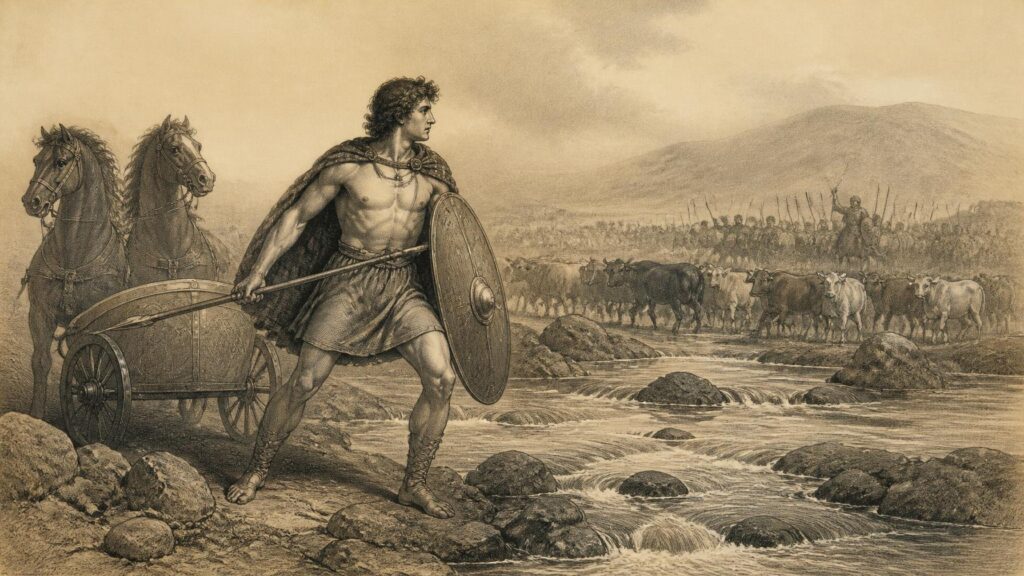
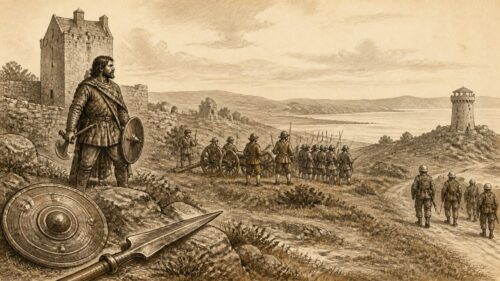
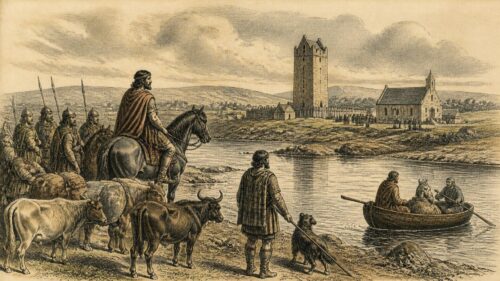
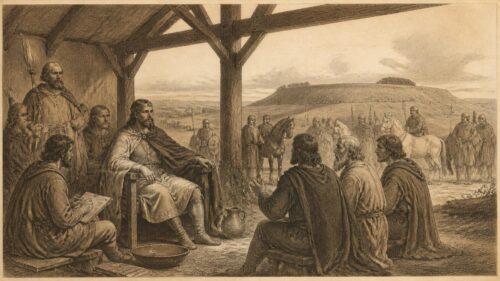
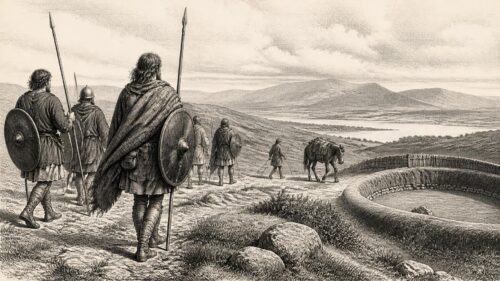
AI generated historical illustration, not a contemporary photograph.
At a Glance
Cú Chulainn, remembered in English as the Hound of Ulster, is among Ireland’s most compelling legendary figures. He is not, however, a securely recoverable warrior from prehistoric Ireland. The surviving evidence is medieval: manuscripts copied by learned Christian scribes, narratives shaped by oral tradition and literary artistry, archaeological landscapes later associated with saga places, and a long succession of readers who remade the hero for their own times. To understand Cú Chulainn historically is not to ask whether he literally fought Queen Medb’s army at a ford, but to ask how and why medieval Irish authors made such a hero imaginable, memorable and authoritative.
Textual Evidence
The starting point for any historical account of Cú Chulainn is a distinction easily blurred by modern retellings. There is no contemporary inscription, annal, legal record or excavated object that identifies a historical man named Cú Chulainn and records the deeds attributed to him. The figure belongs instead to a large body of medieval Irish narrative conventionally called the Ulster Cycle. This is a modern scholarly label, useful but not a medieval title for a fixed canon. The tales are connected by recurring people, places and conflicts: Conchobar mac Nessa, king of Ulster; Emain Macha, his royal centre; Medb and Ailill of Connacht; Fergus mac Róich; Conall Cernach; Emer; and above all the young champion Cú Chulainn.
The greatest of these narratives is Táin Bó Cúailnge, usually translated as The Cattle Raid of Cooley. It makes Cú Chulainn the defender of Ulster when Medb’s Connacht host advances to seize the celebrated brown bull of Cooley. Its plot is by no means a simple national war. Medb’s expedition arises from a domestic contest of status and wealth with her husband Ailill; the hero’s defence of Ulster is complicated by the temporary incapacity of the Ulster warriors; and the story moves between political bargaining, cattle raiding, satire, formal single combat, magic and catastrophe. A medieval tale of astonishing literary range, it resists reduction to either primitive history or simple fairy story.
The surviving Táin is preserved in more than one version and in manuscripts copied long after the period in which the action is supposedly set. University College Cork’s Irish Sagas project presents the principal textual witnesses and makes the point plainly: the familiar Book of Leinster version is one recension among several, while the earlier recension is found in the Lebor na hUidre, or Book of the Dun Cow, and later material survives in the Yellow Book of Lecan and other manuscripts. Variation is therefore not an accidental blemish on a single original. It is evidence that Cú Chulainn’s story was transmitted, abbreviated, supplemented, corrected and reshaped over generations.
That manuscript history gives the hero a real historical setting, though not the setting often claimed for him. Cú Chulainn is historically attested as a major character in medieval Irish literature. The dates belong principally to the creation, copying and reception of texts, not to a demonstrable lifetime. Medieval learned tradition placed him in a remote age around the beginning of the Christian era and wove him into elaborate synchronisms with Roman emperors, Christ and Irish kings. Such chronologies tell historians much about medieval Irish schemes of universal history. They do not establish that a particular Ulster champion lived at a particular date.
The language of the narratives preserves older strata, and individual episodes or motifs may have circulated orally long before the oldest surviving manuscripts. Yet oral antiquity cannot be measured with certainty merely because a story feels ancient. The literary texts available today were written down in Christian Ireland and bear the marks of medieval learning: biblical comparison, Latin literacy, genealogical interests, learned etymology and a sophisticated awareness of storytelling itself. Their antiquity is genuine, but it is medieval antiquity.
Manuscript Worlds
The most important material witnesses are themselves remarkable objects. Lebor na hUidre, held by the Royal Irish Academy, is generally dated to around the turn of the twelfth century, though it contains work by more than one scribe and later intervention. It preserves portions of the first recension of the Táin. The Book of Leinster, Trinity College Dublin MS 1339, is a twelfth-century compilation associated with Áed Úa Crimthainn of Terryglass and contains a fuller but still composite version commonly called Recension II. The Yellow Book of Lecan, produced in the later medieval period, preserves further portions and variants. None is an autograph by an imagined original author; all are products of manuscript culture.
This matters because a manuscript is not a transparent window onto an unaltered pagan past. A scribe selected what to copy, decided where to begin and end, used an inherited exemplar that may have been damaged or incomplete, and sometimes added explanatory matter. The Book of Leinster’s Táin itself ends with a famous colophon whose writer distances himself from aspects of the tale, declaring that some things in it are deceptive or demonic while also blessing those who memorise it properly. The gesture is revealing. The story had enough prestige to be copied and learned, but it also contained supernatural and violent material that a Christian scholar felt obliged to frame.
The manuscript witnesses likewise complicate any claim that there was one complete, stable “original Táin”. The early recension is discontinuous: some episodes are missing or survive only as summaries. The Book of Leinster version supplies different arrangements and fuller sequences. Later manuscripts preserve alternative readings. Editors must compare these witnesses, assess language and narrative coherence, and decide how to present a readable text. A modern edition is therefore an informed scholarly construction, not an untouched voice from antiquity.
The wider Cú Chulainn corpus is even less bounded. Compert Con Culainn, the conception tale, explains his miraculous arrival in the world. Macgnímrada Con Culainn, the boyhood deeds, recounts his first entry into the world of Emain Macha. Tochmarc Emire, the wooing of Emer, joins courtship, verbal skill and martial training. Serglige Con Culainn, often translated as The Wasting Sickness of Cú Chulainn, brings him into an otherworldly entanglement with Fand. Aided Con Culainn, the death tale, tells how enemies exploit obligations and omens to bring down the nearly invincible champion. Other narratives, including the death of Aífe’s only son, expand a life story that is neither fully consistent nor organised as a single medieval biography.
It is better to picture a narrative constellation than a modern novel sequence. Individual tales acquired authority through association with famous characters and through performance, recitation and copying. Prefatory stories, known as remscéla, could provide causes and background for the cattle raid. Their lists and relationships differed. Medieval readers did not necessarily encounter Cú Chulainn in the same order that a modern anthology supplies. A life apparently running from miraculous conception to heroic death is partly the product of later editorial and popular arrangement.
Heroic Origins
Cú Chulainn’s earlier name is Sétanta. In the best-known naming episode, he arrives late at the house of Culann the smith, whose fierce guard dog has been released after guests have entered. The boy kills the hound in self-defence. He then offers to rear a replacement and to guard Culann’s house himself until one is grown. The druid Cathbad declares that he will henceforth be known as Cú Chulainn, “Culann’s hound”. The name joins violence, compensation and service: the child proves terrifyingly capable, yet accepts responsibility for what he has destroyed.
This is folklore and literature, not a report of a childhood occurrence. It nevertheless expresses several values that medieval audiences could recognise. A powerful household has a guarded entrance; a guest’s safety matters; lethal force creates an obligation; public naming fixes reputation. The hero does not simply acquire an animal epithet because he is savage. He becomes a substitute protector bound to a host. Later interpretations have often treated “hound” as proof of an alleged warrior cult or totemic survival. Such claims go beyond the evidence. The episode gives a literary explanation for a name; it does not provide direct access to prehistoric religious practice.
The name itself has attracted scholarly debate. Cú certainly means hound, but can also carry a heroic or warrior sense in Irish naming. The Dictionary of Irish Biography notes proposals that the compound may have associations beyond the plain story of Culann’s dog, including an old word connected with a chariot. Those possibilities remain interpretations of language and tradition, rather than settled facts. Etymology can illuminate a name’s possible resonances, but it cannot by itself recover a lost historical individual.
His parentage is similarly layered. In many accounts his human mother is Deichtine, sister of Conchobar, and his social father is Sualtam or Sualtaim. Other versions make the god Lug central to his conception. The result is a hero with both kinship at the court of Emain Macha and a divine or otherworldly dimension. Medieval Irish narrative frequently allows such doubleness. Characters can be humanly situated by genealogy while simultaneously marked by wonders, prophecies and interventions from the síd, the otherworld.
Scholars have proposed that Cú Chulainn may preserve features of a pre-Christian deity, an ancestral figure or a hero shaped by contact with Britain and Gaul. There are reasonable grounds for asking such questions: the tales include divine connections, a possible link between Sétanta and the north British Setantii, and cultural traffic across the Irish Sea. But a proposal is not proof. The surviving texts are too late and too mediated to permit a straightforward identification of Cú Chulainn with a named Iron Age god. The most secure conclusion is narrower: medieval Irish authors represented him as a hero of exceptional, sometimes semi-divine, potency.
Boyhood Feats
The boyhood deeds establish the pattern of his career. Young Sétanta hears of the warrior youths at Emain Macha and sets out alone to join them. On reaching their playing field, he is attacked because he has not placed himself under their protection according to the expected ritual. He defeats them, only later accepting their safeguard and giving his own. This episode presents childhood not as innocence but as a testing ground for honour, hierarchy and controlled aggression. The boy is already stronger and faster than other children, yet must learn the conventions that make strength socially acceptable.
His accession to arms is equally extravagant. He takes weapons intended for adult warriors and breaks successive sets through the force of his handling until Conchobar’s own arms prove adequate. He performs feats of balance, throwing and acrobatics, known as clis. The literary point is not plausible military training. It is the revelation of a hero whose body exceeds normal measure. The child’s prowess threatens ordinary order before becoming the court’s greatest resource.
One of the most memorable elements is the ríastrad, often rendered “distortion”, “contortion” or, in Thomas Kinsella’s influential phrasing, “warp-spasm”. In battle, Cú Chulainn’s appearance changes grotesquely: his body twists, one eye withdraws while another protrudes, his hair seems to blaze, and blood or heat erupts from him. Descriptions differ between versions, but the broad effect is consistent. He becomes visually and morally terrifying, a warrior transformed by fury into something no longer wholly ordinary.
Modern readers sometimes call this a berserker frenzy, but that comparison can conceal as much as it reveals. The ríastrad is a carefully literary image, not clinical evidence of a combat trance. It represents dangerous excellence. Cú Chulainn is Ulster’s saviour because he can cross a boundary of violence others cannot; he is also hard to reintegrate afterwards. In one famous aftermath, women are sent to expose themselves and shame him into lowering his gaze, while men seize and immerse him in cooling vats. The episode is fantastical, but its structure is social: the community must cool, contain and reclaim the force it has needed.
The boyhood material also makes plain that heroism is never merely strength. Cú Chulainn is judged by speech, appearance, generosity and willingness to observe geasa, personal prohibitions or obligations. He learns from Cathbad, interacts with the king’s household and is assessed by women as well as men. Even in narratives dominated by raids and killing, rank is displayed through dress, chariots, retainers, feasting and verbal exchange. Heroic society is theatrical. Deeds require witnesses, and fame depends upon narrative.
Cattle Conflict
Táin Bó Cúailnge begins not with a battle but with a comparison of possessions. Medb and Ailill count their wealth and discover that, apart from Ailill’s prized white bull, they are equally matched. Medb seeks the brown bull Donn Cúailnge of Cooley to restore parity. The opening is comic, sharp and politically serious. Cattle are wealth, breeding stock, food, prestige and the practical basis of lordly power. A dispute about one animal can therefore stand for a dispute about sovereignty, marriage and public status.
The story’s cattle economy should not be read as a literal account of one prehistoric campaign. It does, however, draw on social realities familiar to medieval Ireland. Livestock was central to Irish law and economy. Raiding cattle was both a material threat and a literary device through which rival kingdoms could be measured. The Táin magnifies such a raid into an all-Ireland crisis, assembling forces from Connacht and allied territories against Ulster. Its geography is recognisably Irish, but it is narrative geography as well as a map.
Medb is among the saga’s most formidable figures. She is not merely Cú Chulainn’s opposite number or a villain whose ambition requires correction. She directs the expedition, negotiates with champions, manages allies and repeatedly acts with political calculation. Her name and role have encouraged interpretations linking her to sovereignty goddesses, while the archaeological landscape at Rathcroghan in County Roscommon has long been identified with Cruachan, her Connacht seat. Again, the distinction is essential. Rathcroghan is unquestionably an important multi-period ritual and elite landscape; that does not prove that a queen named Medb ruled there or launched the raid described in the tale.
Ulster is unable to resist Medb’s host because its men suffer the ces noínden, the “debility of the Ulstermen”. Different explanations connect their weakness with a curse arising from an earlier tale involving Macha. Cú Chulainn alone is exempt, often because of his different parentage or youth. The device solves a narrative problem: how can one champion face an army while the renowned warriors of Ulster remain absent? More importantly, it makes the hero’s isolation fundamental. His greatness is measured not by a victory beside comrades but by a lonely duty imposed by communal incapacity.
He delays the invasion through a sequence of challenges at fords. A pillar stone, a carved branch or an ogham-marked warning may require an opponent to meet conditions before the army advances. Such scenes combine imagined archaic custom with the literary pleasure of postponement. The Connacht force is slowed; scouts, charioteers and champions encounter the young defender; Medb must decide whether to bargain, send another fighter or seek a tactical advantage. Cú Chulainn’s defence of a border is consequently a defence of honour as much as territory.
Single Combat
The recurring combats at fords give the Táin its distinctive rhythm. Rather than a continuous battle, the narrative stages individual encounters. Named adversaries come forward, exchange genealogies and boasts, fight, and die or withdraw. The pattern has sometimes been used to reconstruct ancient Celtic warfare, but that is too confident. The scenes are shaped by conventions of heroic literature. They show what medieval storytellers found dramatically meaningful: prowess made visible, rank tested in public, and violence framed by speech.
Fergus mac Róich provides one of the tale’s deepest tensions. A former Ulster king or champion now associated with Medb, he has affection for Cú Chulainn and old loyalties to Ulster. Their meetings show that political allegiance is not emotionally simple. The story repeatedly treats kinship, fosterage and hospitality as bonds capable of competing with military obligation. A hero’s identity is not a modern national identity. It is a web of personal duties, rival claims and remembered injuries.
The central duel is with Fer Diad, Cú Chulainn’s foster-brother and fellow pupil of the formidable Scáthach. The episode is among the finest examples of tragic pathos in early Irish literature. Fer Diad is not a faceless enemy. He is an equal in skill, familiar in training and bound by affection. Yet Medb’s gifts, pressure and promises draw him into combat. For several days the two exchange weapons and wounds, their fighting escalating until Cú Chulainn uses the gáe bulga, a terrible spear or spear-technique, to kill him.
The exact form and meaning of the gáe bulga have been much discussed, and translations vary. Popular illustrations often make it a barbed fantasy weapon designed with pseudo-archaeological certainty. The texts support a far more cautious description: it is a uniquely dreadful weapon associated with Cú Chulainn and with fatal penetration and branching wounds. Whether it reflects a real implement, a remembered martial practice or pure narrative invention cannot be demonstrated. What is indisputable is its literary function. It marks the point at which a contest between equals becomes irreparable.
After Fer Diad’s death, Cú Chulainn laments and tends his body. The mourning matters as much as the kill. Heroic excellence carries emotional cost, and the tale refuses a simple celebration of slaughter. This does not make the Táin pacifist; it is saturated with glory, boasting and revenge. But it knows that fame is bought through bereavement. The hero who saves Ulster must kill a friend, and the language of lament preserves the scandal of that necessity.
Many later readers have compared Cú Chulainn with Achilles. The comparison has some basis: each is a young, exceptional warrior, associated with a brief and glorious life, and each inhabits a narrative culture conscious of heroic choice. But the comparison should not turn the Irish hero into a local copy of a Greek original. Medieval Irish scholars knew classical material, and literary contact may have encouraged particular resonances. Still, Cú Chulainn’s world of cattle raids, fosterage, geasa, otherworld women and Irish place-lore is distinctively Irish in its surviving form.
Landscape Memory
Cú Chulainn’s stories are anchored in named landscapes. Emain Macha, usually associated with Navan Fort outside Armagh, is the royal centre of Ulster and the court of Conchobar. Cúailnge, the Cooley peninsula in County Louth, gives the cattle raid its destination and its prize. Cruachan, conventionally linked to the Rathcroghan complex near Tulsk in County Roscommon, is Medb’s Connacht centre. Sites in Armagh, Louth, Monaghan, Down and elsewhere have been connected with episodes in the cycle. Place-name lore gives the tales geographical force: a hill, ford, grave or standing stone can seem to hold a memory of heroic action.
Archaeology confirms that several of these landscapes were important long before the surviving manuscripts were copied. Navan Fort is an exceptional ceremonial complex, with evidence of major activity in later prehistory and a famous timber structure deliberately filled with stone and burned. Rathcroghan contains a dense concentration of monuments extending across many periods, including burial mounds, enclosures and elite sites. Such evidence demonstrates that these were ancient and prestigious places to medieval people. It helps explain why storytellers located royal courts there.
It does not confirm the saga narrative. Archaeology cannot identify Conchobar’s hall, Medb’s bedchamber or the precise ford where Fer Diad died. Nor can it show that the Táin records an actual campaign. The chronological distance between archaeological phases, medieval literary composition and later local tradition is too great, while the evidence itself is of different kinds. An excavated structure can tell us about construction, ritual deposition and destruction; a saga can tell us how a medieval narrative imagined kingship and conflict. Their relationship is suggestive, not demonstrative.
The Cooley landscape is particularly important to the story because the brown bull is not an incidental object. Donn Cúailnge carries the status of a kingdom, and the final conflict between him and Ailill’s white-horned bull dramatises the raid’s consequences after human combat has failed to settle them cleanly. The bulls roam through Ireland in the narrative, leaving place-names and destruction behind them. This is not zoological history. It is a mythic mapping of the island, in which animal rivalry mirrors and exceeds human political rivalry.
Local traditions may preserve names such as Cú Chulainn’s Leap, Cú Chulainn’s Stone or his grave. These associations are culturally valuable, but their age and continuity vary considerably. Some may be old; others may have been strengthened by nineteenth-century antiquarians, tourism or popular retellings. Historians should neither dismiss them as meaningless nor elevate them automatically to evidence for the hero’s lifetime. They show how people have attached a legendary figure to visible places, making landscape into a medium of remembrance.
Medieval Meanings
What did Cú Chulainn mean to medieval Irish audiences? There can be no single answer across centuries, regions and manuscript communities. Yet the narratives allow several cautious observations. He embodies an ideal of martial excellence: speed, courage, skill with weapons, refusal to yield and the ability to protect dependants. He is also a figure of excess. His violence is terrifying even to allies; his body becomes grotesque under pressure; his obligations entangle him; and his premature death is foretold. He is a hero precisely because ordinary social life cannot contain him easily.
His relationship with kingship is revealing. Cú Chulainn is essential to Conchobar’s Ulster but is not normally the king. He stands beside sovereignty as its champion, not its stable embodiment. The contrast permits the tale to explore a political problem: rulers need warriors of extraordinary force, but such warriors may be young, unpredictable and tied to loyalties beyond the throne. The king gives patronage and recognition; the hero gives protection; neither role is sufficient alone.
Fosterage is one of the most important institutions imagined in the tales. Cú Chulainn’s bonds with Fer Diad and other figures are not secondary sentiment. Fosterage created durable social and political relationships in medieval Ireland, and saga writers use it to make conflict tragic. A battle between strangers can display courage. A battle between foster-brothers tests the foundations of trust. The narratives repeatedly understand kinship as made as well as inherited.
Women possess substantial agency in these stories, although the narratives are also deeply shaped by masculine honour and violent control. Medb leads an army. Emer tests Cú Chulainn’s fitness as a husband through elaborate verbal exchange. Scáthach is a martial teacher. The Morrígan challenges, obstructs and later assists him in shifting forms. Women also grieve, advise, negotiate and expose the dangers of male pride. It would be misleading to call the Ulster Cycle modernly egalitarian, but equally misleading to treat its women as decorative figures.
Supernatural material is integral, not an optional later embellishment. Lug’s relationship to the hero, the Morrígan’s transformations, prophetic knowledge, healing and otherworld encounters all shape the plots. Medieval Christian scribes copied these things without eliminating them, though sometimes with signs of unease. Scholars must therefore avoid two opposite errors: treating every wonder as a transparent survival of pagan religion, or treating it as meaningless fantasy disconnected from belief. The tales are medieval literary works drawing on inherited mythic materials, contemporary social concepts and Christian intellectual surroundings.
Fatal Obligations
Cú Chulainn’s death is told in more than one form, and later versions have developed details differently. The central pattern is clear. Enemies, including the sons or kin of men he has killed, assemble against him. They exploit his geasa, obligations that make certain acts compulsory or forbidden. In the most familiar sequence, he is bound not to refuse food offered by women, but also bound not to eat dog meat. Offered a meal involving a hound, he chooses an impossible compromise and thereby weakens himself. The incident fuses hospitality with doom.
His final stand is one of the great images of Irish heroic tradition. Mortally wounded, he binds himself to a standing stone so that he may die upright, facing his enemies. A bird lands on his shoulder, signalling that life has left him. Only then do opponents approach. Whether every detail belongs to the earliest extant form is less important than the scene’s long literary afterlife. It makes a body in death continue to serve the function it served in life: to deter invasion and preserve honour through visible endurance.
Conall Cernach’s subsequent vengeance restores part of the heroic balance but cannot undo the loss. The death tale is not simply an account of an invincible warrior finally overcome by superior numbers. It insists that excellence has a price. Cú Chulainn’s gifts create enemies; his obligations render him vulnerable; and the social codes that make him honourable can be turned against him. Fate is not an external machine alone. It works through the values by which the hero lives.
Christian readers could find analogies with martyrdom, sacrifice and upright suffering, though these analogies should be handled carefully. Cú Chulainn is not a Christian saint, and his death is not presented in a single uncomplicated theological register. The later power of the scene owes much to its openness. It could be read as pagan heroism, tragic fidelity, sacrificial patriotism or a warning about violence and pride. That flexibility made it especially available to modern political memory.
Folklore Continuities
Cú Chulainn did not remain confined to vellum manuscripts. His name and stories circulated in oral tradition in Ireland and Scotland, in antiquarian collections, schoolbooks, popular adaptations, theatre and visual art. The route from medieval text to modern folklore was not a simple unbroken chain. Stories were translated, shortened, moralised and recombined. Nevertheless, the hero’s association with Ulster, the Cooley peninsula, martial strength and tragic death proved durable enough to invite local and family memories.
Nineteenth-century collectors and writers often approached such material with assumptions now questioned. They looked for pure survivals of an ancient Celtic past, treated oral tellers as repositories of unchanged antiquity, or harmonised conflicting versions into a single national epic. Their publications are still valuable records of language, story and reception, but they require contextual reading. A tale recorded in the nineteenth century is evidence for nineteenth-century tradition first; it may contain older elements, yet it cannot be dated simply by its subject matter.
The Gaelic revival made Cú Chulainn especially prominent. Writers and cultural nationalists sought a native heroic literature capable of standing beside Greek, Roman and Norse traditions. Standish O’Grady’s retellings gave the Ulster material a major place in English-language Irish literary nationalism. Lady Gregory, W. B. Yeats, Augusta Gregory’s collaborators, artists and dramatists found in the hero a figure of youth, beauty, violence and national potential. Translation and retelling opened medieval material to new audiences, but they also altered tone and emphasis.
These revivalist versions often presented Cú Chulainn as a coherent national champion, smoothing the troublesome plurality of the manuscripts. The medieval tales do not describe a modern Irish nation fighting foreign occupation. Their political world is one of rival Irish overkingships, local lordship, fosterage and cattle wealth, with shifting loyalties that do not map neatly onto later nationalism. The revival’s Cú Chulainn was historically important in his own right, but he was a modern construction built from medieval sources.
National Recasting
The most influential modern image is Oliver Sheppard’s bronze The Death of Cúchulainn. Commissioned for the General Post Office in Dublin as a memorial connected with the 1916 Rising, the sculpture depicts the dying hero bound to a stone, his body stylised and exposed, a bird above him. It was installed in the GPO in 1935. The choice of subject was not accidental. Cú Chulainn’s death could be aligned with the Easter Rising’s ideals of sacrifice, youth and national resurrection.
Patrick Pearse had already invoked Cú Chulainn in speeches and writing, and the association between the mythical hero and revolutionary martyr became powerful after 1916. Elaine Sisson’s study of the boy as national hero shows how the cultural image shifted: a youthful warrior could be interpreted through masculinity, citizenship and sacrifice, while Sheppard’s dead Cú Chulainn increasingly fused with public commemoration of Pearse and the Rising. The medieval protagonist became a civic icon in a newly independent state.
This appropriation was politically effective because the death scene had long been emotionally available, but it narrowed the character. Sheppard’s image foregrounds noble sacrifice rather than the complicated, sometimes alarming protagonist of the manuscripts: the boy who kills a guard dog, the champion whose battle frenzy must be cooled, the lover entangled with otherworld women, the friend forced to kill Fer Diad, and the defender whose victories bring further vendettas. National monuments select. They do not lie merely because they select, but they make some meanings easier to see than others.
Cú Chulainn has also been claimed in contrasting political traditions in Northern Ireland. For some, he appears as an Irish nationalist emblem; for others, particularly within an Ulster identity, he can represent a legendary defender of Ulster whose story predates modern constitutional divisions. Such uses demonstrate the figure’s symbolic adaptability, but they should not be projected backwards. The medieval Ulster of the tales was not Northern Ireland, and its Connacht was not a modern province within a nation-state. The terms share names and landscapes, not political systems.
Modern commercial and popular culture has extended the process further. Cú Chulainn appears in novels, comics, games, murals, sports imagery and tourism. These versions can introduce readers to Irish medieval literature, but they often blend sources without warning, borrow visual conventions from fantasy cinema, and transform a complex narrative tradition into a generic Celtic warrior. Historical understanding begins by restoring the distinctions that adaptation tends to erase: manuscript evidence is not archaeology; archaeology is not proof of narrative events; folklore is not automatically pre-Christian; and national symbolism is not identical with medieval meaning.
Historical Verdict
Cú Chulainn should neither be dismissed as “only a myth” nor claimed as a documented prehistoric chieftain. The first response overlooks the immense historical value of medieval literature and its later reception. The second mistakes cultural memory for archival proof. He is a literary hero whose earliest surviving evidence lies in medieval Irish texts, but those texts preserve extraordinarily rich evidence for the imaginative, social and political worlds of their makers and audiences.
The Táin Bó Cúailnge and related tales show medieval Irish writers working with cattle wealth, kingship, fosterage, honour, place-name lore, Christian scholarship and supernatural narrative. They locate a larger-than-life champion within landscapes that were themselves ancient and meaningful. Navan Fort, Rathcroghan and Cooley need not verify the saga to deepen our sense of why its places carried authority. The archaeological record and the literary record illuminate different aspects of the past and become most useful when neither is forced to impersonate the other.
The Hound of Ulster endures because he concentrates contradictions that history rarely resolves: youth and violence, loyalty and autonomy, protection and destruction, glory and grief. Medieval manuscript culture preserved him; local landscape attached him to place; later folklore and scholarship reanimated him; cultural nationalism monumentalised him; and present-day readers continue to argue over him. That long history is more interesting, and more supportable, than any attempt to turn legend into a simple chronicle.
One compelling issue is the tension between Cú Chulainn as a medieval literary creation and as a figure repeatedly anchored to real landscapes, monuments and political memory. The article suggests that manuscript variation and archaeological association do not weaken his importance; instead, they reveal how communities fashioned meaning around him. Oliver Sheppard’s Dublin memorial shows how a hero from a violent narrative could become a modern symbol. How should contemporary Ireland interpret Cú Chulainn’s legacy: chiefly through the changing medieval texts, through the places connected with the saga, or through the later political and cultural uses that have shaped memory?