

Data, Borders And Fuel2026 CE
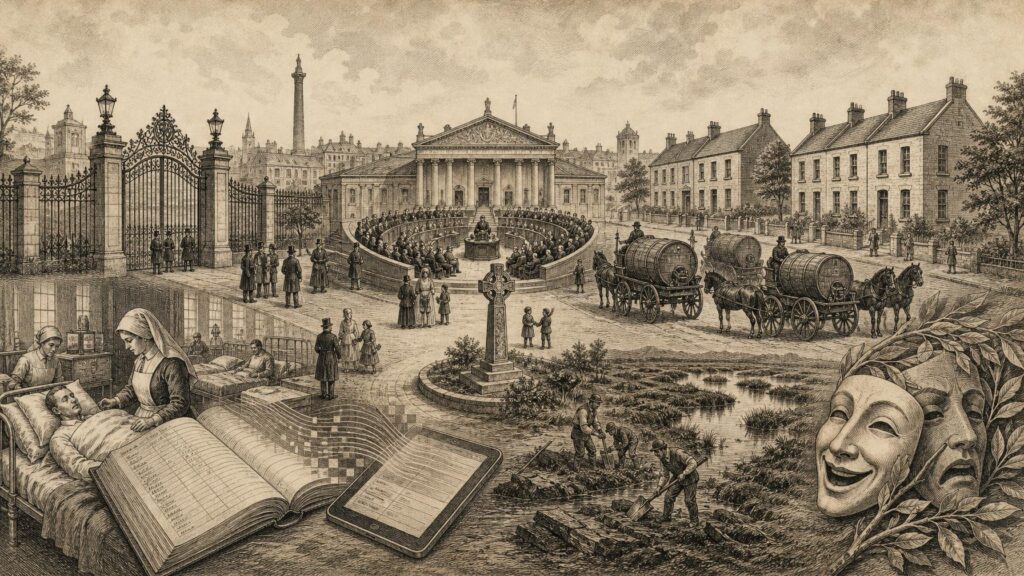
On 30 April 2026, Irish public life was defined less by spectacle than by systems under strain. Ministers met at Hillsborough to manage legacy, policing and Good Friday Agreement institutions; President Catherine Connolly signed the Health Information Act, advancing electronic health records; and the Dáil weighed fuel supports, supply chains and presidential voting rights for citizens in the North. CSO releases on homes, visitors, resources and energy exposed competing pressures of growth, dependency and sustainability. Cultural memory also marked the sudden death of actor Gary Lydon. The day captured a state modernising while arguing over trust, rights and resilience, too.
Dateline
Systems, Not Spectacle
The public record of 30 April 2026 does not point to one single rupture in Irish history. Its significance lies instead in the number of state systems being tested at once: peace-process institutions, emergency economic supports, health data law, housing delivery, environmental restoration and the meaning of Irish citizenship itself. Read together, the day shows an Ireland trying to modernise through legislation and statistics while still negotiating old questions of sovereignty, memory, public trust and dependence on the outside world.
Hillsborough And The Afterlife Of The Agreement
The most symbolically weighty event was the British-Irish Intergovernmental Conference at Hillsborough Castle. The UK side was represented by Northern Ireland Secretary Hilary Benn and minister Matthew Patrick; the Irish Government by Helen McEntee, Minister for Foreign Affairs and Trade and Minister for Defence, and Jim O’Callaghan, Minister for Justice, Home Affairs and Migration. That line-up mattered: the agenda crossed diplomacy, policing, justice and security rather than belonging neatly to one department.
The communiqué placed legacy at the centre. Both governments reviewed the Joint Framework on legacy published in 2025, the Omagh Bombing Inquiry, and Irish legislation intended to allow authorities in the State to co-operate with that inquiry. In the Seanad that morning, members were formally told that the Dáil had passed the International Co-operation (Omagh Bombing Inquiry) Bill the previous day. The timing connected parliamentary machinery in Dublin with the moral weight of unresolved atrocity and with the long argument about how post-conflict societies should balance truth, prosecutions, institutional accountability and the needs of bereaved families.
Security was not treated as a historical matter only. The two governments condemned recent attacks on police stations at Lurgan and Dunmurry, both claimed by the New IRA, and praised continuing co-operation between the PSNI and An Garda Síochána. The conference also considered political stability across the three strands of the Good Friday Agreement, the Northern Ireland Executive’s budgetary pressures, energy security, the North-South electricity interconnector, cross-border working and possible future digital ID systems. The day therefore captured the peace settlement as a living administrative structure, not merely a commemorated achievement of 1998.
Health Data Becomes Law
In Dublin, President Catherine Connolly signed the Health Information Bill 2024, making it the Health Information Act 2026. The Act’s long title makes clear its ambition: to give effect to the European Health Data Space, create and assign electronic health records, place duties on health service providers to share personal health data in defined circumstances, allow patient access, regulate who may see records, and set out how the HSE may request and use health information.
This was a historically important step in the slow digitisation of Irish public services. It promised safer and more connected care, especially for patients moving between hospitals, GPs, voluntary providers and private services. Yet it also sharpened the classic modern dilemma: the information that makes public services more effective can also make citizens anxious about surveillance, data breaches, the use of PPS numbers and secondary uses of personal information. Signing the Act did not by itself deliver a fully functioning electronic health record; commencement, regulations, guidelines and public confidence would determine its practical legacy.
Fuel, Supply Chains And Political Pressure
The Dáil devoted a substantial part of the day to statements on supports for hauliers and supply chains. This followed weeks in which fuel costs, international conflict and protest had exposed how vulnerable an island economy can be when transport prices surge. The previous day, ministers had announced a €120 million Road Transporters Support Scheme and a €100 million Fuel Support Scheme for sectors including farmers, agricultural contractors and fishers.
The Government framed the intervention as a way to keep goods moving, protect jobs and recognise the essential role of hauliers, bus and coach operators and food producers. Opposition voices questioned whether the response was fair, timely and sufficiently targeted, while also linking fuel prices to household hardship and energy poverty. In historical terms, the debate echoed older Irish tensions between urban consumers and rural producers, between climate obligations and immediate costs, and between protest as democratic pressure and disruption as a threat to essential services.
Citizenship North And South
Later that evening, the Dáil considered Aontú’s Forty-first Amendment of the Constitution (Voting Rights in Presidential Elections) Bill 2025 at Second Stage. Peadar Tóibín argued that Irish citizens in Northern Ireland should be able to vote in presidential elections. RTÉ reported that the Government would not oppose the Bill, while keeping the issue under review.
The debate mattered because it moved constitutional citizenship from symbolism into franchise. Irish citizens in Northern Ireland may identify with the Irish State in ways recognised by the Good Friday Agreement, yet they do not vote for the President. Extending that vote would raise practical and political questions: registers, eligibility, the distinction between Northern residents and the wider diaspora, and the sensitivities of unionist opinion. Still, the fact that the Bill received parliamentary time on this date showed how ideas once treated as constitutional aspiration were being tested as administrative proposals.
Numbers Behind The National Mood
The Central Statistics Office releases of the day gave the political arguments a factual backdrop. New dwelling completions reached 7,856 in the first quarter of 2026, up 32.9 per cent on the same period in 2025 and the highest Q1 figure since the series began in 2011. That was an important sign of increased output, but it did not end the housing crisis: need, affordability, location and infrastructure remained central questions.
Tourism figures told a different story of resilience. Some 510,100 foreign visitors completed trips to Ireland in March 2026, 16 per cent more than in March 2025 but slightly below March 2024. The Department of Enterprise, Tourism and Employment welcomed the stability while warning of geopolitical uncertainty and cost pressures, especially around fuel and aviation. Tourism, long used as a measure of Ireland’s international appeal, was being read through the language of risk management.
The CSO’s circular-economy release was more sobering. It reported that Ireland’s energy import dependency was 80 per cent in 2024, the fourth highest in the EU, and that fossil fuels still dominated primary energy requirements. Waste, construction materials, aviation fuel and natural gas were not abstract environmental issues; they were tied to competitiveness, climate commitments and the same supply-chain anxieties debated in the Dáil.
Nature, Culture And Memory
The environmental context deepened with reporting on recommendations from the Independent Advisory Committee for Nature Restoration. The proposal that restoration should begin on public lands, including lands associated with Coillte and Bord na Móna, reflected a changing idea of the State’s estate. Land once valued mainly for timber, peat, energy or commercial return was increasingly being judged by biodiversity, water quality, flood protection and carbon storage.
The Department also announced a change to Irish copyright law arising from an EU court ruling in the RAAP v PPI case. Though technical, the change showed how Irish cultural industries operate within European legal structures, global music markets and debates about remuneration for performers and producers.
The day also became part of Irish cultural memory through the death of actor Gary Lydon, later reported by RTÉ and others. Known for stage work linked to Billy Roche and screen roles in The Clinic, Love/Hate, The Guard, Calvary and The Banshees of Inisherin, Lydon represented a generation of Irish performers who moved between local theatre, national television and international film. His sudden death at 61 gave a human note to a day otherwise dominated by institutions. Taken as a whole, 30 April 2026 was a day of frameworks: for peace, data, energy, housing, ecology, culture and citizenship. Its history lies in how those frameworks revealed the pressures shaping Irish public life.
Primary Sources
- British-Irish Intergovernmental Conference Joint Communiqué, 30 April 2026
- UK and Irish Governments to Reaffirm Security Cooperation and Commitment to Legacy at BIIGC
- President Connolly Signs the Health Information Bill 2024
- Health Information Act 2026
- Dáil Éireann Debate, 30 April 2026
- Seanad Éireann Debate, 30 April 2026
- Ministers Announce €120 Million Road Transporters Support Scheme and €100 Million Fuel Support Scheme
- Govt Will Not Oppose Bill to Extend Áras Vote to NI
- New Dwelling Completions Q1 2026
- Inbound Tourism March 2026
- Business in Ireland 2025 – Circular Economy and Resource Use
- Tourism Figures Indicate Stability Despite Uncertainty
- Change to Irish Copyright Law Following EU Court Ruling
- Ireland Requires Up to €700m Annually to Restore Nature, Report
- Acclaimed Irish Actor Gary Lydon Dies Aged 61