Coal Dues
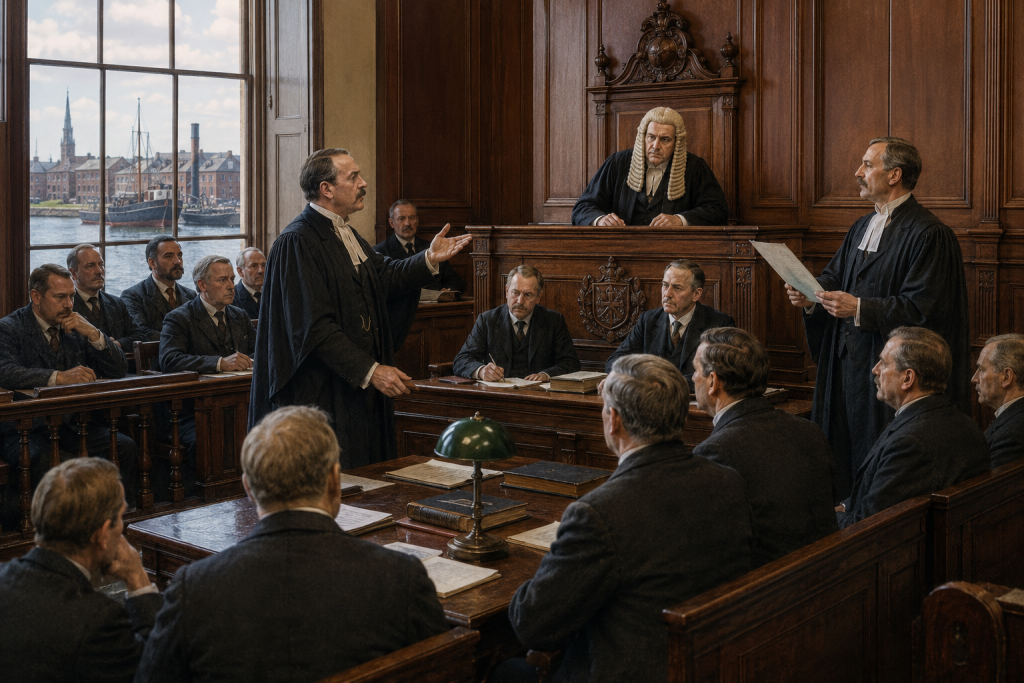
A substantial case before Judge Richard Adams examined the Mayor of Limerick’s asserted right to receive dues upon coal brought into the city. The proceedings, reported on 12 January 1900, required the court to consider whether this inherited privilege rested upon royal charter, lease, long-established prescription or some combination of those authorities. Counsel disputed both the legal foundation of the claim and the capacity in which the Mayor exercised it. What appeared to be an obscure municipal custom therefore became a serious test of whether an ancient commercial right remained enforceable within Limerick’s modern port economy.
The evidence reached back through earlier mayoralties and the long history of Limerick Corporation. Ambrose Hall, who had served as Mayor in 1875, testified that he had received approximately 145 tons of coal as mayoral dues during his year in office. Such testimony was intended to demonstrate actual exercise of the alleged right within living memory. The court nevertheless had to distinguish repeated collection from lawful title. A practice might have continued for many years without conclusively proving whether it originated in a chartered privilege, a leasehold arrangement, ownership of quayside property or an established custom recognised by law.
Coal occupied a central place in Limerick’s economy at the beginning of the twentieth century. Households relied upon it for heating and cooking, while railways, factories, workshops, steam vessels and commercial premises consumed large quantities. Any duty imposed upon imported coal could increase costs for merchants and ultimately be passed to families and businesses. The case therefore concerned more than the personal entitlement of a serving Mayor. It affected the price of an essential fuel, the competitiveness of Limerick Harbour and the power of the Corporation to draw revenue from goods entering along the Shannon and city quays.
For the Corporation, inherited dues formed part of a wider body of privileges and revenues accumulated under successive royal charters and municipal arrangements. These resources helped support civic administration before modern systems of local taxation became fully established. Merchants, however, had an obvious interest in challenging charges whose legal origins appeared uncertain or whose commercial burden had become increasingly difficult to justify. Judge Adams’s examination of charter, lease and prescription reflected the complexity of municipal law in a city where medieval rights, private property, harbour regulation and nineteenth-century commerce continued to overlap within the same streets and waterfront.
The dispute illustrated how Limerick’s commercial modernisation repeatedly encountered institutions inherited from an older civic order. Steam transport and expanding industry increased demand for coal, yet every cargo could still become subject to rights traced through centuries of mayoral and corporate authority. A ruling upon the dues could influence municipal income, import expenses and the relationship between the Corporation and harbour traders. Whatever the final legal outcome, the hearing forced the city to ask whether an established custom remained a legitimate source of public revenue or had become an obstacle to affordable fuel and competitive trade.
- Freeman’s Journal, “The Mayor of Limerick and the Coal Dues,” 12 January 1900, p. 6.
- Limerick Corporation Pre-Reform Collection, 1719–1917, L/OC, charters, leases, legal papers, revenue records and council proceedings, Limerick Archives.
- Limerick Harbour Commissioners Collection, IE LA P2, Coal Dues Book, 1843–1847, Limerick Archives.
- Limerick Harbour Commissioners Collection, IE LA P2, records of imports and exports through Limerick Harbour, Limerick Archives.
- University of Galway, Landed Estates Database, “Hall (Limerick),” biographical record identifying Ambrose Hall as Mayor of Limerick in 1875.