University Demand
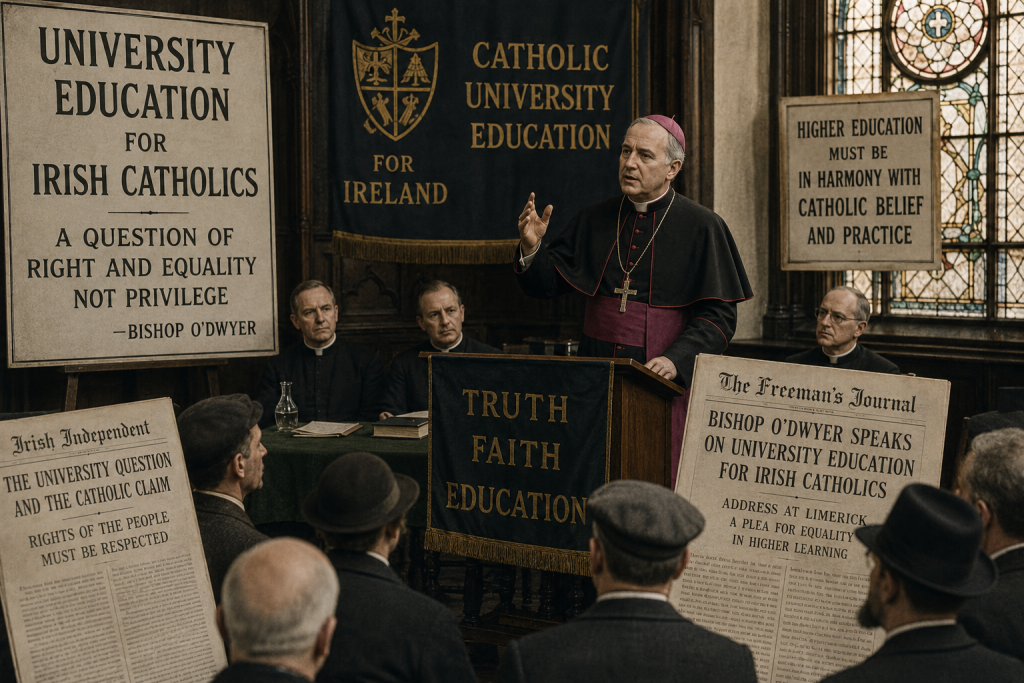
Bishop Edward Thomas O’Dwyer of Limerick delivered a prominent intervention in the continuing dispute over university education for Irish Catholics. He argued that the existing system failed to provide higher education on terms acceptable to the religious convictions of most of Ireland’s population. Catholic students could enter Trinity College Dublin or prepare for examinations through institutions connected with the Royal University, but church leaders maintained that neither arrangement offered a complete university environment shaped by Catholic belief and practice. O’Dwyer presented the question as one of educational equality rather than a request for clerical privilege.
The bishop rejected claims that a new university would merely use public money to strengthen ecclesiastical control. He maintained that Catholics sought access to secular learning under conditions that did not require students or families to disregard conscience. In his published explanation of the case, O’Dwyer accepted significant limitations upon the proposed institution, including safeguards surrounding governance and public funding. His argument was that Protestant and non-denominational opinion should distinguish between establishing a church and removing an educational disability. Catholics contributed to taxation, yet lacked a fully recognised university that reflected the religious atmosphere many parents considered essential.
The problem had serious consequences for professional advancement. University degrees increasingly opened routes into medicine, law, teaching, administration, science and other occupations requiring formal qualifications. Families who rejected existing institutions could send talented sons abroad, support them through less satisfactory arrangements or abandon university ambitions altogether. Each choice demanded money that many households could not provide. The absence of an acceptable Irish university therefore narrowed opportunity most severely for capable students from modest backgrounds. O’Dwyer warned that a country already weakened by poverty and emigration could not afford to leave much of its intellectual ability without suitable higher education.
For Limerick families, the question connected schooling directly with social and economic mobility. The city possessed respected secondary schools and ecclesiastical institutions, while O’Dwyer himself had supported educational development throughout his episcopate. Yet local students seeking advanced degrees usually had to continue their studies elsewhere. Travel, accommodation and fees placed university education beyond the reach of many households, even before religious concerns were considered. A recognised Catholic university could allow Limerick students to pursue professional careers within Ireland while reassuring parents that academic training would not separate education from the moral and religious formation valued within the home.
The university controversy remained unresolved at the opening of the twentieth century because it involved religion, finance, state authority and competing ideas of academic freedom. Catholic bishops did not always agree upon the exact structure they would accept, while British politicians feared denominational endowment and opposition from supporters of existing institutions. O’Dwyer’s forceful contribution ensured that Limerick’s voice remained prominent within the national debate. His central claim was difficult to dismiss: a system serving only a small proportion of Irish Catholics could not be described as equal merely because no law explicitly prevented them from entering institutions many regarded as religiously unsuitable.
- Edward Thomas O’Dwyer, “University Education for Irish Catholics,” The Nineteenth Century, vol. 45, January 1899, pp. 67–80.
- Royal University of Ireland Act 1879, 42 & 43 Vict., c. 63.
- University Education (Ireland) Act 1873, 36 & 37 Vict., c. 21.
- Senia Pašeta, “The Catholic Hierarchy and the Irish University Question, 1880–1908,” History, vol. 85, no. 277, January 2000, pp. 5–22.
- Thomas J. Morrissey, Bishop Edward Thomas O’Dwyer of Limerick, 1842–1917, Dublin: Four Courts Press, 2003.
- Michael V. Spillane, The 4th Earl of Dunraven, 1841–1926: A Study of His Contribution to the Emerging Ireland at the Beginning of the 20th Century, PhD thesis, University of Limerick, 2003.