Materials Wanted
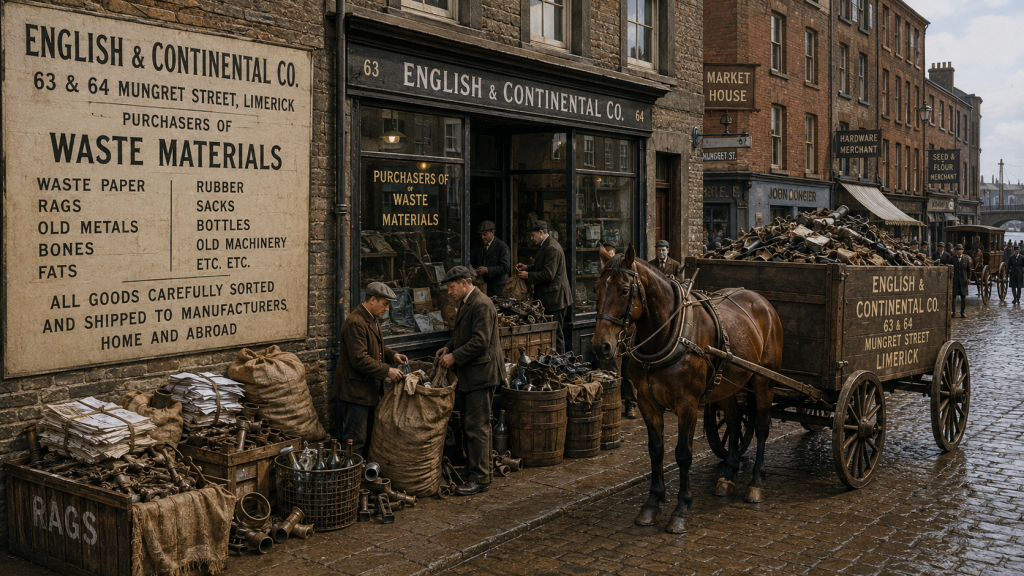
Long before recycling became a familiar part of everyday life, the English and Continental Company invited Limerick residents to recognise the commercial value hidden in unwanted materials. Operating from 63 and 64 Mungret Street in 1900, the firm advertised for discarded goods that could be purchased, sorted and returned to productive use. Its premises stood within a busy commercial district close to the city’s markets, workshops and riverside trade. The advertisement reveals an organised local business in recovered materials, connecting household remnants and industrial offcuts with merchants prepared to sell them into wider manufacturing and export networks.
The language of environmental protection did not shape the company’s appeal. Its purpose was commercial: materials commonly regarded as worn out or useless still possessed a price when gathered in sufficient quantities. Dealers could separate, grade and sell recoverable goods to manufacturers requiring cheaper secondary raw materials. For Limerick households, craftspeople and workshops, the arrangement offered a modest payment for articles that might otherwise occupy storage space or be discarded. For the company, profit depended upon recognising potential value where others saw only refuse and upon assembling small individual quantities into marketable consignments.
Mungret Street provided an appropriate base for such an enterprise. The street formed part of Limerick’s Irishtown commercial landscape and lay beside the Milk Market, where agricultural produce, foodstuffs and manufactured goods circulated through the city. Nearby stores, yards and workshops generated residues that could support a trade in reusable material. The English and Continental Company’s double premises suggest that collection required space for receiving, sorting and holding goods before resale. The surviving advertisement does not establish the size of its workforce or the destinations of every consignment, and these details should not be inferred without further records.
Recovery trades formed an established part of nineteenth-century urban economies. Rags could supply paper manufacture, metals could be melted and recast, containers could be reused, while other discarded substances retained value in industrial processing. Dealers occupied an essential but often overlooked position between consumption and manufacture. Their activity reduced the amount of potentially useful material lost from the economy, though it was motivated primarily by demand, scarcity and price rather than modern ecological ideals. The Mungret Street advertisement shows Limerick participating in this practical trade, with reuse governed by the everyday calculations of buyers, sellers and manufacturers.
Viewed from the present, the company’s methods resemble what is now called a circular economy, in which materials remain in circulation rather than passing directly from use to disposal. That modern description must not obscure the harsher circumstances of 1900, when thrift was often a necessity and many people sold unwanted possessions because even a small return mattered. Nevertheless, the advertisement records resourcefulness within Limerick’s commercial life. At 63 and 64 Mungret Street, discarded goods became commodities again, linking ordinary residents and local workplaces to a trade that recovered value through collection, sorting, resale and transformation.
- Freeman’s Journal, 1900, classified advertisement for the English and Continental Company, 64 Mungret Street, Limerick; exact publication date not confirmed in the available index.
- Thom’s Irish Almanac and Official Directory for the Year 1900, Dublin: Alexander Thom and Company, 1900, Limerick city street and commercial listings.
- Charles E. Goad, Insurance Plan of Limerick, 1897, sheets covering Mungret Street and the adjoining commercial district; Leonard Collection, University of Limerick.