
Stud Dispersal(c.1900s)
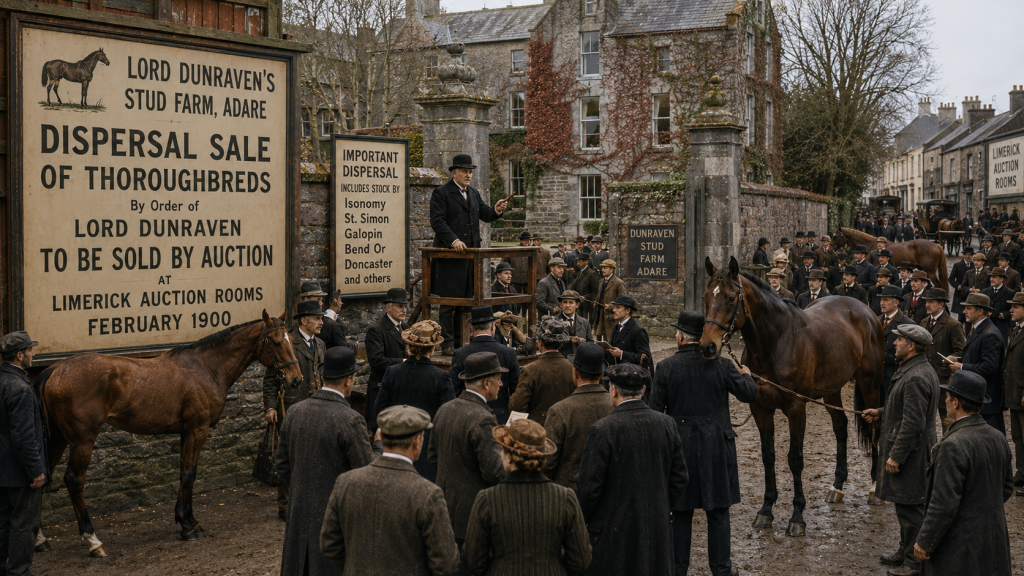
The Irish racing world received unexpected news in January 1900 when reports announced that Lord Dunraven intended to break up his stud farm at Adare and offer a number of its thoroughbreds by public auction in Limerick the following month. The decision immediately concerned County Limerick, where the Dunraven estate had long influenced employment, social life and sporting prestige. The stud was not merely a private collection of horses. It formed part of Adare’s landed economy and connected the village with breeders, trainers, buyers and racecourses throughout Ireland and Britain.
The fourth Earl of Dunraven, Windham Thomas Wyndham-Quin, had established the Fort Union Stud at Adare in 1876. His interest in racing extended over several decades, encompassing ownership, breeding and earlier experience as a steeplechase rider. The enterprise developed a reputation well beyond the estate, while Dunraven’s horses carried the Adare association into prominent sporting circles. A dispersal therefore represented more than the sale of valuable animals. It suggested a substantial alteration to an undertaking through which aristocratic wealth, agricultural skill and the competitive culture of the turf had been brought together.
The surviving announcement stated that a number of thoroughbreds would be sold publicly in Limerick, but it did not provide a complete catalogue, identify the auction premises or explain why Dunraven had taken the decision. Buyers would have judged each animal through pedigree, age, condition, racing performance and breeding promise, while the sale itself offered local horsemen an unusual opportunity to acquire stock associated with a recognised establishment. For stud employees and others dependent upon the estate’s equestrian activity, however, dispersal also raised practical questions about future work, management and the continuing scale of horse breeding at Adare.
Later evidence shows that the announcement should not be interpreted as proof that every breeding operation at Adare ended permanently. In June 1900, a racing report recorded that the stallion Kirkham was still performing stud duty on the estate. The same report noted the victory of Dunraven’s filly Moanerla, a daughter of Kirkham and Gold Wave, and referred to her full sister Kirschwasser as a multiple handicap winner. These details suggest either that the January plan concerned only part of the stock, that selected horses were retained, or that the proposed dissolution was subsequently modified.
Whatever the final extent of the sale, the announcement revealed the importance of bloodstock to Limerick’s rural and commercial life. Thoroughbreds represented accumulated investment, family pedigrees and years of skilled care, making their movement from one owner to another a matter of sporting as well as financial interest. In Adare, the prospect of dispersal marked a moment of uncertainty around one of the county’s best-known private studs. It also demonstrated how decisions taken within a great estate could reach far beyond its stable yards, affecting workers, traders, breeders and the wider reputation of Limerick horse racing.
Primary Sources
- Limerick Archives, “Lord Dunraven’s Stud Farm Dissolution: Impact and Speculation in the Horse Racing Community,” 20 May 2023.
- Milo V. Spillane, “The 4th Earl of Dunraven, 1841–1926,” PhD thesis, Mary Immaculate College, University of Limerick, 2003, p. 113.
- The Queenslander, “Racing Notes,” Brisbane, 30 June 1900, p. 1216.