Limerick

Militia Mobilised

The South African War entered everyday life in Limerick during 1900 when the Royal Limerick County Militia was embodied for extended military service. Since the army reforms of 1881, the historic county force had formed the 5th Battalion of the Royal Munster Fusiliers and maintained its local headquarters at Strand Barracks. Its mobilisation connected families throughout Limerick city and county with the wider demands of an imperial conflict. Although the battalion did not campaign against the Boers as a complete unit, its men undertook duties that released regular soldiers for service elsewhere.

Commons Uproar

The House of Commons descended into uproar on 2 February 1900 after Colonel Edward Saunderson invoked remarks attributed to John Daly, the Mayor of Limerick, during a fierce attack upon Irish Nationalists. Speaking in a debate on the Government’s conduct of the South African War, the North Armagh Unionist argued that a ministry dependent upon Nationalist votes could not be trusted to prosecute the conflict. Limerick’s political voice therefore entered Westminster at a moment of imperial crisis, exposing the gulf between Irish opposition to the war and Unionist demands for victory and loyalty to the Crown.

Stud Dispersal

The Irish racing world received unexpected news in January 1900 when reports announced that Lord Dunraven intended to break up his stud farm at Adare and offer a number of its thoroughbreds by public auction in Limerick the following month. The decision immediately concerned County Limerick, where the Dunraven estate had long influenced employment, social life and sporting prestige. The stud was not merely a private collection of horses. It formed part of Adare’s landed economy and connected the village with breeders, trainers, buyers and racecourses throughout Ireland and Britain.

Materials Wanted

Long before recycling became a familiar part of everyday life, the English and Continental Company invited Limerick residents to recognise the commercial value hidden in unwanted materials. Operating from 63 and 64 Mungret Street in 1900, the firm advertised for discarded goods that could be purchased, sorted and returned to productive use. Its premises stood within a busy commercial district close to the city’s markets, workshops and riverside trade. The advertisement reveals an organised local business in recovered materials, connecting household remnants and industrial offcuts with merchants prepared to sell them into wider manufacturing and export networks.

Excursion Riot

A railway excursion organised by Cleeve’s Creamery in Tipperary town drew the Limerick-based company into public controversy on Saturday, 7 April 1900. The creamery, then the town’s largest employer, arranged a special train to Dublin for its mainly female workforce during Queen Victoria’s final visit to Ireland. Each employee received a rosette in red, white and blue, and the journey was intended as a visible demonstration of loyalty as the royal procession passed through the capital. Because Cleeve’s had its headquarters and industrial identity in Limerick, the episode immediately touched the reputation of one of the city’s most prominent commercial enterprises.

Election Violence

The South Mayo by-election of February 1900 drew Limerick directly into a bitter struggle over the direction of Irish nationalism. John Daly, the veteran Fenian then serving as Mayor of Limerick, travelled to County Mayo to support Major John MacBride, whose candidature was promoted while he fought beside the Boers in South Africa. Daly’s intervention carried symbolic importance: a former political prisoner and leading republican, he represented a separatist tradition sharply critical of parliamentary dependence upon Westminster. Reports that he was attacked during the campaign showed how readily political argument could pass into physical intimidation.

Divided Welcome

Queen Victoria’s final visit to Ireland in April 1900 became a matter of immediate political argument in Limerick before the royal party entered Dublin. Patrick Fidelis Kavanagh, a Franciscan friar and president of the Limerick Young Ireland Society, received a circular from the county’s High Sheriff inviting him to a meeting intended to organise an address of welcome. Kavanagh declined and sent a lengthy reply attacking both British rule and the South African War. His refusal provides direct evidence that the proposed civic greeting was not a simple expression of shared enthusiasm, but an occasion on which Limerick’s competing loyalties were sharply exposed.

Shamrock Resolve

Limerick observed St Patrick’s Day on Saturday, 17 March 1900, beneath dark skies, persistent rain and an unwelcome chill. The difficult weather reduced the comfort of those moving through the city but did not erase the feast from public life. Residents attended religious services, wore shamrock and gathered wherever music, companionship and shelter could be found. The occasion belonged less to the organised civic spectacle familiar in later generations than to churches, families, neighbourhoods and voluntary associations. Its importance lay in the determination to honour Ireland’s patron saint despite conditions that might otherwise have emptied the streets.

Surrender Refused

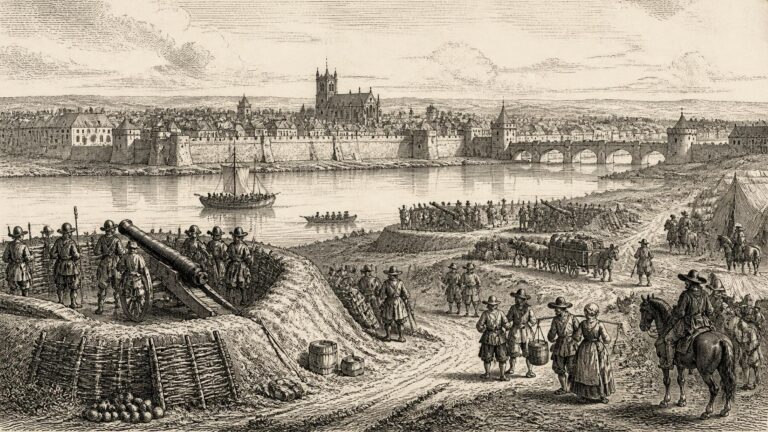
Limerick formally entered a state of siege on 9 August 1690 when William III’s army moved from its camp near Cahirconlish and established itself before the city. William sent a summons demanding surrender to Alexandre de Rainier de Droué, Marquis de Boisseleau, the French officer entrusted with commanding the Jacobite infantry within Limerick. The decision placed the city’s inhabitants, soldiers and defences at the centre of the war following the Boyne. William expected the remaining Jacobite resistance to collapse, but Limerick’s position behind the Shannon and the presence of a substantial garrison offered the defenders a final opportunity to continue the campaign.

Shannon Retreat

Limerick became one of the principal centres of Jacobite resistance after William III’s victory at the Boyne on 1 July 1690 forced the Irish army to abandon the eastern approaches to Dublin. James II departed for France, but most of his surviving soldiers remained under arms and withdrew westwards towards the River Shannon. Some gathered around Athlone, which guarded an important crossing into Connacht, while the larger concentration developed around Limerick. The city’s walls, river position and access to the western counties offered the Jacobites a defensible base from which the war might continue despite the loss of Dublin.

Now Sharing: Articles (154) Images (306) Total Items Archived (460)
Our Mission: 100,000 Items Total Percentage Achieved (0.46%)