Frontiers Under Pressure1178 CE
Dateline
Ireland in 1178 was neither conquered nor divided into two simple, united camps. The lordship claimed by Henry II of England rested most securely in Dublin, parts of Leinster and eastern Meath, while Anglo-Norman adventurers attempted to enlarge their own territories. Gaelic kings continued to rule most of the island, but they competed among themselves as well as resisting foreign expansion. The year’s record is consequently one of raids, ambushes, disputed successions and attacks upon politically important churches. It also reveals how warfare affected cattle herds, settlements, religious communities and ordinary households.
A Divided Political Order
The wider framework had been reshaped at the Council of Oxford in May 1177, when Henry II designated his young son John as lord of Ireland. John was still a child and did not visit Ireland until 1185, so authority in 1178 remained dispersed among royal officers and powerful magnates. Hugh de Lacy, lord of Meath and custodian of Dublin, was the leading representative of English royal power on the island. John de Courcy, meanwhile, pursued a remarkably independent conquest in the north.
The Treaty of Windsor of 1175 had envisaged Ruaidrí Ua Conchobair, king of Connacht, ruling much of Gaelic Ireland beneath Henry’s overlordship. By 1178 that arrangement was visibly failing. Ruaidrí could defend Connacht and influence the central Shannon region, but he could not restrain every Gaelic ruler or prevent Anglo-Norman expeditions beyond the recognised colony. The result was not a stable frontier but overlapping claims enforced through castles, hostages, alliances, raids and tribute.
De Courcy’s Northern War
The firmest annalistic evidence for 1178 concerns John de Courcy’s campaigning. His seizure of Downpatrick is normally dated to early 1177. Mac Carthaigh’s Book places the initial occupation under 1178, illustrating the chronological disagreements between medieval compilations, but the Annals of Tigernach, the Four Masters and modern scholarship support 1177. The events securely associated with 1178 therefore belong to the difficult consolidation that followed his first victories.
De Courcy marched from Downpatrick into Machaire Conaille, the coastal plain extending through part of modern County Louth. After taking plunder, his force camped for the night at Glenn Righe, generally associated with the country near Newry. Murchad Ua Cerbaill, king of Airgialla, and the Ulaid under their Mac Duinn Sléibe king surprised or overtook the expedition. The Annals of Ulster record a severe defeat and slaughter among de Courcy’s men. The Four Masters give losses of 450 foreigners and 100 Irish defenders, but such precise annalistic totals should be treated cautiously rather than as a modern battlefield count.
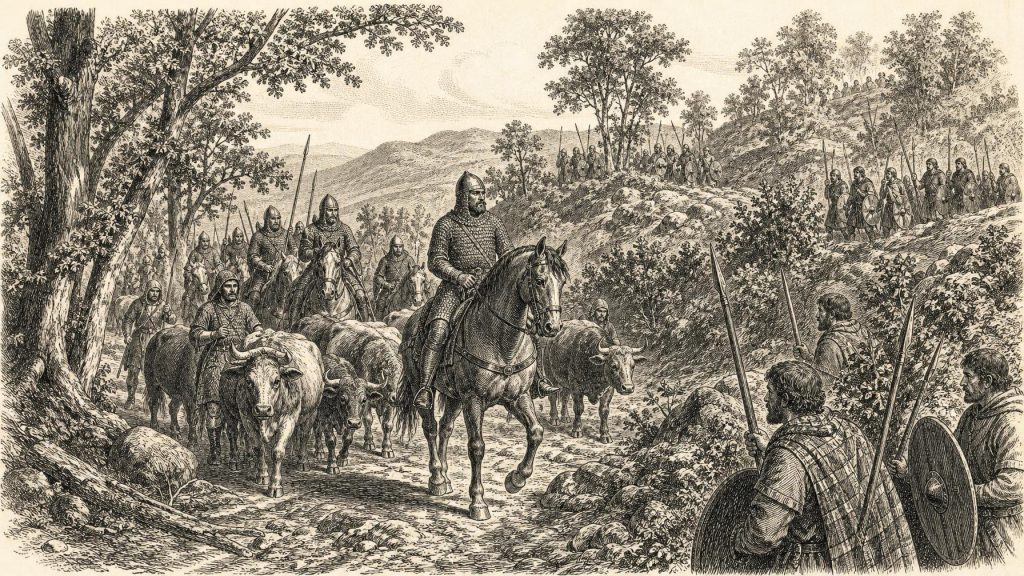
De Courcy then raided Dál nAraidi and Uí Tuirtri, in eastern Ulster. Cú Mide Ua Flainn, king of Uí Tuirtri and Fir Lí, defeated him there as well. A later account says that de Courcy was wounded and escaped with difficulty to Dublin. These reverses demonstrate that cavalry, armour and archery did not guarantee Anglo-Norman victory. Woodland, narrow routes, broken ground and local knowledge could expose a raiding column, particularly when it was burdened with captured livestock.
Clonmacnoise and the Midland Frontier
Hugh de Lacy also tested the limits of expansion. The Annals of Tigernach say that the foreigners of Dublin, including de Lacy, raided Fir Cheall before he advanced with a strong force to Clonmacnoise. The Four Masters report that his troops plundered the settlement but spared its churches and the bishop’s houses. Connacht forces prevented the raiders from resting securely, and de Lacy withdrew the next morning for fear that Ruaidrí Ua Conchobair and the Síl Muiredaig would overtake him.
Clonmacnoise was more than an isolated monastery. It was a religious centre, burial place, place of learning, settlement and strategic crossing-point beside the Shannon. It also possessed close connections with the Ua Conchobair dynasty, and a mint had operated there during the 1170s. De Lacy’s raid was therefore an assault upon a political and economic centre on the approaches to Connacht. Sparing the principal sacred buildings may reflect both practical calculation and genuine fear of violating a powerful sanctuary, although homes, workshops and stored goods elsewhere in the settlement remained vulnerable.
War Across the Provinces
Mac Carthaigh’s Book assigns another expedition into Connacht to 1178. It states that Miles de Cogan led men from Dublin westwards, whereupon the Connachtmen burned churches and houses throughout the open country. Denied provisions and shelter, the invaders returned exhausted. Closely related accounts are placed in 1177 by other annals, so the exact year is uncertain. Nevertheless, the episode belongs clearly to the campaigns surrounding 1178 and records a recognisable defensive method: removing food and lodging before an advancing army could seize them.
Southern warfare was also continuing. The Annals of Tigernach place in 1178 the killing of many Englishmen by Ua Fáeláin, king of the Déisi, and the sons of Finghin Mac Carthaigh. Mac Carthaigh’s Book records the plundering of Lismore, Cashel and Magh Feimhin by foreigners. These brief notices provide no dependable day or sequence of operations, but they show that English positions in Munster remained insecure. Control of Cork, Waterford and other fortified centres did not amount to mastery of the surrounding territories.
Gaelic Rivalries
Conflict among Gaelic dynasties remained as important as resistance to the newcomers. In the north-west, the chieftaincy of Cenél Moen changed hands repeatedly. Conchobar son of Conallach Ua Luinigh displaced Domnall Ua Gairmledaig, was himself deposed within a quarter of a year, and was later killed treacherously while under the protection of an erenagh. Further attacks killed Domnall, Tigernán son of Ragnall and several leading men. The sequence involved expulsions, restoration, vengeance and broken protection, exposing the fragility of authority even within a relatively small lordship.
In the midlands, Art Ua Máelshechlainn, the Uí Failge and Anglo-Norman allies defeated Delbna Ethra, Máel Sechlainn Bec and part of the men of Tethbae. Muirchertach, son of An Sinnach, was killed. Elsewhere, Máel Sechlainn Bec attacked Art’s residence, though Art escaped. Such alliances warn against imagining a fixed ethnic war. Gaelic rulers could fight beside the newcomers against Irish rivals, while Irish kings who opposed one Anglo-Norman expedition might cooperate with another when local advantage demanded it.
Churches, Relics and Learning
Religious institutions stood at the centre of public life and warfare. Clergy controlled lands, maintained hospitality, preserved learning and acted as guardians of saints’ relics. Relics could be carried with armies as sacred guarantors and sources of protection. Mac Carthaigh’s Book describes northern clergy accompanying a coalition against de Courcy with the relics of Patrick and other saints. Although the episode may partly duplicate fighting assigned elsewhere to 1177, it shows how military mobilisation could also become a religious procession. The capture or loss of relics was therefore a political and spiritual disaster, not merely the loss of valuable metalwork.
Two episcopal deaths are firmly entered under 1178: Domnall Ua Fócarta, bishop of Ossory, and Gilla Críst Ua hÉoda, bishop of Conmaicne or Ardagh. The death of Amlaíb Ua Domnalláin, ollam or chief learned poet of Connacht, also appears in the record. His notice is a reminder that professional poets and scholars remained important custodians of genealogy, praise, political memory and elite reputation.
The Cistercian house of Assaroe in Tír Conaill is conventionally dated to 1178 and was established from Boyle Abbey, although sources differ over its founder and some place its formal endowment or dedication in 1184. Grace’s Annals likewise assign the foundation of Rosglas, later Monasterevin, to 1178, while other traditions suggest a later date. These foundations should thus be treated as developments of about this year rather than securely dated ceremonies. They nevertheless demonstrate that Gaelic patrons, as well as Anglo-Norman lords, embraced international religious orders and continental monastic architecture.
Livelihoods Under Threat
For most people, daily life centred upon farming rather than courts or battlefields. Cattle supplied dairy produce, meat, hides and social wealth, while sheep, pigs and cereal cultivation also mattered. Annalistic references to armies taking large herds were not incidental details: cattle enabled rulers to reward followers and feed households, and their loss could damage a community for years. Raiding was therefore both warfare and economic extraction.
Most rural families lived in dispersed farmsteads, while monasteries and ports formed the principal concentrations of population. The expanding colony introduced more mottes, defended manorial centres and planned settlements, especially in Meath and Leinster, but this change remained uneven in 1178. Dublin connected the new military elite with Britain and continental trade, yet its garrison and merchants depended upon supplies drawn from an unsettled hinterland. The year’s campaigns repeatedly turned upon access to grain, livestock, roads, river crossings and shelter.
Wind and Water
The annals also preserve unusual natural observations. A violent wind felled extensive woodland and more than 120 great oaks at Derry, the Columban religious centre. The Four Masters and Annals of Ulster agree on the event, though no exact day is supplied. Another notice says that the River Galway temporarily dried from the Island of the Clerics towards the sea, allowing local people to gather stranded fish and objects from its bed. Whatever physical circumstances lay behind the report, it records both environmental disruption and communal opportunism.
By the end of 1178, the Anglo-Norman colony had survived and continued to expand, but neither de Courcy’s northern lordship nor de Lacy’s midland frontier was secure. Gaelic rulers remained capable of defeating armoured expeditions, denying armies supplies and forming effective regional coalitions. At the same time, their own succession disputes and rivalries opened paths for foreign intervention. The year is best understood not as a completed conquest, but as a struggle over routes, herds, sanctuaries and local loyalties whose outcome remained undecided.
Primary Sources
- The Annals of Ulster — Year U1178
- Annals of the Four Masters — Volume 3, 1178
- The Annals of Tigernach
- Mac Carthaigh’s Book — Annal MCB1178
- Annales Hiberniae
- Courcy, John de
- Lacy, Hugh de (I)
- Ua Conchobair, Ruaidrí
- Cogan, Miles (Milo) de
- Mac Duinnsléibe, Ruaidrí
- Derbforgaill: Twelfth-Century Abductee, Patron and Wife
- ‘Relentlessly Striving for More’: Hugh de Lacy in Ireland
- Hugh de Lacy
- Mark Hagger PhD Thesis
- Downpatrick Archaeological Excavation Report 2012: 22762
- Three Medieval Settlements
- Looking West: Ireland in the Middle Ages
- The Zooarchaeology of Medieval Ireland
- Early Medieval Ireland: Archaeological Excavations, 1930–2009
- The Archaeology of Livestock and Cereal Production in Early Medieval Ireland, AD 400–1100
- Table of Cistercian Monasteries Founded in Medieval Ireland
- An Introduction to the Architectural Heritage of County Donegal
- Monasterevan, Parish Of — Comerford’s Dioceses of Kildare and Leighlin
- Religious Orders
- Giraldi Cambrensis Expugnatio Hibernica