Membership is completely free, giving members unlimited access to all available resources, services, features, and benefits without any restrictions or fees.
Welcome back. Sign in to continue enjoying unlimited access to all available resources, services, features, and member benefits at no cost.
Henry III was Lord of Ireland, but royal authority depended on the cooperation of magnates, ecclesiastics, local officials and military households. The justiciar was Henry of London, archbishop of Dublin, whose government had to preserve royal castles and revenues while managing ambitious Anglo-Norman lords. The greatest private lordship was that of William Marshal, earl of Pembroke and lord of Leinster. In 1223 Marshal drew men and resources from Ireland for his successful campaign in south Wales. That movement of forces mattered in Ireland: it reduced the immediate availability of one of the lordship’s most powerful military patrons and helped create an opening for rivals.
Hugh de Lacy’s position lay at the centre of the year’s politics. He was the younger son of the Anglo-Norman lord of Meath and had been made earl of Ulster after helping King John to displace John de Courcy. In 1210, however, John stripped him of Ulster after the de Lacys had supported William de Braose against the king. Hugh escaped through Scotland and spent years abroad, including service in the Albigensian crusade in southern France. His claim to Ulster remained a dangerous unresolved question.
The most firmly documented political development was the removal of Geoffrey de Marisco as justiciar, the king’s chief officer in Ireland. Geoffrey had held office since 1215. A substantial landholder in Munster, Leinster and Offaly, and connected by marriage and patronage to leading colonial families, he was exceptionally powerful. He was also under sustained pressure to account for royal income. The minority government of Henry III in England had received complaints about Irish revenues, while Geoffrey had previously been ordered to pay crown receipts into the Dublin exchequer and to answer for his conduct.
The evidence needs careful handling. The Annals of Ulster, compiled from contemporary and near-contemporary northern materials, enters several events under 1220. The later Annals of the Four Masters places others in 1220 that the Annals of Loch Cé assigns to 1221, while the Annals of Inisfallen dates the arrival of a papal legate to 1221. Such differences reflect the difficulties of medieval annalistic chronology, copying and the choice of when a year began; they do not automatically mean that one account is false. Accordingly, some developments can be placed firmly in 1220, while others belong more safely to the opening years of the decade and illuminate the situation during this calendar year.
The most consequential development for the Anglo-Norman colony was William Marshal’s death at Caversham on 14 May 1219. Marshal was an English magnate and regent for Henry III, but he was also directly important to Ireland through his wife Isabel de Clare, daughter of Richard de Clare, or Strongbow, and Aífe, daughter of Diarmait Mac Murchada. Through Isabel, Marshal had acquired the great lordship of Leinster. In the previous two decades he had strengthened its administration, supported borough development and reshaped its defensive landscape around centres including Kilkenny, Carlow, New Ross and Wexford.
Henry III was still a child in 1218, and William Marshal, earl of Pembroke, governed England as regent. That mattered greatly in Ireland. Marshal was not merely an English statesman: through his wife Isabel de Clare, heir of Richard ‘Strongbow’ de Clare, he was lord of vast Leinster estates. His interests joined the administration of the English crown to the concerns of a great landholder whose castles, manors, towns and tenants lay on both sides of the Irish Sea.
John was still issuing instructions about Ireland during the final months of his life. On 18 August, at Berkeley, he ordered Geoffrey de Marisco, justiciar of Ireland, to allow Walter de Lacy peace concerning the fine owed for his Irish lands while de Lacy served the king in England. A further order restored to Walter the castles of Nobber and Ratoath, associated with his brother Hugh de Lacy, and Trim Castle, formerly held by Matthew de Lacy’s tenant Matthew de Twit, as parts of Walter’s inheritance. These were no minor properties. The de Lacys’ Meath lordship was one of the great territorial powers of the colony, and its castles controlled routes, settlements and lordly revenue.
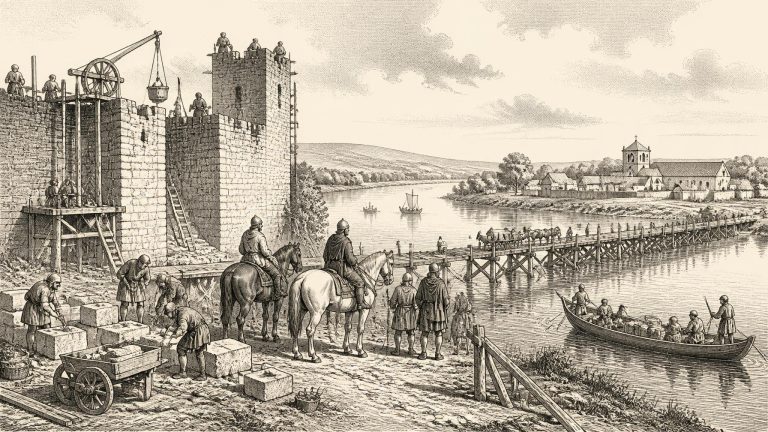
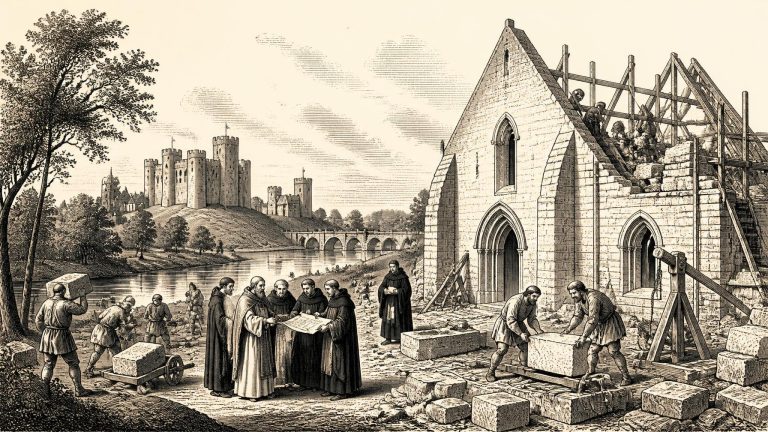
The clearest sequence assigned to 1214 in the Annals of Loch Cé concerns the central plain. It reports that “Foreigners” – the annalists’ usual term for Anglo-Norman settlers and their forces – built castles at Clonmacnoise and Durrow. Neither entry supplies a precise day, construction history or named patron, but their placement together is revealing. Clonmacnoise, on the Shannon, remained a religious centre of exceptional prestige as well as a strategically valuable crossing-point. A castle there was therefore not merely a military building: it announced an attempt to command movement, land and resources around an old ecclesiastical settlement. Durrow likewise lay within a region where control was disputed rather than settled.
Two precisely dated events linked Ireland to the grave political crisis then enveloping King John. On 15 May 1213, at Dover, John formally surrendered England and Ireland to Pope Innocent III and received them back as papal fiefs. His charter explicitly named both realms. Ireland was therefore included in a settlement designed principally to end John’s destructive quarrel with the papacy and to avert the threat of French-backed intervention. The change did not transfer the daily conduct of Irish affairs to Rome, nor did it make the king’s claims effective in every Irish region. It did, however, give the lordship a newly emphatic place in John’s relationship with the papacy.
The evidence requires care. Medieval Irish annals did not all reckon years in precisely the same way, and later compilations sometimes place an event a year apart from other annals. The Annals of Ulster enter the building of Clones castle, the raid into Tír Eógain and the destruction at Derry under 1212. The Annals of the Four Masters, compiled centuries later, place several of those same episodes under 1211, while recording a further sequence of fighting and castle-burnings under 1212. Rather than treating this as a reason to discard the evidence, it is best to see 1212 as a campaigning season extending across annalistic boundaries. The firmly attested picture is of an intensifying frontier war in Ulster, accompanied by serious disturbances in the midlands and Munster.
The immediate background was John’s expedition of 1210. His target had been both the fugitive William de Braose and the powerful Anglo-Norman magnates Hugh and Walter de Lacy, whose lands, castles and connections had made them dangerously independent of the crown. John’s progress through the east and south-east, and his seizure of the de Lacys’ great northern stronghold at Carrickfergus, were important demonstrations of force. But a royal visit could not itself administer Ireland. Once the king had returned across the Irish Sea in August 1210, the task fell to the officials and garrisons he left behind.
John had first visited Ireland as a young prince in 1185. In 1210 he returned as king of England and lord of Ireland, armed with much greater resources and determined not to let the great colonial lordships become virtually independent. His immediate targets were the de Lacy brothers: Walter de Lacy, lord of Meath, and Hugh de Lacy, earl of Ulster. Their position had been strengthened by inheritance, conquest and local alliances; from the king’s perspective, their combined influence across Meath, Oriel and Ulster was an unacceptable threat to royal control. The wider crisis also involved the fugitive William de Braose and his family, whose conflict with John had spread across the Irish Sea world.
John de Grey, bishop of Norwich, was acting as justiciar of Ireland by the end of January 1209. His appointment in the previous year put a trusted servant of King John at the head of the royal administration. The justiciar was not merely a military commander: he represented the king in issuing orders, managing lands and revenues, overseeing royal justice, and dealing with magnates whose loyalties were useful but never automatic. De Grey’s arrival signalled the crown’s wish to tighten its hold over the lordship after years in which great baronial families, especially the Lacys, had accumulated formidable regional influence.
The most consequential development in the lordship was the collapse of Meiler fitz Henry’s position. Meiler had long served King John as justiciar, the chief royal official in Ireland, but he was also a landholder and an active participant in the rivalries of the colony. That dual role proved dangerous. His dispute with William Marshal, earl of Pembroke and lord of Leinster through his wife Isabel de Clare, had become an armed contest by the winter of 1207–8.
The clearest institutional development associated with 1206 was Bishop Simon Rochfort’s transfer of the see of Meath from Clonard to Newtown, beside Trim on the River Boyne. Sources differ slightly in their wording—some describe the move as to Trim, others more precisely to Newtown by Trim—but they agree on its significance. Rochfort founded a house of Augustinian canons there, dedicated to St Peter and St Paul, and its church became the diocesan cathedral.
The Annals of Loch Cé record an unusually prolonged frost and snow, lasting from the Kalends of January—1 January—to the feast of St Patrick, 17 March. The notice does not quantify hunger, mortality or lost livestock, so it would be unsafe to turn it into a general famine. Nevertheless, more than ten weeks of severe winter weather mattered in a predominantly rural society. Travel over roads and tracks, movement of cattle, access to mills and markets, and the routine journeys of clerics, tenants and messengers would all have been more difficult. Its preservation in the annals is a reminder that weather was a political as well as a domestic fact: hosts could not easily move, and communities dependent upon stored food faced a demanding season.
Meiler fitz Henry, King John’s justiciar in Ireland, was the crown’s principal officer on the island. His task was not simply to fight Irish rulers. He also had to contain Anglo-Norman barons whose castles, retinues and private alliances could make them almost independent. The collapse of much of John’s continental inheritance to Philip II of France in 1204 sharpened the king’s need for dependable revenue, loyal service and defensible authority in Ireland. That wider crisis helps explain why Irish affairs were being handled with unusual attention from the royal court.
The most securely dated political acts of the year came from King John’s court. On 7 July, William de Burgh was summoned to answer before the king over complaints arising from his activity in Connacht. On the following day, the king removed his control of the city of Limerick and granted it, at farm, to William de Braose, already lord of the honour of Limerick. The distinction mattered. Limerick was not merely a wealthy settlement at the head of the Shannon estuary: it was a strategic river port, a military base and an outlet through which power in Munster and western Ireland could be supplied and financed.
Connacht had been divided by a prolonged struggle within the Ua Conchobair dynasty. Cathal Crobhdearg, whose byname means “Red Hand”, had competed for power with Cathal Carrach, son of the former king Conchobar Maenmaige. The conflict was rooted in rival claims within a ruling family rather than in a fixed rule of primogeniture: kingship in Gaelic Ireland was contested among eligible members of a wider kindred, and military backing, hostages, clientage and alliance mattered greatly.
The evidence requires some care. The Annals of Ulster, Annals of Loch Cé and Mac Carthaigh’s Book place major Connacht and Ulster events under 1201. The much later Annals of the Four Masters, however, assigns some of the same Connacht campaigning to 1199. This is not a reason to discard either tradition, but it does mean that 1201 should be understood as the annalistic setting for a connected phase of war rather than as a modern day-by-day timetable. The sources are clearest about participants, places and outcomes, and much less secure about sequence, dates within the year and the size of forces.
Connacht was divided by rivalry within the Uí Conchobair dynasty. Cathal Crobderg, son of Toirdelbach, had sought to establish himself as king against his grand-nephew Cathal Carrach, son of Conchobar Máenmaige. Neither the title nor the territory was simply inherited by automatic succession. A prospective king needed the backing of important kindreds, subordinate rulers and fighting men; he also needed to protect or obtain the resources on which such support rested. The contest therefore turned quickly into a wider regional conflict.
The most consequential event beyond Ireland was the death of King Richard I on 6 April 1199 and the succession of his younger brother John. John was already lord of Ireland, a title and territorial lordship created under their father Henry II. His coronation at Westminster followed on 27 May. The change therefore did not suddenly place Ireland under an entirely new form of English authority: royal claims, castles, grants and officials had operated there for three decades. But it did unite the English crown and the lordship in one person, ending the possibility that Ireland might remain a separate apanage in John’s hands.
The Annals of Ulster, whose entry is explicitly headed 1198, records three matters: the resignation of Gilla Mac Liac Ua Brenáin from the succession of Colum Cille; the ordination of Gilla-Crist Ua Cernaigh in his place by the clergy and laity of northern Ireland; and the killing of a son of Brian of Bréifne, himself a son of Toirdelbach Ua Conchobair, by Cathal Carrach, son of Conchobar Máenmaige. The annal then remarks that this may be the proper year for the death of Ruaidrí Ua Conchobair. That last phrase is unusually revealing: even a learned annalistic tradition could preserve uncertainty about the proper placement of a major death.
The fullest accounts of 1197 come from the northern annals. They report that John de Courcy led the “Foreigners of Ulidia” on an expedition to Eas Craibhe and built a castle at Cell Santain, usually rendered Kilsanctan. The force devastated the cantred of Ciannachta and left Roitsel Fitton with a garrison in the new stronghold. A castle was not merely a battlefield shelter. It was a durable claim upon land: a base from which troops could operate, a focus for supplies and tribute, and a threat to neighbouring communities. The entry therefore records an attempt to extend, secure and administer de Courcy’s influence rather than a passing raid alone.
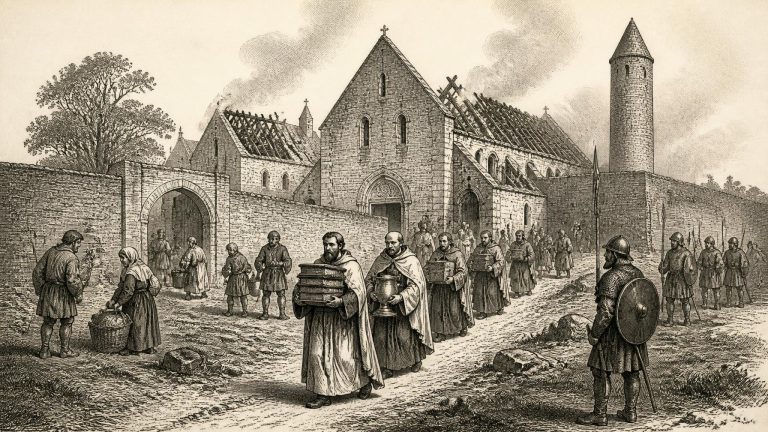
The most immediately striking event was the burning of the house of the Canons Regular of Saints Peter and Paul at Armagh, together with its churches and a substantial part of the surrounding enclosed precinct, or rath. The Annals of Ulster date this firmly to 1196, but do not name those responsible or explain how the fire began. It would therefore be unsafe to attach it to a particular raid or faction. Nonetheless, the destruction was grave. Armagh was both a major religious settlement associated with St Patrick and an important political place in the north. Its churches, clerical community, books, movable treasures, food stores and dependent households would all have been exposed to loss or disruption.
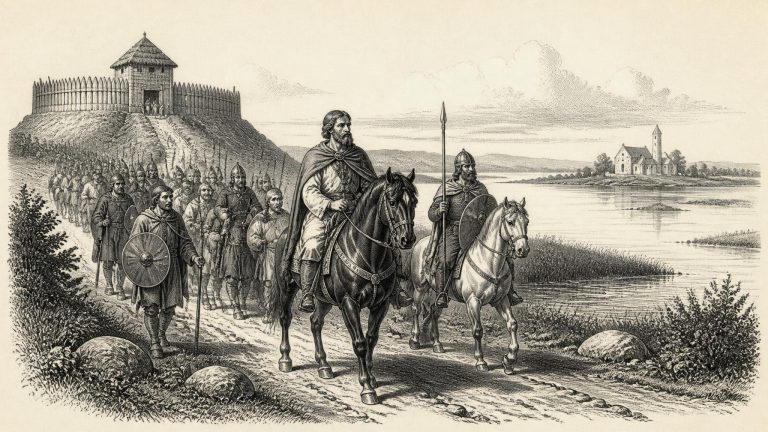
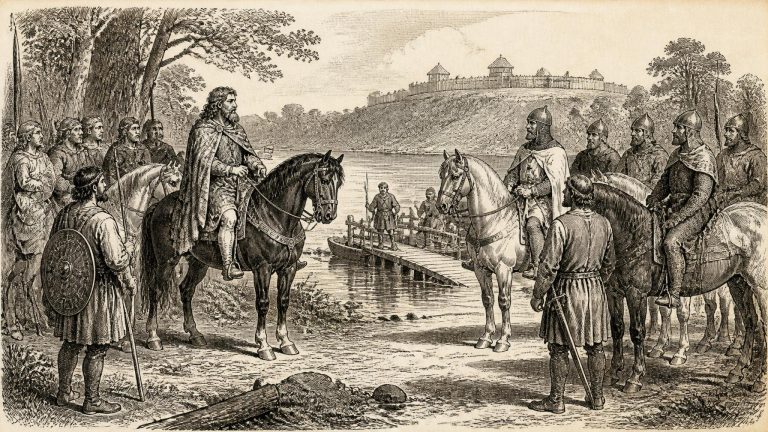
The pivotal development was Cathal Crobderg Ua Conchobair’s intervention beyond Connacht. Cathal was king of Connacht, though his position was neither uncontested nor secure from internal rivals. The Annals of Loch Cé record a great muster at Athlone, a strategic Shannon crossing where Connacht met the lordship’s midland frontier. Cathal reportedly assembled 1,200 men or more. There John de Courcy, Walter de Lacy—the son of Hugh de Lacy—and leading Anglo-Norman nobles came to meet him, and peace was made.
The evidence for 1194 is substantial by contemporary standards, though it needs careful handling. The Annals of Ulster, Annals of Inisfallen, Annals of Loch Cé, Mac Carthaigh’s Book and the later Annals of the Four Masters preserve overlapping but not identical accounts. Their year-numbers do not always align: material placed under 1194 by one compilation can appear a year earlier in another. The safest approach is therefore to treat the principal notices as belonging to the 1194 annalistic horizon, while avoiding invented days, months or sequences where the sources provide none.
The clearest strictly year-dated political news comes from the annals. Eochaidh Ua Baighill was killed by the Uí Fhiachrach of Ard Sratha, in the north-west. Such a terse notice tells us little about the immediate dispute, but it is a reminder that power was exercised and resisted at the level of regional kindreds as well as great kings. In the same year Cathal Odhar, a member of the Mac Carthaigh family of south Munster, was killed by Domhnall Mór Mac Carthaigh. The wording in Mac Carthaigh’s Book calls the killing treacherous, signalling not simply warfare but a bitter conflict within a ruling family.
On 15 May, John issued a substantial charter to the citizens of Dublin. It was addressed in deliberately broad terms to his French, English, Irish and Welsh men and friends, present and future; the privileges themselves, however, belonged to the city’s recognised citizens. The document confirmed the bounds formerly perambulated under Henry II and set out the legal and commercial liberties available within them. It was an important act of written government for the principal town of the English colony in Ireland.
The most substantial narrative assigned to 1191 is Ruaidrí’s journey from Connacht. The Annals of Ulster and Annals of Loch Cé, which preserve a terse common notice, state that he left Connacht and went into Cenél Conaill, the powerful kingdom centred on what is now much of Donegal. The much later Annals of the Four Masters expands this into a striking itinerary: Ruaidrí sought forces first in Tír Chonaill, then in Tír Eógain, from the Ulstermen, from the English of Meath, and finally in Munster. That expanded account says that the northern rulers and the English of Meath declined to help him recover Connacht, while Síl Muiredaig, Ruaidrí’s own wider dynastic community, granted him lands in Tír Fhiachrach and in Cineaál Echtge instead.