Crotty and Enniskillen1987 CE
Dateline
In 1987 Ireland moved through a year of sharp contrasts: a change of government in Dublin, an uncompromising attempt to repair exhausted public finances, a constitutional ruling that reshaped how the State approached European treaties, and terrible violence in Northern Ireland. It was also the year in which a new method of economic bargaining—social partnership—was agreed. None of these developments solved Ireland’s longstanding difficulties at once. Together, however, they marked a decisive change in the political language of the late 1980s: from repeated electoral instability and fiscal crisis towards restraint, negotiation and an increasingly European frame of reference.
An Election After Collapse
The immediate political setting was the fall of Garret FitzGerald’s Fine Gael–Labour coalition. On 20 January, Labour ministers would not support the government’s proposed budget, particularly its projected cuts in health and social welfare. The Dáil was dissolved the following day. This was the fourth general election of the 1980s, a frequency which conveyed the fragility of government in a decade defined by recession, debt and emigration.
Polling took place on 17 February. Fianna Fáil, led by Charles J. Haughey, emerged as the largest party with 81 of the 166 seats, but fell short of an overall majority. Fine Gael was reduced to 51 seats; Labour won 12. The striking electoral newcomer was the Progressive Democrats, established only in 1985 by former Fianna Fáil figures led by Desmond O’Malley. With 14 TDs, the party became the third-largest force in the Dáil and gave organised expression to a liberal, economically reforming alternative to the two dominant parties. Turnout was high, at about 76 per cent, an indication that the election was understood as a consequential verdict on hard economic choices.
On 10 March Haughey was elected Taoiseach by a single vote and formed a Fianna Fáil minority government. The narrowness of that parliamentary arithmetic mattered. Ministers could not assume that legislation would pass simply through party discipline; they required either acquiescence or support from opponents and independents. FitzGerald resigned the Fine Gael leadership on 11 March, and Alan Dukes succeeded him later that month. The change gave Fine Gael an opportunity to reconsider how an opposition party should respond to a government confronting a national fiscal emergency.
The Cost of Fiscal Repair
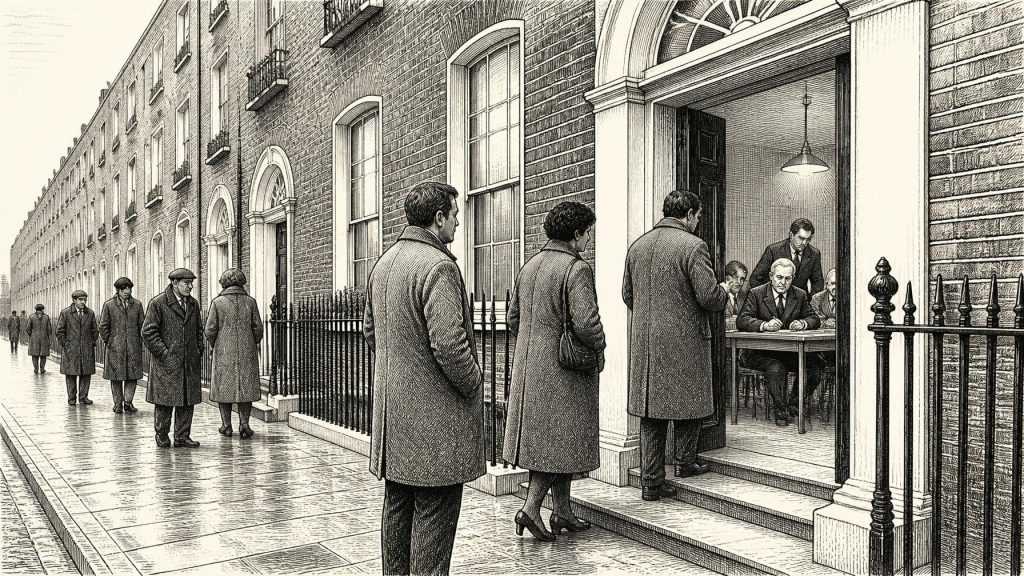
For many households, the governing fact of 1987 was not a change of party but economic insecurity. The State faced exceptionally heavy borrowing and debt-servicing burdens, while unemployment remained painfully high. Central Statistics Office series place the annual average number unemployed on the International Labour Organization measure at 226,000 in 1987, against employment of just over 1.11 million. Such totals do not capture every personal circumstance, but they help explain the atmosphere of anxiety surrounding work, mortgages, public services and the prospect of leaving Ireland to find employment elsewhere.
Ray MacSharry, the new Minister for Finance, presented the Fianna Fáil government’s first budget on 31 March. Its central proposition was stark: there was no room for “soft options”. The budget sought lower borrowing and tighter control of public expenditure, while arguing that the recovery of productive activity and employment required restored confidence and lower interest rates. The measures included reductions or curtailments in public programmes, affecting areas such as housing, education, health and social provision. The hardship and political controversy generated by such decisions were real; fiscal repair was not an abstract exercise when it altered services on which people depended.
Yet the year also produced a new attempt to secure consent for restraint rather than impose it through a succession of confrontations. On 9 October the government, employers, trade unions and farming organisations announced the Programme for National Recovery, intended to cover 1988–90. The agreement linked moderate centrally negotiated pay increases to tax changes and wider objectives: tackling public-finance imbalance, improving competitiveness, developing employment and addressing social equity. Its provisions belonged mainly to the years ahead, so it should not be treated as an instant economic turnaround in 1987. Its importance within the calendar year was institutional. After a period in which national wage agreements had broken down, leading interests accepted a shared framework for bargaining.
This was the beginning of what became known as social partnership. It did not remove disagreement between unions, employers, farmers and government, nor did it spare people from the immediate effects of cuts. But the October settlement introduced a political habit of structured negotiation which would influence Irish economic policy for more than two decades. In the short term, it also helped a minority government present discipline not simply as a ministerial decree but as a national programme.
Crotty and the European Question
Europe became an unusually direct constitutional question in the spring. Ireland had joined the European Economic Community in 1973, and the Single European Act aimed to deepen Community cooperation and advance the completion of the internal market. The government initially intended to ratify it under the existing constitutional authority for European membership. Raymond Crotty, a farmer and campaigner, challenged that course in the courts.
The Supreme Court’s decision in Crotty v An Taoiseach, delivered in April, distinguished between elements of the Act. The Court held that the foreign-policy cooperation provisions went beyond what the Constitution already authorised and that the people’s approval was required before Ireland could ratify them. The judgment was a major assertion of constitutional limits upon the executive conduct of foreign relations. It did not amount to a rejection of European integration. Rather, it established that further significant commitments could require direct popular consent through constitutional amendment.
A referendum followed on 26 May, and voters approved the Tenth Amendment. Signed into law on 22 June, it expressly permitted the State to ratify the Single European Act. The sequence from litigation to referendum was compressed, but its consequences were enduring. Future European treaties would be examined not merely as diplomatic texts but also as potential constitutional questions. In 1987, the electorate reaffirmed Ireland’s European direction while the courts clarified the democratic procedure through which that direction must sometimes be authorised.
Conflict Across the Border
Northern Ireland remained a central concern for the State, both because of the human cost of the conflict and because the Anglo-Irish Agreement of 1985 had formally given the Irish government a consultative role in Northern Ireland affairs. The Agreement’s Intergovernmental Conference continued to meet; a conference meeting in London is documented for 16 July 1987. Its existence was resisted intensely by unionism, which objected to any formal role for Dublin in the governance of Northern Ireland. Unionist protest continued throughout the year, while efforts to move the principal constitutional parties towards dialogue made little immediate headway.
The violence of 1987 demonstrated how remote a political settlement still seemed. On 8 May, an IRA unit attacked the Royal Ulster Constabulary station at Loughgall, County Armagh, and was ambushed by the Special Air Service. Eight IRA members and a civilian were killed. The incident was the IRA’s greatest single loss of life during the Troubles and intensified arguments over security policy, intelligence and accountability. It also illustrated the local danger of militarised conflict: the civilian victim had driven into the village as the operation unfolded.
On 1 November French authorities intercepted the Eksund, carrying a large consignment of arms intended for the IRA. A week later came a calamity whose impact travelled far beyond County Fermanagh. On 8 November an IRA bomb exploded beside the war memorial in Enniskillen shortly before the town’s Remembrance Sunday ceremony. Eleven people were killed and 63 injured, many seriously. The dead included three married couples and Marie Wilson, aged 20, whose father Gordon was injured beside her.
The choice of a civic commemoration, attended largely by local people honouring war dead, made the attack especially devastating. It was an atrocity against civilians, not an outcome that could be explained away by the wider political dispute. Gordon Wilson’s public words after his daughter’s death, in which he spoke of forgiveness, became one of the most remembered personal responses to the violence. On 22 November, Margaret Thatcher attended a memorial service in Enniskillen alongside thousands of people. The bombing hardened revulsion at paramilitary violence while underlining the human stakes of British-Irish cooperation.
Culture, Memory and Public Life
Irish cultural life in 1987 offered contrasting forms of public expression. On 9 May, Johnny Logan won the Eurovision Song Contest in Brussels with the self-written “Hold Me Now”. Having previously won for Ireland as a singer in 1980, he became the first performer to win the contest twice. The result was a modest but vivid moment of international visibility, shared through television and popular music at a time when much public news was dominated by unemployment and conflict.
That same year Seamus Heaney published The Haw Lantern. The collection ranged through loss, conscience, language and public responsibility, including the “Clearances” sonnets written after his mother’s death. Heaney’s work cannot be reduced to a commentary on current events, but its publication belongs firmly to 1987 and spoke to a society in which private memory, political violence and questions of moral witness were closely entangled.
By year’s end, Ireland had not escaped its economic or constitutional pressures, and Northern Ireland had endured another dreadful round of bereavement. Still, 1987 left behind more than crisis. The Crotty judgment placed popular sovereignty at the centre of European treaty change; the Programme for National Recovery offered a new mechanism for managing economic conflict; and the events at Loughgall and Enniskillen made the failure of violence painfully plain. It was a year in which institutions, voters and ordinary communities were forced to reckon with difficult choices—and in which the consequences of those choices would extend far beyond December.
Primary Sources
- Ireland: Dates of Elections, 17 February 1987 (Dáil Éireann)
- Dáil and Seanad Terms
- General Election 1987
- Financial Resolutions, 1987: Financial Statement, Budget, 1987
- Labour Market
- Labour Market: Ireland and the EU at 50
- Crotty v. An Taoiseach [1987] IESC 3
- Judgment of the Supreme Court of Ireland, ‘Crotty v. An Taoiseach’ (9 April 1987)
- Constitution of Ireland
- Tenth Amendment of the Constitution Act, 1987
- Programme for National Recovery
- A Strategy for Development 1986–1990
- Economic and Social Development 1986–1990
- Appendix 1: The Social Partnership Programmes, 1987–2009
- Agreement between the Government of Ireland and the Government of the United Kingdom, Hillsborough, 15 November 1985 (Anglo-Irish Agreement)
- Ireland Through the Decades
- National Archives, Ireland: Records on the CAIN Web Site
- CAIN: Chronology of the Conflict 1987
- Monthly Security Report for Northern Ireland and Border Areas, 4 December 1987
- CAIN: Victims—Memorials, 1987
- CAIN: Enniskillen Bomb Memorial
- Johnny Logan: Ireland, Brussels 1987
- Hold Me Now: Johnny Logan
- The Haw Lantern
- The Haw Lantern / Seamus Heaney