Granard, Henry Street and Howth1984 CE
In 1984, recession, unemployment and industrial closures, including Ford Cork and Irish Shipping, shaped Irish life, while DART and the East-Link bridge improved Dublin transport. The New Ireland Forum developed a shared nationalist approach to Northern Ireland, although Thatcher rejected its options and violence continued, notably the Brighton bombing and supergrass case collapses. Reagan’s visit prompted both celebration and protest. Ann Lovett’s death in Granard and the Kerry babies investigation exposed harsh attitudes and institutional failings affecting unmarried pregnant women. Dunnes Stores workers began an anti-apartheid strike, while the GAA centenary provided a significant cultural celebration in Thurles that year.
Dateline
In 1984, Ireland’s public life was marked by sharply contrasting places: a rural Marian grotto outside Granard, a supermarket checkout on Henry Street, new electric trains running beside Dublin Bay, and negotiating rooms in Dublin and London concerned with Northern Ireland. The Republic remained in a difficult recession, while violence continued to shape lives in the North and Irish–British diplomacy. Yet the year also exposed social assumptions that had long gone unchallenged and displayed forms of civic action that reached far beyond the island.
A Political Agenda for the North
The year’s central constitutional development came on 2 May, when the New Ireland Forum issued its report. Convened by Taoiseach Garret FitzGerald, the Forum had brought together Fine Gael, Labour, Fianna Fáil and the SDLP to consider how lasting peace and stability might be achieved democratically. Unionist parties had declined to participate, an absence that set clear limits on its reach; nevertheless, the report represented an unusual degree of agreement among constitutional nationalists north and south of the border.
It identified the alienation of Northern nationalists as a fundamental political fact and argued that any settlement had to respect both Irish nationalist and unionist identities. Its preferred outcome was a unitary Irish state, but it also outlined federal or confederal arrangements and joint authority or joint sovereignty as possible constitutional structures. The importance of the document in 1984 lay less in an expectation that one of these designs would swiftly be enacted than in its creation of a shared nationalist agenda. It shifted discussion away from a purely internal Northern Ireland question and towards the institutional relationship between the Irish and British governments.
FitzGerald’s government took that agenda into its contacts with London. The immediate results were frustrating. At a Chequers summit on 19 November, Margaret Thatcher rejected the Forum’s three constitutional options in language remembered for its emphatic sequence of refusals. The meeting did not produce an agreement. Still, the Forum, the summit and the continuing official exchanges were firmly part of the diplomatic process that would lead, not in 1984 but the following year, to the Anglo-Irish Agreement. That later outcome should not obscure the uncertainty of the moment: no settlement was in sight, and neither government had bridged the profound distrust of unionism.
Violence made that uncertainty impossible to ignore. On 12 October, the Provisional IRA bombed the Grand Hotel in Brighton during the Conservative Party conference, killing five people and narrowly missing Thatcher. The attack occurred in England, but it was inseparable from the conflict over Northern Ireland and placed the Irish question before an international audience in a particularly destructive form. In Northern Ireland itself, killings by republican paramilitaries, loyalist paramilitaries and state forces continued. December also saw the collapse of major prosecutions based on the evidence of republican informer Raymond Gilmour: cases against 35 people from Derry, involving 180 charges, were dropped after many defendants had spent more than two years in custody. The episode intensified criticism of the non-jury ‘supergrass’ trial system in both Northern Ireland and the Republic.
Reagan’s Welcome and Opposition
United States President Ronald Reagan made a four-day visit to Ireland from 1 to 4 June. It combined state ceremony, diaspora symbolism and political controversy. Reagan arrived at Shannon, spent time in the west, received an honorary degree at University College Galway, and on 3 June visited Ballyporeen, County Tipperary, the community associated with his ancestral family. Thousands turned out for the visit, which gave a small rural village an extraordinary international prominence. Traditional music and dancing, genealogical interest and the rhetoric of Irish-American kinship supplied the most visible imagery.
But the visit did not command universal enthusiasm. Demonstrations in Dublin opposed Reagan’s foreign policy, particularly US military policies and Washington’s stance towards conflicts in Central America and elsewhere. Religious activists, left-wing campaigners and other citizens appeared among the protesters. Their presence is a useful corrective to any simple image of an uncomplicated homecoming. On 4 June Reagan addressed a joint session of the Oireachtas before leaving for London. His visit showed both the continuing importance of American connections to Irish political culture and a growing willingness among Irish people to contest American power publicly.
Granard and Kerry
The most searing domestic events of the year concerned pregnancy, secrecy and the treatment of unmarried women. On 31 January, Ann Lovett, a fifteen-year-old schoolgirl from Granard, County Longford, died after giving birth beside a grotto near the town. Her baby boy was stillborn. The circumstances in which she laboured alone, and the speed with which intense media scrutiny descended on Granard, horrified the country. The tragedy exposed the isolation that could surround teenage pregnancy in a society where sexual knowledge, family reputation, religion and fear of public shame were deeply entangled.
It is important not to portray 1984 as an instant turning point, or to impose a single explanation upon Ann Lovett’s death. Her family and community endured intrusive attention, while public debate often revealed as much about wider Irish anxieties as it did about the private facts of her life. Yet the event became a lasting symbol of the inadequacy of support available to vulnerable young women and of the silence that could attend pregnancy outside marriage.
In April, the discovery of the body of a newborn boy at White Strand near Cahersiveen, County Kerry, began another case that exposed grave weaknesses in public institutions. Joanne Hayes of Abbeydorney was arrested and charged with murder on 1 May after Garda questioning. A second dead infant, Hayes’s own child, was then found on the family farm; the two babies had different blood groups, and the charges against Hayes and her family were dropped. A tribunal of inquiry was established later in the year. Its proceedings and findings belonged principally to 1985, so they should not be folded into the events of 1984. What can firmly be said is that the investigation already raised profound questions about Garda methods, confession evidence and the assumptions directed at an unmarried pregnant woman.
Work, Recession and New Connections
Economic insecurity remained a daily reality. The OECD described persistent macroeconomic imbalances, weak growth and unemployment above 14 per cent of the labour force. Government ministers argued for restraint in public spending and pay, while households faced joblessness, emigration and high taxation. These were not merely abstract indicators: they shaped decisions about leaving Ireland, delaying household formation and seeking precarious work.
Cork felt the industrial strain particularly sharply. Ford announced on 17 January that its Cork car-assembly plant would close, and production ended on 13 July. The closure cost about 800 jobs at a factory that had been part of the city’s industrial landscape since 1917. Ford attributed the decision to a depressed car market and to the plant’s inability to compete with larger continental operations after import restrictions were lifted. Irish Shipping, the State company created during the Second World War to secure vital sea transport, was also placed in liquidation during the year. Together, such failures underlined the exposure of an open, small economy to international competition and heavy borrowing costs.
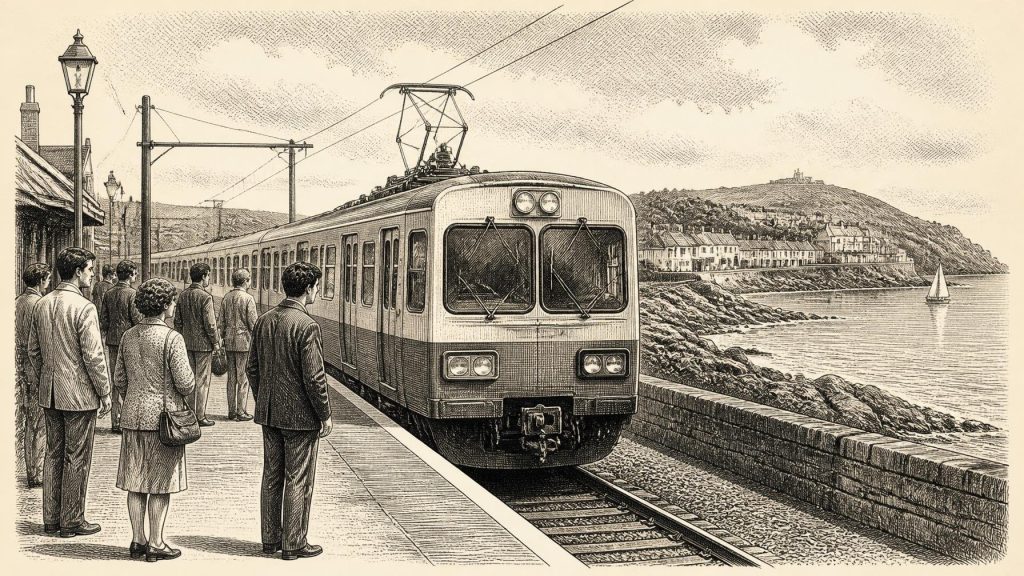
Yet 1984 also brought conspicuous improvements to Dublin’s physical connections. On 23 July, DART services began operating between Howth and Bray. Electrification made the old coastal railway a modern suburban line and offered a new daily routine to commuters travelling through the city’s growing eastern suburbs. On 22 October, the East-Link toll bridge opened across the Liffey between North Wall and Ringsend, replacing a ferry connection and creating the State’s first toll bridge. With a 30p charge for cars, it also introduced a practical reminder that new infrastructure could be paid for directly by its users. Neither project erased recession, but both altered the geography of movement in the capital.
Henry Street and International Solidarity
On 19 July, a local workplace dispute acquired international significance. Mary Manning, a twenty-one-year-old checkout operator in Dunnes Stores on Henry Street, refused to handle South African grapefruit in accordance with an instruction from the Irish Distributive and Administrative Trade Union. She was suspended. Nine colleagues, including shop steward Karen Gearon, walked out in support and began a picket.
The strike was only beginning in 1984; its eventual duration and political consequences lay in the future. At that point the immediate issue was whether low-paid retail workers could be disciplined for refusing to deal in goods associated with apartheid South Africa. The picket made an ethical question visible in one of Dublin’s busiest shopping streets. It linked Irish trade unionism, anti-racist activism and the international anti-apartheid movement, while also showing the personal cost borne by workers who turned a union instruction into a sustained act of conscience.
Centenary, Sport and Public Culture
Sport supplied a more celebratory national marker. The Gaelic Athletic Association marked the centenary of its foundation at Hayes’s Hotel, Thurles, on 1 November 1884. The centenary All-Ireland hurling final was accordingly played in Thurles rather than Croke Park, bringing the championship’s culminating occasion back to the town where the Association had begun. Cork defeated Offaly. The anniversary invited reflection on the GAA’s formidable role in parish life, voluntary organisation and the cultivation of Irish games, even as its members lived through the economic and political pressures of the 1980s.
Thus 1984 cannot be reduced to either bleakness or renewal. It was a year of recession and unresolved conflict, but also of new transport, international engagement and public challenge to old certainties. The Forum sought a democratic route through the Northern conflict; the tragedies in Granard and Kerry unsettled assumptions about authority and care; and the Dunnes strikers demonstrated that a small group of Dublin workers could connect an Irish street directly to a global struggle for equality.
Primary Sources
- CAIN: Chronology of the Conflict 1984
- Background Note on the Report of the New Ireland Forum
- Estimates, 1984: Vote 3, Department of the Taoiseach
- Extracts from Transcript of Press Conference with Margaret Thatcher Following an Anglo-Irish Summit, London, 19 November 1984
- CAIN: Sutton Index of Deaths, 1984
- President Ronald Reagan and Ireland
- Public Papers of Ronald Reagan: June 1984
- President Ronald Reagan Visits Ancestral Home In Ballyporeen 1984
- Protest At Ronald Reagan Visit 1984
- Tragic Death of Ann Lovett 1984
- Lovett, Ann
- Dead Baby Boy Discovered 1984
- State Papers: What We Have Learned
- Dunnes Stores Workers Against Apartheid
- Doing Something About Apartheid 1984
- OECD Economic Surveys: Ireland 1984
- OECD Economic Surveys: Ireland 1984 (PDF)
- Cork Ford Plant Closure 1984
- Report No. 02: Irish Shipping Limited
- The DART is 40!
- New Toll Bridge Opens 1984
- Timeline 1945-2015
- GAA History: Timeline 1884-1945
- National Results: Ireland, 1984-1989 Constitutive Session