Hillsborough’s Uneasy Promise1985 CE
Dateline
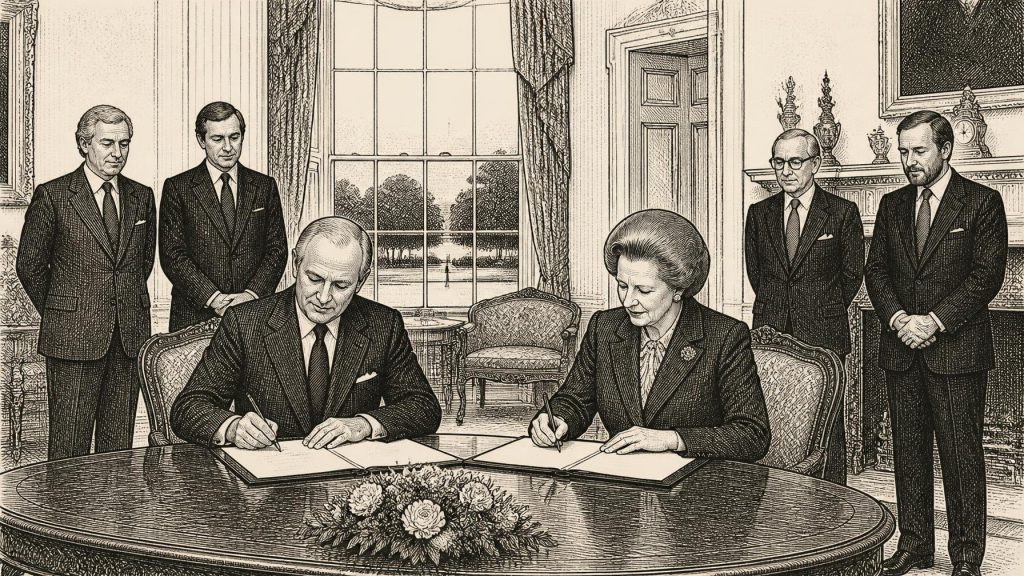
In 1985, Irish political life was shaped above all by the effort to turn a violent and apparently immovable Northern Ireland conflict into a matter of sustained diplomacy. The year did not bring peace: killings, bomb attacks and communal confrontation continued across the North and touched the Republic. Yet on 15 November, at Hillsborough Castle in County Down, Taoiseach Garret FitzGerald and British Prime Minister Margaret Thatcher signed the Anglo-Irish Agreement. It was a limited and controversial settlement rather than a constitutional transformation, but it established a formal Irish governmental role in Northern Ireland affairs for the first time since partition. That made 1985 a consequential year in the long, uneven passage towards the later peace process.
The Hillsborough Agreement
The Agreement’s central political fact was carefully framed. Britain confirmed that Northern Ireland’s constitutional position would not change without the consent of a majority of its people. Ireland, in return, gained a permanent channel through which to express views on political, legal, security and cross-border matters. An Anglo-Irish Intergovernmental Conference, supported by a secretariat based at Maryfield near Belfast, was to meet regularly. In areas where Northern Ireland lacked devolved government, Dublin could make proposals and put forward its concerns, especially on policies affecting the nationalist minority.
These provisions fell far short of Irish unity, and they did not give the Irish Government executive authority in Northern Ireland. Their importance lay instead in recognition: London accepted that the Government in Dublin had a legitimate and continuing interest in the governance of the North. The agreement also committed both governments to work for improved security co-operation, fair administration, respect for both identities and political arrangements acceptable to the communities of Northern Ireland. It entered into force on 29 November, while the first meeting of the new Intergovernmental Conference followed on 11 December.
The diplomacy had roots in earlier initiatives, notably the New Ireland Forum of 1983–84, and in the close working relationship between FitzGerald and Tánaiste and Minister for Foreign Affairs Dick Spring. Its immediate setting was more severe. The Troubles had shown that security policy alone could not settle the constitutional dispute, while nationalist alienation from the institutions of Northern Ireland remained profound. The agreement offered constitutional nationalists, particularly the SDLP led by John Hume, evidence that peaceful politics and Irish-British negotiation could achieve something tangible. It did not resolve the conflict; it changed the framework within which its political claims were argued.
The reaction demonstrated its limits. Unionist leaders James Molyneaux and Ian Paisley regarded the arrangement as an unacceptable Dublin intrusion into the affairs of a part of the United Kingdom. Large protests followed in Belfast, and unionist-controlled district councils adopted adjournment and boycott tactics. The Northern Ireland Assembly became a further arena of protest. In the Republic, Charles Haughey’s Fianna Fáil opposed the agreement, arguing that it entrenched partition and had been inadequately negotiated; nevertheless, the Dáil approved it on 21 November by 88 votes to 75. The parliamentary division showed that Hillsborough had remade political alignments in Dublin as well as in Belfast.
Violence and Political Stalemate
Diplomacy unfolded amid lethal violence. On 28 February the Provisional IRA fired homemade mortars at the RUC station in Newry, killing nine police officers and injuring many others. It was the RUC’s greatest single loss of life during the conflict. Other attacks during the year underlined the precariousness of daily life in Northern Ireland: an IRA bomb killed an RUC officer and a civilian worker at Newry courthouse in April; four RUC officers were killed by a bomb at Killeen, County Down, in May; and paramilitary violence also reached the Republic. On 27 June Sergeant Patrick Morrissey of the Garda Síochána was shot dead during a post-office robbery in Ardee, County Louth, attributed to the INLA.
Street politics exposed a further source of instability. In Portadown, disputes over Orange Order parade routes through or near Catholic districts led to protests, policing operations and serious disorder in July. Such confrontations were not simply local disputes about roads. They expressed rival claims to public space, history and authority in a divided town. Meanwhile, Sinn Féin’s growing electoral presence complicated the constitutional landscape. In the Northern Ireland district council elections of 15 May it won 11.8 per cent of the vote and 59 seats. On 2 November its Ard Fheis voted to end the party’s refusal in principle to take seats in Dáil Éireann, should it win them. The decision did not end abstentionism at Westminster or Stormont, but it marked a significant reassessment of electoral strategy.
A Hard Republic
For many people in the Republic, the North’s constitutional drama was experienced alongside a severe economic squeeze. Official retrospective figures put average unemployment in 1985 at about 16.7 per cent, with roughly 219,600 people unemployed. Long-term unemployment was a particularly damaging feature: the OECD noted that more than two-fifths of those unemployed in late 1984 had been out of work for over a year. Emigration remained an anticipated safety valve in economic planning, but also a personal reality for households whose children and siblings sought work in Britain, North America and elsewhere. The Fine Gael–Labour coalition governed under the pressure of high public borrowing, weak job creation and the need to restore confidence in the public finances.
That bleak setting helps explain the significance of a political rupture within Fianna Fáil. Desmond O’Malley was expelled from the party on 25 February after refusing to support its opposition to liberalised contraception legislation. On 21 December he and Mary Harney launched the Progressive Democrats from offices on South Frederick Street, Dublin. Its arrival did not immediately displace the established parties, but it challenged the Civil War party system and joined arguments about economic reform, enterprise, personal liberty and the role of the State. The party’s foundation belonged firmly to 1985, even if its later influence lay ahead.
Contraception and Conscience
Social change was also recorded in statute. The Health (Family Planning) (Amendment) Act became law on 12 March and came into operation on 1 October. It permitted the sale of condoms and spermicides, without a medical prescription, to people over eighteen through specified outlets including pharmacists, doctors, health institutions and family-planning services. The measure was modest by later standards: it retained restrictions on where contraceptives could be sold and did not create unrestricted retail access. But it dismantled an especially conspicuous feature of the 1979 law, under which access had been tied to a prescription and an asserted need for family planning.
The parliamentary arguments were unusually revealing. Supporters said law should meet the practical realities of adult life, prevent unwanted pregnancy and reduce the need for Irish women to travel abroad for abortion. Opponents, including vocal Catholic campaigners and politicians, feared a weakening of sexual morality, family life and parental authority. Catholicism remained central to public culture, yet the controversy showed that church teaching could no longer settle legislative questions without sustained challenge. The same year gave a very different illustration of popular religious feeling. From 22 July, claims that a Marian statue moved at Ballinspittle, County Cork, attracted pilgrims and sceptics alike; reports of similar phenomena spread to many places. The Church counselled caution, while the crowds made the summer’s ‘moving statues’ a striking episode of belief, media attention and debate.
Stages, Stadiums and Memory
Cultural life offered spaces in which Irish identities could be reimagined. On 18 February, Frank McGuinness’s Observe the Sons of Ulster Marching Towards the Somme premiered at the Peacock Theatre in Dublin. Its focus on eight Ulster Protestant volunteers and the First World War brought unionist experience to a major Dublin stage with unusual seriousness. In a year increasingly defined by negotiations over the North, the play mattered because it asked southern audiences to encounter an inheritance often treated as foreign or hostile. It did not supply a political solution, but it enlarged the imaginative ground on which one might be sought.
Mass gatherings projected a different confidence. U2 played before more than 50,000 people at Croke Park on 29 June, the stadium’s first major rock concert. Its scale reflected the band’s international rise and the widening role of Dublin as a venue for global popular culture. Cork, meanwhile, mounted year-long ‘Cork 800’ celebrations, marking eight centuries since the city’s traditional charter date of 1185. The anniversary was historically approximate—the original charter’s precise date is uncertain—but the celebrations were real: exhibitions, sporting events and civic occasions used the medieval port’s past to assert local identity during difficult economic times.
Thus 1985 cannot be reduced to Hillsborough, important as it was. The agreement was the year’s defining political development, born of conflict and immediately resisted by many whom it most directly affected. Around it were unemployment and emigration, changes in personal law, intense religious expression, new party formation and energetic cultural life. Ireland ended the year neither reconciled nor prosperous. It had, however, acquired a new diplomatic structure for addressing the Northern conflict, while its society continued to test the authority of older political, religious and cultural certainties.
Primary Sources
- Agreement between the Government of Ireland and the Government of the United Kingdom, Hillsborough, 15 November 1985 (Anglo-Irish Agreement)
- National Archives Displays Original Anglo-Irish Agreement at 40th Anniversary Event
- CAIN: Chronology of the Conflict, 1985
- Anglo-Irish Agreement: The Northern Ireland Assembly 1982–1986
- John Hume’s House of Commons Speech on the Anglo-Irish Agreement, 26 November 1985
- Anglo-Irish Agreement: Details of Source Material
- Health (Family Planning) (Amendment) Act, 1985
- Health (Family Planning) (Amendment) Act 1985: Commencement Information
- Health (Family Planning) (Amendment) Bill, 1985: Second Stage (Resumed), Seanad Éireann
- Social Sustainable Development Indicators Ireland 2017: Unemployment Rate 1985–2016
- Statistical Yearbook of Ireland 2012
- OECD Economic Surveys: Ireland 1985
- Party History
- Moving Statues in Ballinspittle
- Miracle at Ballinspittle
- Scannal: Tubaiste Air India
- Observe the Sons of Ulster Marching towards the Somme
- U2 Croke Park Debut 1985
- 1985: Reeling in the Years
- Cork 800 Maritime Exhibition Catalogue (SM994)
- Cork Past and Present
- Annual Release of Records of State
- District Council Elections, May 1985: PRONI Record