
Castlepook’s Reindeer Trail
Around 31,798 BCE, Ireland formed part of a changing Late Pleistocene landscape, with fluctuating ice, lower seas and intermittently exposed cold, open terrain. Evidence is regional and uncertain, since later glaciation destroyed or disturbed much of the record. Castlepook Cave in County Cork yielded reindeer, hyaena, bear, fox, hare, lemming and mammoth remains, accumulated at different times through natural and animal processes. A reindeer leg bone, dated roughly 33,000 years ago, bears a possible stone-tool cut mark, suggesting human activity. It cannot prove settlement, population continuity or social life. Castlepook instead highlights Ireland’s Ice-Age fauna and evidence for Palaeolithic visitors.
View Record
Maguirebridge’s Buried Wetland
Although 31,799 BCE is an artificial precise label, it denotes later Marine Isotope Stage 3, when parts of Ireland were ice-free before the Last Glacial Maximum. At Derryvree near Maguiresbridge, freshwater silts sealed between glacial tills, radiocarbon dated broadly to 36,900–31,700 calibrated years BP, reveal cold open tundra, wetlands and periglacial conditions. Southern caves preserve remains of mammoth, reindeer, giant deer and predators, though mixed deposits cannot provide a single-time census. A possibly tool-marked Castlepook reindeer bone suggests an early human visit, not settlement. Subsequent British–Irish Ice Sheet expansion transformed and obscured these fragile prehistoric landscapes over the following millennia.
View Record
Trifoliate Seed Beneath a Drumlin
Circa 31,800 BCE, Ireland lay within the climatically unstable Marine Isotope Stage 3, not a precisely datable historical year. Calibrated evidence from Derryvree, County Fermanagh, records freshwater tundra sediments, including bogbean, between glacial tills, showing locally ice-free, periglacial conditions before later ice expansion. Cave and speleothem records indicate shifting cold environments and intermittent habitats for mammoth, reindeer, giant deer, carnivores and other fauna. A cut-marked Castlepook reindeer bone may suggest a brief Upper Palaeolithic visit, but disturbed context prevents confirmation. No secure evidence supports permanent human settlement, society, culture or political life. Ireland remained an ecologically demanding Ice Age fringe.
View Record
Fermanagh’s Moss-and-Sedge Archive
Around 31,801 BCE, a retrospective and imprecise calendar conversion, Ireland lay in the unstable later Marine Isotope Stage 3. At Derryvree, County Fermanagh, organic sediments between tills preserve mosses, sedges and cold-climate insects, indicating open tundra, freshwater hollows and periglacial conditions between ice advances. Related deposits confirm intermittent non-glacial environments, not island-wide conditions. Castlepook Cave, County Cork, contains mixed MIS 3 fauna including mammoth, reindeer, hyaena and bear. A cut-marked reindeer femur may indicate human carcass processing, but cannot prove settlement. Approaching major ice expansion, Ireland’s record remains environmental, fragmentary and cautiously interpreted, with chronology expressed through broad calibrated ranges.
View Record
The Maguiresbridge Silts
Around 31,802 BCE, Ireland lay within the climatically unstable Marine Isotope Stage 3, not a date capable of supporting annual history. At Derryvree near Maguiresbridge, freshwater silts, mosses, sedges and Arctic insects between till layers record a cold, treeless, locally ice-free interval. Comparable northern deposits show repeated glacial advances and retreats. Castlepook Cave preserves remains of cold-adapted fauna, including reindeer, giant deer, mammoth and predators, accumulated over varied periods. A possibly tool-marked reindeer bone suggests, but cannot prove, brief human presence. Evidence supports environmental change and animal occupation, while rejecting claims about contemporary Irish society, settlement or continuous human ancestry.
View Record
Castlepook’s Hyena Corridor
Although 31,803 BCE cannot denote a documented Irish event, it falls within MIS 3, before the Last Glacial Maximum. Ireland then experienced unstable cold conditions, with exposed tundra, wetlands and advancing ice rather than uniform glaciation. Derryvree sediments in Fermanagh indicate periglacial vegetation and freshwater habitats. Castlepook Cave, Cork, preserves a long, disturbed fossil record including mammoth, reindeer, giant deer, predators and lemmings, demonstrating access for Ice Age mammals. A marked reindeer femur may indicate brief Upper Palaeolithic butchery, but lacks secure context or supporting artefacts. Evidence supports animal landscapes and possible transient human visits, not settled population or polity.
View Record
A Cut on Cork Bone
Labelled 31,804 BCE, this period falls within unstable Marine Isotope Stage 3, for which only broad calibrated chronologies are defensible. Irish sediments show that some areas were ice-free before the later Last Glacial Maximum, supporting cold, open tundra environments and mobile fauna. Castlepook Cave in County Cork preserves diverse, time-layered Pleistocene animal remains. A reindeer femur, dated broadly to about 33,000 years ago, bears a mark interpreted as stone-tool damage during butchery. If confirmed, it suggests a brief human encounter with a carcass, not settlement. No evidence supports continuous occupation, identities, politics, religion, or culture, while expanding ice transformed Ireland.
View Record
Derryvree’s Muskeg Window
31,805 BCE is a modern label within late Marine Isotope Stage 3, not a date for recoverable Irish events. Ireland experienced unstable glacial conditions, with ice-free areas varying regionally before later ice reshaped evidence. Derryvree’s freshwater sediments, preserved between tills, reveal cold, treeless tundra-like wetlands supporting insects and pools. Southern caves preserve fauna including mammoth, reindeer, giant deer, bear and hyaena, indicating open habitats but complex depositional histories. A possibly cut-marked reindeer bone from Castlepook raises prospects of transient Upper Palaeolithic visitors, yet no settlement or secure human occupation is known. These fragmentary archives demonstrate environmental change, not social history.
View Record
Glenulra’s Shifting Shore
Circa 31,806 BCE, Ireland lay within the climatically unstable Marine Isotope Stage 3, not a precisely datable single year. Ice margins varied regionally: Glenulra records land depression and high local relative sea levels near northern ice, while southern coasts could remain ice-free. Open, largely treeless tundra-steppe supported hardy plants and animals including reindeer, mammoth, hyaena, bears, hares and foxes, evidenced especially in southern caves. A cut-marked Castlepook reindeer femur may indicate episodic human butchery, but cannot demonstrate settlement. Later glaciation destroyed much evidence. The period is best understood as a changing Ice Age landscape, with human presence uncertain and provisional.
View Record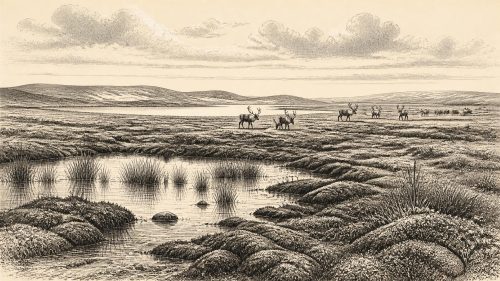
Bogbean Under Derryvree
31,807 BCE is a modern marker within unstable Marine Isotope Stage 3, not a documented Irish year. Derryvree, County Fermanagh, preserves freshwater sediments between glacial tills, dated broadly enough to encompass this period. Bogbean, mosses, sedges, insects and sparse herbs indicate cold, open, wet tundra-like ground during an ice-free interval. Greenagho confirms intermittent freshwater environments, challenging assumptions of continuous ice cover. Castlepook Cave records cold-stage fauna, including reindeer, mammoth, predators and scavengers, but represents successive episodes rather than one community. A possible cut-marked reindeer bone suggests transient Upper Palaeolithic visitors, not settlement. Ireland was a shifting frontier before maximum glaciation.
View Record