
Maguirebridge’s Trifoliate Marsh31373 BCE
At the notional date of 31,373 BCE, Ireland lay within the climatically unstable Late Pleistocene, for which evidence permits only broad ranges rather than annual history. At Derryvree near Maguiresbridge, freshwater organic sediments between tills, radiocarbon dated broadly to this period, demonstrate an ice-free or ice-marginal interval with cold wetlands, bogbean, mountain avens, insects and active water. Castlepook Cave records a diverse cold-climate fauna, including reindeer, mammoth and predators, but mixed deposits prevent a single-date reconstruction. A possibly cut-marked reindeer bone suggests disputed transient Upper Palaeolithic human activity. No evidence supports settlement, farming or society; climate and glaciation reshaped Ireland.
Dateline
“31,373 BCE” is a modern chronological label, not a year that can be recovered from Irish evidence. No calendar, settlement sequence or individual event on the island can be dated at annual resolution so far back. In calendar terms the label sits roughly 33,300 years before AD 1950, during the Late Pleistocene and Marine Isotope Stage 3 (MIS 3), a climatically restless part of the last Ice Age. The responsible history for this point is therefore a history of ranges, sediments and probabilities rather than an annal of named happenings.
The closest particularly informative Irish record is at Derryvree, near Maguiresbridge in County Fermanagh. There, road-cutting in 1969 exposed freshwater silts, fine sands and organic deposits enclosed between two substantial layers of till: debris laid down directly by glacier ice. Organic material from the intervening deposit produced the radiocarbon determination BIRM-166, conventionally dated to 30,500 ± 1,100 radiocarbon years before present. Calibration does not turn that measurement into a single date. Using modern radiocarbon calibration, it is generally expressed as a broad range of approximately 36,900–31,700 calendar years before present, or about 34,950–29,750 BCE. The nominated year falls within that span, but it cannot be assigned to a particular season, pool, animal or human action.
A Freshwater Interval Between Glaciers
Derryvree’s value lies in its sequence. A glacier crossed the ground and laid down the lower till. Afterwards, at least locally, conditions permitted fresh water, fine sediment, vegetation and animal remains to accumulate. A later ice advance overrode and sealed the deposits beneath a further till sheet. That order of layers gives unusually direct evidence that northern Ireland’s last Ice Age was not one uninterrupted blanketing of ice. It alternated between glacial advances and ice-free or ice-marginal intervals, although the dating and exact extent of each phase remain subjects of scientific reconstruction.
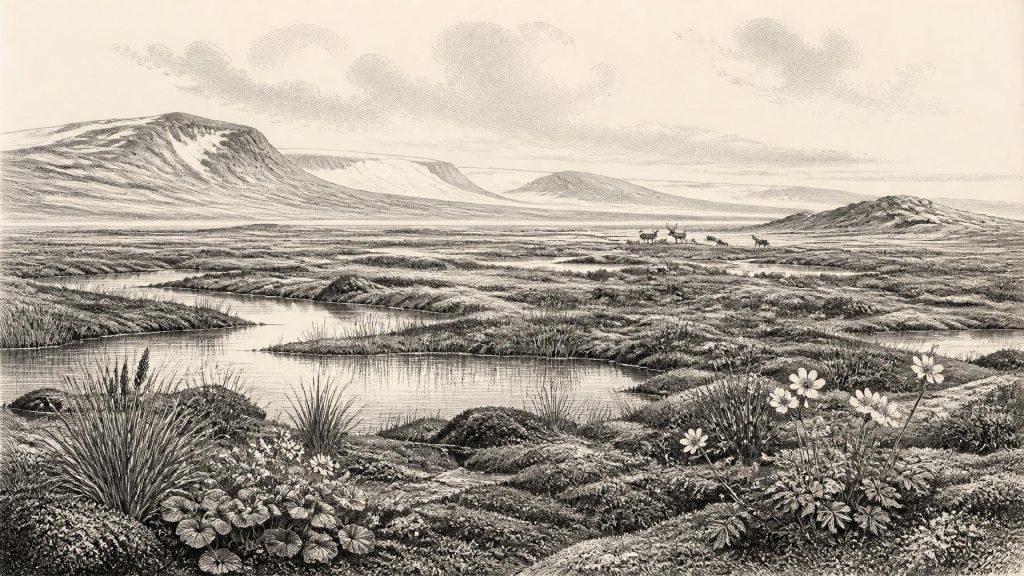
The Derryvree deposits record an open, cold and waterlogged landscape, often described as periglacial tundra or muskeg. Periglacial does not mean permanently ice-covered: it denotes ground strongly shaped by frost, freezing and thawing in a severe climate close to glacial conditions. The setting would have had shallow pools, saturated hollows and soft organic margins rather than woodland, hedgerows or fields. Fossil pollen, plant macrofossils, mosses and insects preserve evidence of that living ground. A seed of bogbean, Menyanthes trifoliata, and remains of mountain avens, Dryas octopetala, are among the striking indicators of cold-adapted wetland and open-ground vegetation.
Those remains provide evidence, not a complete landscape painting. They show that plants capable of surviving short growing seasons grew near freshwater at Derryvree; they do not establish the precise density of vegetation across all Fermanagh, nor the weather in 31,373 BCE itself. Nevertheless, they decisively rule out any picture of an entirely sterile, featureless ice desert. In at least this protected interval, water circulated, mud accumulated, plants flowered and invertebrates occupied the margins. The island’s environment was harsh but biologically active.
Cold Country, Changing Coasts
Ireland’s geography was also unlike the familiar modern island. Global sea levels were lower during the last glacial cycle because large quantities of water were stored in continental ice sheets. Yet the precise form of coasts, channels, exposed seabed and ice barriers changed over millennia, while the weight of ice depressed land in some places. It is unsafe to draw a single fixed shoreline for this date, or to presume a simple, dry land bridge linking Ireland to Britain and continental Europe. Animal movements into Ireland show ecological connections with north-west Europe at some points in the Late Pleistocene, but the precise routes and timing of every crossing remain unresolved.
The wider British–Irish Ice Sheet was developing unevenly. Modern reconstructions emphasise that its advance, maximum extent and retreat differed markedly from one sector to another. Around the time represented by Derryvree’s broad range, local ice and ice margins mattered greatly to which valleys remained available to plants and animals. Over the following thousands of years the ice sheet grew into a much more extensive system. Thus the chief regional development around the notional year was environmental instability: a landscape of locally viable wetlands and open ground existed within a longer trajectory towards more formidable glaciation.
Castlepook’s Faunal Evidence
Nearly 300 kilometres to the south-west, Castlepook Cave near Doneraile in County Cork preserves another essential, though difficult, archive. Excavations begun in the early twentieth century recovered an enormous quantity of bone from a complex limestone cave system once known as Mammoth Cave. The assemblage includes remains attributed to reindeer, woolly mammoth, giant deer, brown bear, wolf, foxes, Arctic fox, hare, lemmings and spotted hyaena. It demonstrates that Ice Age Ireland was not ecologically empty. Large grazing animals and formidable carnivores had reached parts of the island during the Middle Midlandian, the older regional term commonly associated with this part of MIS 3.
But Castlepook is not a census of one year or one valley. Cave deposits were accumulated by carnivores, water movement and other natural processes, then disturbed by early excavation. Bones of different ages can be mixed together, and a named species in the collection need not have lived alongside every other species listed. Radiocarbon dates on selected bones broadly place important elements of the fauna tens of thousands of years ago, while later research has shown why older dates and associations require careful reassessment. Castlepook can securely illuminate the kind of animal world available in Irish landscapes during this broad period; it cannot prove that every animal named was alive in 31,373 BCE.
The fauna does, however, suggest an open-country food web. Reindeer and mammoth depended on extensive plant resources; wolves and hyaenas were predators and scavengers able to exploit carcasses in a demanding environment. Caves could serve as carnivore shelters and places where bones accumulated, rather than as ordinary human homes. Their presence would have made cave entrances consequential places in the landscape: sources of shelter and stone, but also sites of danger, competition and animal activity. This is ecology rather than evidence for a human economy.
The Human Question
Political affairs, diplomacy, organised warfare, religious institutions, literacy, trade and permanent settlement cannot responsibly be described for Ireland at this date. There are no named communities, leaders, monuments, graves, hearths, houses, field systems or securely stratified tool assemblages from the island that establish such things. There was certainly no evidence for farming: agriculture and domesticated livestock arrived in Ireland vastly later, in the Neolithic. Nor can the movements of animals be converted into evidence for Irish trade routes or territorial groups.
There is nevertheless one important, contested possibility. A reindeer femur from Castlepook’s older collections was reported in 2021 as dating to about 33,000 years ago and bearing marks interpreted as cuts or chops from a stone tool. If that interpretation is confirmed, it would indicate that people processed a reindeer carcass in Ireland during the Upper Palaeolithic, dramatically earlier than the long-established evidence for Mesolithic settlement after the Ice Age. It would not demonstrate a continuously occupied island, a village at Castlepook, or an event in this precise numbered year.
Caution is especially necessary because the bone derives from historic excavations rather than a newly excavated, intact occupation surface. The cave’s deposits have complex formation histories, and the distinction between human modification, carnivore damage and later disturbance must be tested closely. Recent excavations have sought undisturbed, stratified Pleistocene deposits in other parts of the cave system, an important effort because context is as valuable as a radiocarbon date. At present, the reindeer bone is best understood as a potentially momentous trace of transient human activity, not as a foundation for a detailed Irish Palaeolithic society.
What Everyday Life Cannot Yet Tell Us
If people did reach Ireland during this interval, their lifeways would have depended on mobility, detailed environmental knowledge and the ability to obtain food in a cold, open landscape. That is an interpretation based on wider Upper Palaeolithic patterns, not direct evidence for a particular Irish group. No Irish object from 31,373 BCE permits historians to reconstruct language, kinship, ritual, clothing, artistic practice or relations between groups. The most honest conclusion is therefore both limited and significant: the evidence shows a changing Irish environment capable, in places and periods, of sustaining wetland vegetation and a diverse cold-climate fauna; it leaves human presence at this depth of time an important but unconfirmed archaeological question.
Derryvree’s buried freshwater bed is the clearest witness to that world. It preserves neither a kingdom nor a calendar year, but a physical record of life between episodes of ice. Its bogbean seed and associated flora remind us that Ireland’s deep past was not simply a prelude to later human history. Long before durable settlements, the island’s terrain, waters, plants and animals were already being repeatedly remade by climate, ice and changing connections across the north-west European world.
Primary Sources
- A Middle Midlandian Freshwater Series at Derryvree, Maguiresbridge, County Fermanagh, Northern Ireland
- The Irish Quaternary Fauna Project
- Growth and Retreat of the Last British–Irish Ice Sheet, 31,000 to 15,000 Years Ago: The BRITICE-CHRONO Reconstruction
- The IntCal20 Northern Hemisphere Radiocarbon Age Calibration Curve (0–55 cal kBP)
- The Colonization of Ireland: A Human Ecology Perspective
- Advances in Irish Quaternary Studies
- Quaternary
- Publications
- Outreach and Education Resources
- BSBI: Menyanthes trifoliata
- BSBI: Dryas octopetala
- Pleistocene Vertebrates in the British Isles
- Occurrence of Mammalia Relicts at Site Castlepook Cave
- The Exploration of Castlepook Cave, County Cork
- Castlepook Cave, County Cork: 2022 Excavation Report
- Irish Caves Database: Mammoth Cave
- Guide to the National Museum of Ireland
- Spotted Hyena Skull
- New Insights on the Fauna of Ireland’s Younger Dryas and Early Holocene from Alice & Gwendoline Cave
- Using Novel Methods to Track British and Irish Ice Sheet Dynamics Since the Late Pleistocene, Along the West Porcupine Bank, NE Atlantic