
A Reindeer Mark at Doneraile31375 BCE
Around 31,375 BCE, a label rather than a precise Irish date, Ireland lay within cold conditions of Marine Isotope Stage 3. Treeless tundra-like landscapes and lower sea levels supported fauna, though advancing ice and later glaciation destroyed much evidence. Castlepook Cave near Doneraile preserves remains of reindeer, mammoth, giant deer, predators and cold-adapted animals, demonstrating intermittent access for mammals before the Last Glacial Maximum. A marked reindeer femur may indicate butchery by people, Ireland’s earliest human trace. However, it proves neither settlement nor continuous occupation. No evidence exists for farming, trade, politics or identifiable culture, only possible brief hunter-gatherer visits.
Dateline
A Date Beyond Calendar History
31,375 BCE is a modern calendar label, not a year that can be identified in Ireland’s archaeological record. No community on the island kept a written calendar, named a ruler, recorded a battle or marked an event at this point in the Late Pleistocene. The responsible way to approach the date is therefore through broad, calibrated scientific ranges and through the environmental evidence that survives. It falls within Marine Isotope Stage 3, the long and climatically unstable part of the last glacial cycle before the Last Glacial Maximum. In calendar terms it sits roughly 33,000 years before the present, but even that phrasing should not imply precision to a single season, let alone a single year.
For Ireland, the central historical question is not which event occurred in 31,375 BCE, but what kind of country could briefly have supported animals—and perhaps people—during this changing interval. The evidence is fragmentary: cave bones, old excavation records, modern radiocarbon measurements, glacial sediments and comparisons with better-preserved landscapes elsewhere in north-west Europe. It gives a vivid but incomplete picture of a cold, open Ireland whose later ice cover would erase or bury much of the evidence.
An Island Entering a Colder Phase
Ireland was not yet uniformly entombed beneath the great ice sheet that would dominate the Last Glacial Maximum. That maximum is generally placed later, broadly between about 26,000 and 19,000 years ago, although the growth, thickness and exact margins of the British–Irish Ice Sheet differed greatly from region to region. Modelling and geological evidence indicate an increasingly severe climate around the beginning of the ice-sheet build-up, with ice caps developing in upland parts of the British Isles. Whether a particular Irish valley, lowland or coast lay beside permanent ice, seasonal snowfields, tundra or open ground cannot be established for a numbered year.
Sea level was much lower than today because vast quantities of water were held in continental ice sheets. Ireland’s coastlines and surrounding seas consequently looked very different, but the geography of possible crossings remains uncertain. It is unsafe to imagine a simple, continuous land bridge from Ireland to Britain or continental Europe. Waterways, ice margins, exposed shelves and shifting coastlines all mattered. What can be said is that the Irish Sea basin was part of a changing northern landscape rather than the fixed maritime barrier familiar in the modern era.
Open Ground, Not Green Fields
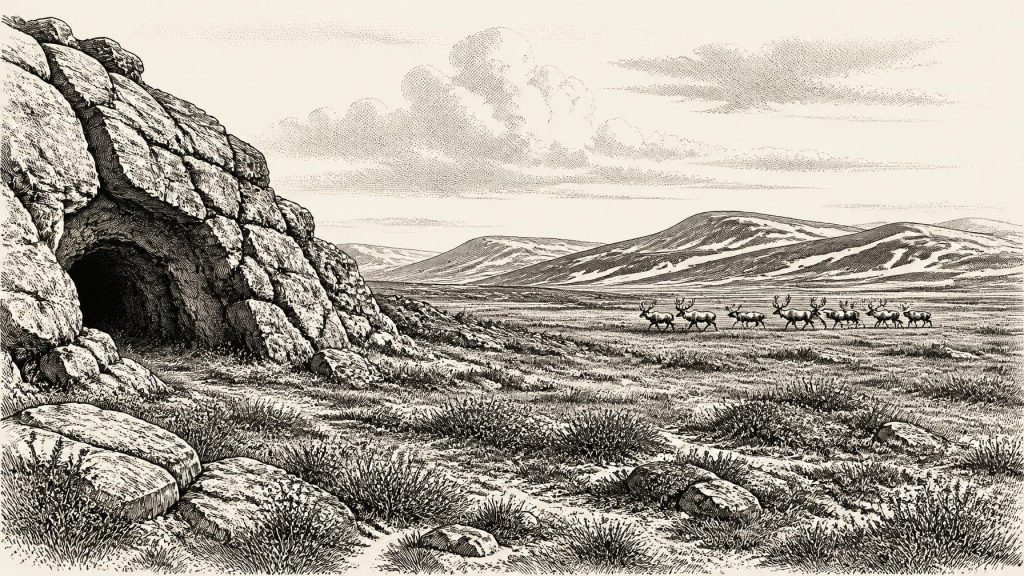
The Ireland of this period was not the wooded and pasture-rich island of later millennia. The best available evidence points instead towards a generally treeless, cold environment, with grasses, sedges, herbs, dwarf shrubs and patches of hardy tundra vegetation. Local conditions would have varied sharply with altitude, drainage, exposure and proximity to ice. Sheltered limestone districts in the south may have offered more productive seasonal niches than wind-scoured uplands or ice-proximal ground. Permafrost and repeated freezing and thawing would have reshaped soils, slopes and streams.
Such landscapes were not empty wastelands. Open vegetation could feed grazing and browsing mammals, while caves and fissures in limestone country trapped bones and sediments. Yet the very processes that made these deposits possible also complicate interpretation. Bones may have been dragged in by carnivores, washed into passages, moved by sediment collapse or disturbed during nineteenth- and early twentieth-century digging. A cave assemblage is therefore not a straightforward census of animals standing outside its entrance at one moment in time.
Castlepook’s Ice-Age Fauna
The most important directly relevant place is Castlepook Cave, also known as Mammoth Cave, near Doneraile in north County Cork. Its deposits and historic collections contain an exceptional Pleistocene fauna. Reassessment and improved radiocarbon dating have shown that some Castlepook animals belong much earlier in the last glacial cycle than older dating programmes suggested. The cave has yielded evidence for reindeer, woolly mammoth, giant deer, brown bear, wolf, Arctic fox, mountain hare, lemmings and spotted hyaena. This is powerful evidence that Ireland supported a varied cold-climate animal community during parts of Marine Isotope Stage 3.
The animals should not be treated as a single herd living together in a neatly dated scene. Individual specimens can differ substantially in age, and the cave’s deposits were not all laid down in one episode. Nevertheless, the assemblage demonstrates that Ireland was repeatedly accessible to large mammals before the Last Glacial Maximum. Reindeer in particular evoke a mobile grazing world, while hyaena remains show that large carnivores also ranged into the region. Hyaenas may have carried prey remains into their dens; their presence provides an alternative explanation for many broken or accumulated bones and is one reason why claims for human activity require close scrutiny.
The Reindeer Femur
Castlepook is also the focus of a consequential but still limited claim about people. A reindeer femur in the National Museum of Ireland’s natural-history collections has been presented as bearing a deep mark made on fresh bone by a sharp stone tool during butchery. County Cork heritage publications associate the bone with an age of about 31,000 BCE, while the wider scientific re-dating of southern Irish cave fauna places Castlepook firmly within the debate over pre-Last Glacial Maximum animals and environments. If the mark is correctly identified as anthropogenic, it may be Ireland’s earliest known indication that people handled an animal.
That conclusion must remain carefully bounded. A date obtained from bone establishes the age of the animal, not the exact moment when a surface mark was made. Nor does one marked fragment prove a settlement, a camp, a population, a migration route or continuous human occupation. Ireland has not produced a securely associated Upper Palaeolithic hearth, stone-tool assemblage, house floor, burial or occupation surface of this antiquity. There is also no basis for assigning any possible visitors to a named continental archaeological culture. The reindeer bone is an important lead, not a complete foundation story.
People, If Present, Were Mobile
Interpretation rather than direct evidence allows the cautious possibility that small groups of Upper Palaeolithic hunter-gatherers occasionally reached Ireland in milder or more productive intervals. Across north-west Europe, people at this time were highly mobile and relied upon intimate knowledge of seasonal animals, shelter, stone resources and safe routes through difficult country. A successful visit to the Doneraile area might have involved scouting grazing ground, intercepting reindeer, processing a carcass and carrying selected meat, marrow, hides, sinew or bone away. None of this can be demonstrated at Castlepook; it is simply the most economical human scenario if the incision is genuine.
There is no evidence for farming, animal domestication, pottery, metalworking, permanent villages or landscape clearance. No crops were grown and no livestock were kept. Food would have depended on wild resources, with large herbivores potentially significant but never guaranteed. Hunting was dangerous and seasonal, and scavenging or opportunistic collection may also have formed part of a flexible subsistence strategy. In a cold landscape, fuel, clothing, shelter and knowledge of weather could have been as decisive as a successful hunt.
No States, Wars or Diplomacy
Political affairs cannot responsibly be reconstructed for Ireland at this date. There were no known kingdoms, chiefs, tribes, territorial boundaries, treaties or diplomatic institutions, and no writing from which to recover personal names or spoken languages. Conflict is equally invisible. Hunters elsewhere in Europe certainly possessed weapons and competed for resources, but there is no Irish evidence from around 31,375 BCE for warfare, raiding or organised violence. It would be misleading to project later Irish identities, Gaelic culture or ideas of nationhood into this remote period.
Social life is also almost entirely beyond direct recovery. If people did visit, they probably travelled in small kin-based groups whose co-operation was essential to survival. Knowledge would have been learned and transmitted orally: where game moved, how to work stone, which places provided shelter, and how to manage cold and darkness. Such learning was culture in the fullest sense, but no Irish artwork, musical instrument, ornament, burial rite or ritual site can securely be assigned to this horizon. Religion, ceremony and belief therefore remain unknown rather than absent.
Routes, Exchange and Regional Change
There is likewise no evidence for trade in the later sense of regular exchange between established Irish communities. Any people who reached the island would have brought tools and social connections from elsewhere, and movement through the wider Irish Sea world could have transferred materials and knowledge. But no diagnostic imported object has been recovered from Ireland for this period. “Trade” should not be used as a substitute for the unproven possibility of occasional movement.
The decisive regional development was environmental instability. Cooling conditions, expanding glaciers and altered sea levels increasingly narrowed the ecological opportunities represented by the Castlepook fauna. Later advance of the British–Irish Ice Sheet would transform the island’s surface, scour older deposits and help explain why evidence for early people is so sparse. Ireland’s deep human past may eventually be extended by newly excavated, well-stratified sites; recent work at Castlepook has sought precisely such deposits. For now, the reindeer mark and the cave fauna offer a disciplined conclusion: around this broad period, Ireland was a cold but intermittently habitable animal landscape, and it may have witnessed brief human contact long before enduring post-glacial settlement.
Primary Sources
- HERITAGE ARTEFACTS of County Cork
- Archaeological Heritage of County Cork
- A reconsideration of the radiocarbon dating of the Marine Isotope Stage 3 fauna from southern Ireland
- The Irish quaternary fauna project
- New insights on the fauna of Ireland's Younger Dryas and Early Holocene from Alice & Gwendoline Cave
- Growth and retreat of the last British–Irish Ice Sheet, 31,000 to 15,000 years ago: the BRITICE-CHRONO reconstruction
- Behavioural tendencies of the last British–Irish Ice Sheet revealed by data–model comparison
- The timing and magnitude of the British–Irish Ice Sheet between Marine Isotope Stages 5d and 2: implications for glacio-isostatic adjustment, high relative sea levels and ‘giant erratic’ emplacement
- Maximum extent and dynamic behaviour of the last British–Irish Ice Sheet west of Ireland
- Last Glacial Maximum cirque glaciation in Ireland and implications for reconstructions of the Irish Ice Sheet
- Stratigraphic and palaeo-geomorphological evidence for the glacial-deglacial history of the last British-Irish Ice Sheet in the north-western Irish Sea
- Archaeology Research Excavation Grant 2022
- 32564
- UCD School of Archaeology Research Day 2022
- Mammoth Cave
- Figure 6.— The subdivision of the Quaternary Period in Ireland
- Anthropogenic changes to the Holocene nitrogen cycle in Ireland
- The colonization of Ireland: A human ecology perspective
- Restricted cirque glaciers in the Wicklow Mountains, Ireland, during the Nahanagan Stadial (Greenland Stadial-1/Younger Dryas)
- Maximum extent and dynamic behaviour of the last British–Irish Ice Sheet west of Ireland