Newport’s Fever Inquiry1819 CE
In 1819, Ireland faced continuing fever, hunger and unemployment after the post-war downturn and bad seasons. Sir John Newport’s Commons committee investigated contagious disease and labouring poverty, linking epidemic conditions to destitution while favouring regulated charity, fever hospitals and work over an Irish poor law. The Fisheries Act sought employment and food through managed fisheries, but offered limited immediate relief. Henry Grattan’s Catholic emancipation motion narrowly failed, confirming enduring political exclusion. John Devereux recruited an Irish Legion for Bolívar’s cause, though recruits suffered overseas. Belfast founded the Irish Harp Society, while Ribbonism reflected rural tension. The year exposed persistent insecurity.
Dateline
In 1819, Ireland’s most urgent story was not a single battle, rebellion or ministerial change. It was the collision of illness, hunger, insecure work and political exclusion. The great fever crisis that had followed the bad seasons of 1816–17 had not simply vanished: it still shaped official policy, charity and ordinary movement through towns and countryside. At Westminster, meanwhile, Irish Catholics again pressed their claim to full civil equality. The year therefore exposed a central contradiction of the Union: government could investigate Irish suffering in impressive detail while declining to alter some of the structures that made much of the population feel excluded from power.
The firmest landmark was the parliamentary inquiry chaired by Sir John Newport. From 9 April to 7 June, a House of Commons select committee examined both contagious disease and the condition of Ireland’s labouring poor. Its paired reports made distress an object of state investigation. They did not discover poverty in 1819; rather, they brought together testimony produced by an exceptional emergency and asked what could be done without committing Parliament to a general Irish poor law.
Fever, Want and Official Inquiry
The inquiry belonged to the long aftermath of war. Peace after 1815 brought falling agricultural prices and discharged soldiers into an economy already short of secure employment. Population continued to grow, while the unusually cold, wet weather of 1816 and subsequent scarcity had exposed the vulnerability of households dependent on small plots, casual labour and the potato. It is important not to project the catastrophe of the 1840s backwards: 1819 was not the Great Famine. Yet it was a year in which hunger, unemployment and epidemic disease combined on a devastating scale, and contemporaries understood that combination clearly.
The committee treated fever as a symptom of general social distress as well as a medical problem. Its approach was constrained by contemporary knowledge. Typhus was not yet understood through the later science of lice-borne infection; officials frequently attributed transmission to foul clothing, overcrowded rooms and the movement of destitute beggars. Those observations could identify real conditions of danger, but they also encouraged a punitive view of the poor. The report proposed powers to remove wandering beggars from parishes, confine them briefly to hard labour, and wash both people and clothes. Relief, policing and public health were thus tightly entangled.
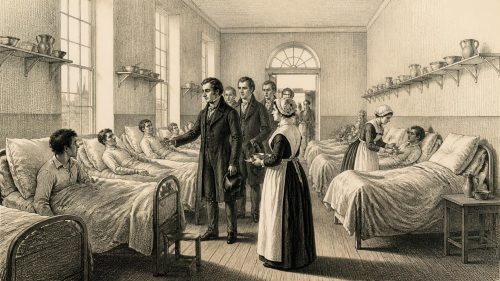
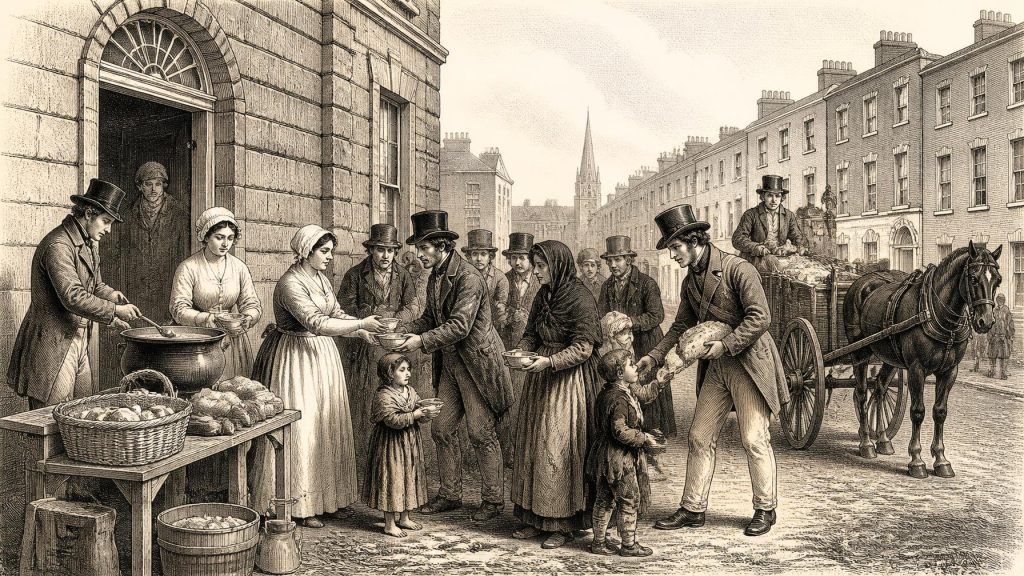
That mentality should not obscure the scale of need. In Dublin, Dr Steevens’ Hospital admitted 4,778 fever patients between September 1817 and August 1819. At Cork Street Fever Hospital, soup and bread were supplied to the public during 1819; in the first seven months, 9,295 people used that assistance. Such figures do not measure everyone who fell ill or went hungry—many sick people never entered institutions—but they make visible the pressure on a limited charitable and medical system.
Ireland already had a legislative framework for fever hospitals. The Hospitals (Ireland) Act of 1818 enabled county and town bodies to establish fever hospitals, employ medical staff and receive poor patients, with local elites, clergy, magistrates and contributors prominent in their governance. In 1819, the inquiry tested the practical limits of that response. Hospitals could isolate and treat some patients, but they could not by themselves supply regular work, adequate housing or dependable food.
Work Rather Than a Poor Law
Newport’s committee recognised a “general distress” and shortage of employment, but it remained wary of direct state provision. Its members framed their labour inquiry around agriculture and fisheries, the occupations thought capable of absorbing labour without provoking the supposed dependency associated with English poor relief. This was an important choice. The state’s answer to destitution was imagined chiefly as productive work, local subscription and regulated charity—not an enforceable right to assistance.
The Irish Fisheries Act of 1819 belongs in that setting. It established a new administrative framework for fisheries, including a Fishery Board and commissioners, while its detailed rules attempted to protect stocks: among other restrictions, it prohibited undersized drag nets in Irish coastal waters, bays, harbours, rivers and creeks. The measure was both economic and environmental in intention. It treated fishing as a resource that might offer employment and food, but also one vulnerable to destructive methods. Legislation, however, could not instantly turn coastal fishing into a remedy for the widespread insecurity of rural labourers.
Grattan’s Narrow Defeat
Political disability was the other great issue of the year. On 3 May, Henry Grattan moved that the House of Commons should go into committee on the laws requiring oaths and declarations from Roman Catholics before they could hold office or exercise civil functions. The immediate proposal was procedural, but its object was unmistakable: Catholic emancipation. Irish Catholics had possessed the parliamentary vote under the 1793 relief legislation, subject to property qualifications, but they remained excluded from Parliament and many offices by religious tests.
Grattan’s motion was defeated by the painfully narrow margin of 243 votes to 241 after corrections to the division list. The closeness mattered. It demonstrated that emancipation was no marginal idea, while the defeat confirmed that Catholic political equality could still be withheld by Westminster. Arguments against the motion dwelt on the Protestant character of the constitution, the established churches and fears of Catholic political predominance in Ireland. Supporters answered that exclusion itself produced alienation, and that conciliation would strengthen rather than endanger the state.
The debate was among the last major parliamentary exertions of Grattan, who had repeatedly pursued Catholic relief and would die in London in June 1820. It did not create the mass movement that Daniel O’Connell would organise after 1823, but it preserved the issue at the centre of Irish public life. In 1819, constitutional reform remained an aspiration argued through petitions, speeches and parliamentary votes, not yet an organised nationwide association.
An Irish Legion Overseas
Irish horizons in 1819 extended far beyond the United Kingdom. John Devereux, a Wexford-born veteran of 1798, promoted an Irish Legion for Simón Bolívar’s struggle against Spanish rule in northern South America. A first detachment is recorded as sailing from Liverpool on 26 June. Devereux’s recruiting venture appealed to unemployed former soldiers with promises of pay and land, and it drew support in Dublin: O’Connell attended and helped arrange a dinner in Devereux’s honour at Morrison’s Hotel in July.
By the end of the year Devereux had recruited some 1,700 men, while around 1,000 members of the legion reached Margarita Island in August and September. This was not an Irish state expedition, nor evidence that Ireland as a whole embraced a South American war. It was, rather, a revealing private enterprise: an outlet for veterans, adventure-seekers and political romantics in a depressed post-war world. The realities were grim. Poor preparation, disease, food shortages and inadequate accommodation brought severe suffering, and officers returning to Dublin in December denounced Devereux’s management.
Harp, Town and Uneasy Order
There was also a quieter cultural renewal. On 16 April in Belfast, a meeting constituted the Irish Harp Society to manage a fund raised in India to revive the harp and Ireland’s ancient music. The revival drew on the legacy of the Belfast harp movement associated with Edward Bunting and the late harper Arthur O’Neill. Its funding from Irish people abroad was itself striking: cultural preservation in Belfast depended partly on networks reaching to British India. The society would provide teaching and sustain an instrument whose older hereditary tradition was in steep decline.
Against this programme of improvement stood a hardening language of disorder. Reports placed disturbances associated with Ribbonism around October 1819. The evidence does not justify turning this into a single, neatly dated national rising. “Ribbonism” was a broad and often politically loaded label, applied to secret combinations and agrarian intimidation in a period when land, work, rents, food and local authority were sources of acute tension. Its appearance in the record nevertheless indicates that distress could move beyond petition and charity into clandestine resistance.
Thus 1819 left no simple verdict. Fever hospitals, soup distribution, parliamentary investigation, fisheries legislation, emancipation debates, emigration and cultural patronage all showed people seeking remedies or opportunities. But each also revealed limits: medical relief was partial, employment schemes uncertain, political reform defeated, overseas ventures hazardous and rural order fragile. Newport’s inquiry made Ireland’s condition impossible to ignore. It did not, by itself, make that condition secure.
Primary Sources
- First [Second] Report from the Select Committee on the State of Disease, and Condition of the Labouring Poor, in Ireland
- A History of the Irish Poor Law
- Roman Catholic Question, House of Commons, 3 May 1819
- Roman Catholic Question, House of Lords, 17 May 1819
- Grattan, Henry | Dictionary of Irish Biography
- Devereux (D'Evereux, Devereaux), John | Dictionary of Irish Biography
- Catholic Emancipation
- Health and Poverty: Content of the Registered Papers, 1818–1833
- Hospitals (Ireland) Act 1818
- Survey of Hospital Archives in Ireland
- Fever | Dr Steevens’ Hospital
- Fever Hospitals in Counties Armagh and Down: 1817–39
- Begging and Alms-Giving: Perceptions and Motivations
- Pre-Famine Relief Committees, 1817–42
- Irish Fisheries Act, 1819, Section 14
- The Office of the Chief Secretary of Ireland: Chronology
- Bunting’s Airs, Grace: The Irish Harp Society and Edward Bunting
- The Beath Collection and the Irish Harp Society
- Devereux, John (1778–1854) | Dictionary of Irish Latin American Biography
- JB/109/130/001 | Transcribe Bentham
- ‘Night Marauders’ and ‘Deluded Wretches’: Public Discourses on Ribbonism in Pre-Famine Ireland
- Fever Part 2: 1811–1820 | Cork Street Fever Hospital