

Fever Wards and Steam Packets1818 CE
Ireland in 1818 faced a contagious-fever epidemic, associated chiefly with typhus, intensified by poverty, overcrowding and post-war dislocation. Parliamentary inquiry and the Fever Hospitals Act established local bodies to provide hospitals, though funding, coverage and care remained uneven, and compulsory removal reflected social control. Dublin opened Francis Johnston’s General Post Office, symbolising communications, while pioneering steamships connected Dublin and Belfast with Scotland. Religious developments included the death of Archbishop Richard O’Reilly, an Irish-language Protestant educational society, and the Secession Synod. Official records revealed crime and distress; Anthony Gallagher was executed. Literary works by Lady Morgan and Patrick Brontë portrayed Ireland.
Dateline
Ireland in 1818 was marked above all by a public-health emergency whose scale made hardship visible in cottages, crowded streets, hospitals and the correspondence of government. Yet the year also produced striking signs of institutional and technological change: Dublin acquired its monumental new General Post Office; the Irish Sea was crossed by pioneering steam vessels; and Parliament created a framework for fever hospitals. These developments did not cancel deprivation. Rather, they showed an administration and a society trying—unevenly and often inadequately—to manage the consequences of post-war economic dislocation, population growth, bad harvest years and epidemic disease.
A Capital Post Office
On 6 January, the new General Post Office opened for business on Sackville Street, Dublin, now O’Connell Street. Designed by Francis Johnston, its long classical façade and portico gave the postal service a commanding home in the centre of the city. The building had been under construction since 1814, and its opening was a definite event in the public life of the capital, not merely an architectural finishing touch.
The GPO stood for communication, administration and the integration of Ireland into the United Kingdom after the Act of Union. Letters, official orders, newspapers, commercial accounts and remittances depended upon postal networks that joined towns and rural districts to Dublin, and Dublin to Britain and the wider world. The grand new building did not mean that every Irish household enjoyed ready access to those networks: literacy, distance and postage costs remained substantial barriers. But it expressed the increasing importance of rapid, regular information in a country governed through Dublin Castle and Westminster.
The Fever Crisis
The most urgent reality of 1818 was the continuing epidemic conventionally described at the time as “contagious fever”. Modern historians commonly associate the great epidemic of 1816–19 chiefly with typhus, while recognising that contemporary medical language grouped illnesses more broadly than later diagnosis would allow. Fever was inseparable from poverty in the testimony gathered during the period: overcrowded dwellings, inadequate clothing, unstable employment, poor diet and the movement of destitute people in search of work all made illness both more likely and more destructive.
The background was the difficult transition from war to peace. The end of the Napoleonic Wars in 1815 depressed agricultural prices and released former soldiers into an already strained labour market. The exceptionally cold conditions of 1816 and food scarcity had inflicted a severe shock. By 1818, even where food supplies had improved, the epidemic had acquired its own momentum. It is therefore misleading to present the year simply as a famine year, or to treat disease as an automatic and immediate result of harvest failure. The interaction of poverty, mobility, crowded housing and infection was more complicated—and more enduring.
From 22 April to 26 May, a House of Commons select committee examined the prevalence of contagious fever in Ireland, its causes and possible remedies. Its very establishment acknowledged that this was not a local inconvenience. Witnesses and reports revealed a crisis reaching across provinces. Cork offers a stark illustration: the later published evidence recorded 10,228 fever patients passing through that city’s fever hospitals during 1818, after admissions had already risen sharply in 1817. Such figures cannot simply be converted into a citywide mortality total, but they convey the extraordinary pressure placed upon charitable and medical institutions.
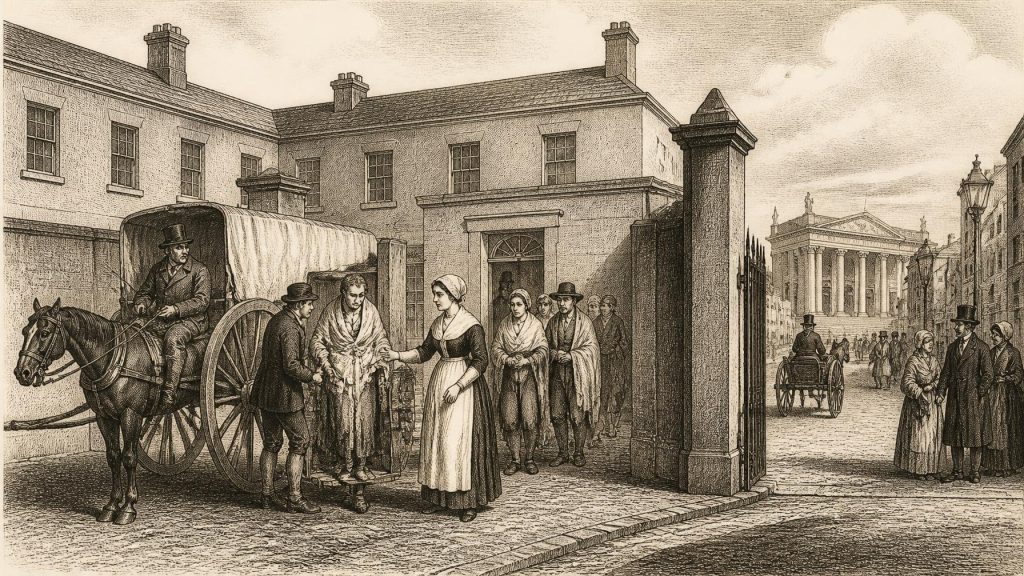
Hospitals offered isolation as well as treatment. Removing a sick person from a one-room or crowded household was thought essential to interrupt contagion, though medical practice had not yet identified the louse-borne mechanism of typhus transmission. Patients, nurses, doctors, clergy and visitors all confronted serious risks. For families, entry to a fever hospital could mean separation at a moment of acute need; for those outside, it might mean fear that sickness in a neighbour’s home would bring official intervention.
The Fever Hospitals Act
On 30 May, Parliament passed the Hospitals (Ireland) Act, usually called the Fever Hospitals Act. Its full title made its purposes clear: to establish fever hospitals, relieve suffering poor people and prevent the increase of infectious fevers. The measure created a corporate body for every county and every county of a city or town. Bishops, MPs, justices of the peace and, in urban counties, civic office-holders were built into its governing structure; residents and donors could also be admitted under prescribed conditions.
This was an important move towards an organised public response, but not a national health service in the modern sense. Local bodies had to obtain funds before they could hire or build premises, appoint physicians, surgeons, apothecaries, nurses and other staff, and admit patients. The Act required separate accommodation for men and women. It relied heavily on local authority, charitable subscription and the willingness of county elites to act. In practice, provision would remain patchy, contested and dependent on local resources.
The legislation also gave boards of health a coercive power that deserves emphasis. Where a medical practitioner certified that an infected person lacked proper care or conditions to prevent contagion, commissioners could order removal to a fever hospital after inquiry. Such compulsory removal had to be reported rapidly to the Lord Lieutenant or Chief Secretary. The provision reveals the era’s tension between charitable relief and social control: the poor were to be aided, but their illness was also treated as a danger to households, neighbourhoods and the country at large.
In Dublin, the fever emergency touched institutions beyond the new statutory scheme. Buildings at Grangegorman associated with the planned Richmond General Penitentiary were used for fever patients during the outbreak; the penitentiary itself would not receive its first prisoners until 1820. This distinction matters. Accounts that describe it simply as a prison opened in 1818 flatten a more unsettled reality, in which structures intended for confinement or reform could be commandeered for emergency care.
Sea Routes Remade
While fever exposed the fragility of everyday life, steam navigation suggested a new command over distance. In mid-May, the paddle steamer Thames made the first recorded steam-vessel passage from the Clyde to Dublin. On 13–14 June, the Rob Roy travelled from Greenock, by way of Campbeltown, to Belfast. These were pioneering open-sea passages, important demonstrations that steam power could link Irish ports to western Scotland across waters more demanding than a river or sheltered estuary.
The immediate services were small, experimental and far from the later mass transport system of the Victorian Irish Sea. Sail still dominated shipping, and weather remained decisive. Nevertheless, the voyages mattered to merchants, travellers, mail contractors and port towns. Belfast’s growing commercial connections with Scotland acquired a new technological symbol, while Dublin’s connection to the Clyde pointed towards quicker, more regular crossings. In a year when people and information moved under the shadow of disease and distress, steam packets offered an opposing image: movement made more predictable by machinery.
Religion, Language and Authority
Religious life also changed in definite ways during 1818. On 31 January, Richard O’Reilly, Roman Catholic archbishop of Armagh and primate of all Ireland, died at Drogheda after more than three decades in the primatial office. His death left the leading Catholic see vacant for the rest of the calendar year; Patrick Curtis was appointed only in 1819. The vacancy is a reminder that the Catholic Church remained a major national institution despite the continued exclusion of Catholics from Parliament.
In Dublin, Henry Joseph Monck Mason, Robert Daly and other Church of Ireland evangelicals founded the Irish Society for Promoting the Education of the Native Irish through the Medium of Their Own Language. The title itself is revealing. Rather than treating Irish as an obstacle to be removed, the society proposed using it for schooling and scriptural instruction among Irish speakers. Yet this was not a politically neutral celebration of the language. Its purpose was evangelical Protestant mission, and its educational work was bound to hopes of religious conversion among Catholics. The foundation therefore belongs both to the history of Irish-language print and to the confessional competition that shaped education long before a state national-school system.
For Presbyterians, 1818 brought the formation of the Secession Synod, created through the union of Burgher and Anti-burgher seceding bodies. It was smaller than the General Synod of Ulster, but its formation demonstrates that Irish Protestantism was never a single, uncomplicated bloc. Differences in church order, doctrine and inherited Scottish connections continued to organise communities, particularly in Ulster.
Order, Crime and Representation
The year’s official records also disclose anxiety about crime, prisons, transportation, unemployment, bankruptcy and emigration. The newly surviving registered correspondence of the Chief Secretary’s Office begins in 1818, offering an unusually rich administrative window onto these pressures. Dublin Castle received petitions and reports from across the island, but its paperwork was not the same as effective relief. State attention could mean patronage, investigation or punishment as readily as assistance.
In County Mayo, the summer assizes tried Anthony “Captain” Gallagher and associates accused of robbery. Gallagher was executed on the Green at Castlebar on 29 August. Later folklore turned him into a romantic rapparee or highwayman, but archival research cautions against repeating its colourful details as fact. What is securely placed in 1818 is the prosecution and execution, following a manhunt that involved local magistrates, military personnel, Dublin Castle and arrests in London. The episode points to the porous Irish Sea world of policing as well as to insecurity in a distressed rural region.
Print and Perspective
Irish settings continued to travel through print. Sydney Owenson, Lady Morgan, published Florence Macarthy: An Irish Tale in 1818, using Munster landscapes, history and political argument in a work shaped by her public controversy with hostile reviewers. Patrick Brontë’s The Maid of Killarney, also published that year, offered another literary Ireland, though one filtered through a strongly Protestant and anti-Catholic outlook. Such books did not describe ordinary life neutrally; they show how Ireland was being imagined, debated and marketed to readers.
Thus 1818 was not a year of one single Irish story. It was a year in which a new post office, new steam routes and new religious organisations appeared beside crowded fever wards, coercive public-health powers and stark penal authority. The most consequential development was the attempt to confront epidemic disease through permanent local institutions. Its limits were as revealing as its ambition: Ireland’s poor had become impossible for government to ignore, but were still far from being secure in any enforceable right to care.
Primary Sources
- Hospitals (Ireland) Act, 1818
- Hospitals (Ireland) Act, 1818, Section 3
- The Hospitals (Ireland) Act 1818
- Commons Chamber, 22 April 1818
- First Report from the Select Committee on the State of Disease, and Condition of the Labouring Poor, in Ireland
- Historical Commentary for 1818
- Chief Secretary’s Office Registered Papers, 1818–1922
- The Registered Papers of the Chief Secretary's Office
- Health and Poverty
- Irish Post Office History
- Bicentenary of the Opening of the GPO
- General Post Office, Dublin
- Early Clyde Steamboats III
- David Napier and the Belfast Trade
- Fever Hospitals in Counties Armagh and Down: 1817–39
- History of Grangegorman
- O'Reilly, Richard
- Archive of the Archdiocese of Armagh
- Timeline for Presbyterianism in Ireland
- Bishop Robert Daly: Ireland's “Protestant pope”
- History of the Origin and Progress of the Irish Society, Established for Promoting the Education of the Native Irish, Through the Medium of Their Own Language
- Captain Gallagher – Highwayman
- Captain Gallagher – Police Manhunts, County Mayo Cases 1814–1821
- Florence Macarthy: An Irish Tale
- Fiction Relating to Ireland, 1800–29