Howth’s Royal Landing1821 CE
In 1821, Ireland experienced population growth, economic hardship, political exclusion and royal pageantry. The first comprehensive census recorded about 6.8 million people, exposing dependence on insecure rural livelihoods; most detailed returns were later destroyed in 1922. Post-war depression, rents, tithes and scarce employment contributed to Munster’s emerging Rockite disturbances. Westminster’s Catholic Disability Removal Bill passed the Commons but failed in the Lords, preserving Catholic exclusion from Parliament. George IV’s August landing at Howth inspired displays of loyalty, including Daniel O’Connell’s conciliatory participation, but brought no reform. Administrative changes and cultural activity highlighted tensions between Union, equality, rural insecurity and identity.
Dateline
In 1821 Ireland was measured, celebrated and unsettled at the same time. The year brought the first full government census of the island, a spectacular royal visit by George IV, renewed parliamentary argument over Catholic political rights, and the opening phase of a serious rural disturbance in Munster. These were not separate stories. They revealed a country whose population was growing rapidly, whose countryside was under acute economic pressure, and whose Catholic majority remained excluded from the highest offices of the state. Public ceremonial could produce extraordinary displays of loyalty; it could not by itself resolve those conditions.
A Country Counted
The most consequential administrative event began on 28 May, when enumerators started the first full census of Ireland. Earlier attempts at a national count had proved inadequate. This inquiry was markedly ambitious for its time: officers were instructed to proceed house by house, recording each resident’s name, age and occupation. Their notebooks also allowed for relationships within households, the number of storeys in a dwelling, acreage held by local landholders, and observations on schools. Soldiers in barracks, prisoners, infirmary patients, boarders at schools and visitors were, in principle, to be included. The census was therefore an attempt to turn an immensely varied society into legible local facts, townland by townland.
The results were subsequently abstracted into a total population of about 6.8 million people. That figure should not be treated as a simple measure of prosperity. It registered a remarkable increase since the Union, but it also pointed towards the central difficulty of the age: a growing rural population depended on holdings, wages and food supplies that were often insecure. The census itself did not explain why households lived as they did. It nevertheless created a benchmark from which the scale of pre-Famine Ireland can be seen more clearly than ever before.
For historians, 1821 has a further significance. The original returns once held a wealth of individual information, but almost all were destroyed in the burning of the Public Record Office in Dublin in 1922. Published totals, a small number of surviving fragments and later reconstructions are consequently crucial. This later loss should not obscure what happened in 1821: the state’s agents really did seek names, livelihoods, homes and family connections across the island, even though much of that close-grained record did not survive.
Pressure in the Countryside
The census was taken amid the prolonged economic dislocation that followed the Napoleonic wars. Wartime demand and high agricultural prices had encouraged expansion and high rents; the post-war fall in prices hit cultivators and labourers hard. The burden did not fall uniformly across Ireland, and neither did local economies resemble one another. Yet the combination of population growth, dependence on small-scale agriculture, rent demands, tithes payable to the Established Church and scarce paid employment made many districts vulnerable. Scholarship on the period identifies a deep post-war depression and recurring local food crises as major features of early nineteenth-century Irish life.
One unusually revealing local survival comes from the Aran Islands. The 1821 material there shows a community sustained by farming, fishing and kelp-making, with commercial links to the neighbouring coasts of Clare and Galway. It also shows the limits of that economy: population pressure and agricultural difficulty were already apparent. Aran should not be made to stand for all Ireland, but it gives rare texture to the national count. Households combined several forms of work, depended upon maritime as well as agricultural resources, and faced a precarious margin between subsistence and want.
In southern Munster, hardship and local grievances helped to fuel the movement later known as Rockitism. The disturbances are conventionally dated from 1821 to 1824, and their opening phase belongs firmly to this year. Those who acted in the name of the imagined “Captain Rock” targeted landlords, tithe collectors, middlemen and others associated with rural authority through threatening notices, attacks on property, incendiarism and violence against animals. Such activity was secretive and varied from place to place; it was not a coherent national rebellion. But it was sufficiently serious for Dublin Castle and the government in London to regard the south of Ireland as a mounting security problem by the autumn.
Rockitism exposed the limits of easy explanations. It cannot responsibly be reduced to either religious conflict or mere criminality. Tithes mattered because the Church of Ireland was supported by payments from a population that was predominantly Roman Catholic; rents mattered because access to land governed survival; wages mattered because many labourers had little secure property. The rural disorder of 1821 was thus connected to the wider political order, but it sprang from immediate contests over work, land, payment and authority in particular localities.
Relief Refused
Religion and political power remained inseparable questions. Roman Catholics could vote under the settlement of 1793, but they could not sit in parliament or hold many senior public offices. In February and March 1821, William Conyngham Plunket advanced a Roman Catholic Disability Removal Bill at Westminster. The Commons carried it after sustained debate. Its provisions were not uncomplicated emancipation: alongside the removal of disabilities, the proposal included safeguards intended to regulate Catholic ecclesiastical affairs and restrict perceived papal influence. Many Catholic clergy objected strongly to those securities, especially any state intervention in the appointment and governance of bishops.
The bill nevertheless passed from the Commons to the Lords, where it was defeated at its second reading on 17 April. The debate displayed the constitutional divide in its starkest form. Supporters argued that Catholic exclusion denied justice to loyal subjects and perpetuated alienation. Opponents portrayed the Protestant establishment in Church and state as fundamental to the constitution, and feared that admitting Catholics to parliament would weaken it. The Lords’ refusal ensured that 1821 did not bring emancipation. It also made clear that loyal addresses, petitions and parliamentary speeches had still not overcome entrenched resistance at the centre of the United Kingdom.
The King at Howth
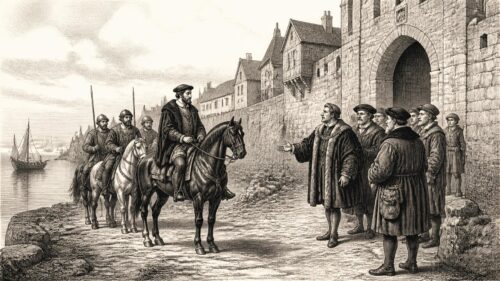
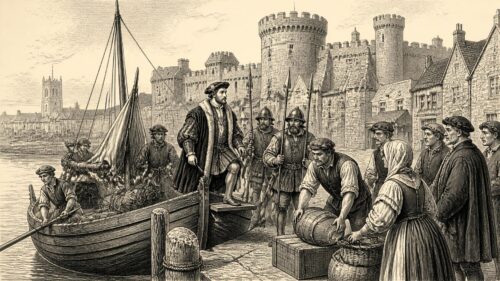
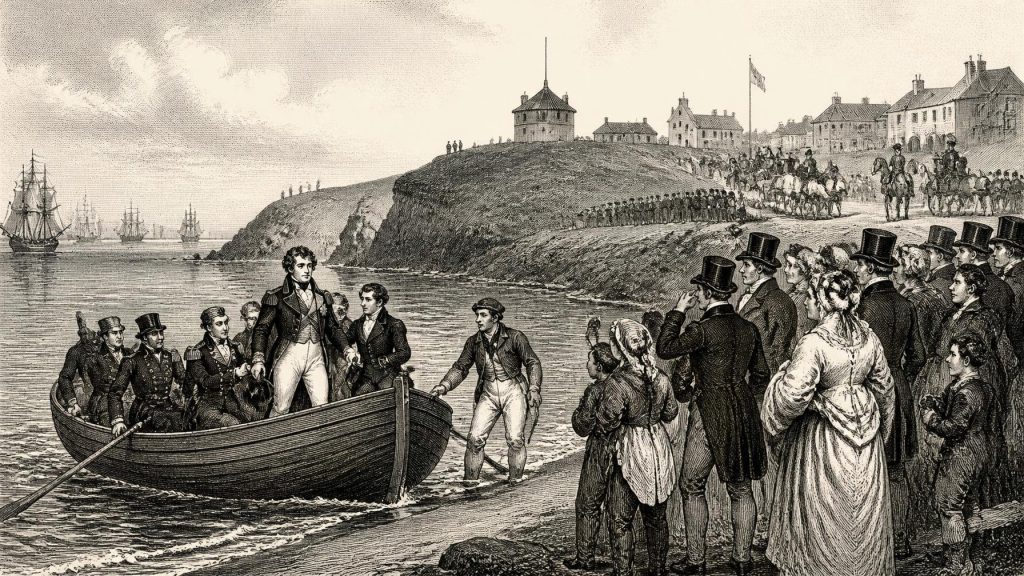
Against that background, George IV’s arrival at Howth on 12 August was politically charged. It was the first peacetime visit to Ireland by a British monarch, and it set off an elaborate season of illuminations, processions, civic addresses, reviews and entertainments. Dublin’s public spaces became stages on which municipal corporations, merchants, guilds, aristocrats and voluntary bodies could demonstrate attachment to the Crown. Commemorative medals, including examples made with Wicklow copper, converted the landing into a tangible object of popular and commercial memory.
The programme also put Irish institutions and economic interests on display. On 23 August the king visited the Dublin Linen Hall, an occasion later commemorated by the linen merchants in a statue. The following day he visited the Royal Dublin Society at Leinster House, inspecting its museum and library before a reception on the lawn. These occasions were not simply diversions. Linen manufacture, learned collections, improvement and polite sociability were all presented as evidence that Ireland could be prosperous, cultivated and securely attached to the Union.
Daniel O’Connell participated in the welcome. His conspicuous loyalty has sometimes looked surprising in light of his later reputation, but in 1821 he hoped that a shared Catholic and Protestant demonstration might encourage conciliation and Catholic relief. That hope was widely felt, although not universally. The royal visit created a brief atmosphere in which political opponents could occupy the same ceremonial space, yet it followed the Lords’ rejection of the relief bill and supplied no constitutional concession. Spectacle offered recognition; it did not alter the law.
George IV reviewed troops on the Curragh late in August and departed from Dún Laoghaire on 3 September. The visit left abundant prints, medals, civic recollections and a durable memory of crowds in Dublin. Its immediate political legacy was far less certain. The warmth of the reception showed that Irish public feeling could not be described simply as either loyal or disaffected. It also showed how readily loyalty could coexist with demands for equality, local grievance and distrust of government.
A Changed Administration
By December the administration itself was changing. The Earl Talbot’s term as lord lieutenant ended on 10 December, and Richard Wellesley became the new lord lieutenant that month. Wellesley’s reputation as more sympathetic to Catholic claims encouraged expectations of a less rigid policy, while Henry Goulburn’s appointment as chief secretary on 29 December supplied a firmly Protestant counterweight. The pairing foreshadowed a difficult official response to the intertwined problems of Catholic politics and rural unrest, but the measures most associated with that response belonged to subsequent years. In 1821, the important fact was the transition and the unresolved expectations surrounding it.
Cultural life also registered a national feeling expressed through forms acceptable in drawing rooms and print shops. The eighth number of Thomas Moore’s Irish Melodies appeared in London in 1821, and a Dublin pirated edition quickly followed. Moore’s English words, set to airs associated with older Irish musical traditions, helped make “Irishness” audible to audiences in Ireland and beyond. That cultural achievement did not settle the language, class or political divisions of the island. But it formed part of the same world in which royal ceremony, Catholic claims and rural protest all competed to define what Ireland was.
Thus 1821 was neither a year of reconciliation nor merely one of crisis. The census supplied a new portrait of an expanding people; Rockite activity revealed insecurity beneath the rural surface; Westminster reaffirmed exclusion; and the king’s progress supplied an extraordinary, if temporary, theatre of unity. Ireland entered the 1820s with its tensions newly visible, carefully recorded and still unresolved.
Primary Sources
- Census through History
- Census Reports 1821-2006
- 1821 Census: Abstract of Answers — Appendix: Instructions for the Enumerators
- 1821 Census: Abstract of Answers — Grounds of the Present Act, and Proceedings under It
- History of Irish Census Records
- Official Census Returns and Census Substitutes
- General Report, Ireland, 1911
- The Rockite Movement in County Cork in the Early 1820s
- Rockites, Magistrates and Parliamentarians: Governance and Disturbances in Pre-Famine Rural Munster
- ‘Wholesome Regulation and Unlimited Freedom’: Governing Market Space in Southern Ireland before the Famine
- Population and Poverty, 1815–1845: From One Waterloo to Another
- The Economy and Society of the Aran Islands, County Galway, in the Early Nineteenth Century
- Roman Catholic Claims, 28 February 1821
- Roman Catholic Disability Removal Bill, 16 March 1821
- Roman Catholic Disability Removal Bill — Petition from Limerick, 11 April 1821
- Roman Catholic Disability Removal Bill, 17 April 1821
- ‘Ireland Hails with Joy the Visit of Her Sovereign’—Royal Medallions
- Statue of George IV
- The King’s Visit to the Curragh
- George the Fourth’s Visit to Ireland, August 12th 1821
- ‘All Our Joys Will Be Complated’: The Visit of George IV to Ireland, 1821
- O’Connell, Daniel
- Talbot, Charles Chetwynd-
- Goulburn, Henry
- Irish Folk Music
- Thomas Moore Returns to the Centre Stage