Anno Witnesses627 CE
The annalistic evidence for 627 CE in Ireland is sparse and uneven. In the Four Masters, the year is marked as the Age of Christ 627 and the fourth year of Domhnall, with notices for the battle of Ath Abla and the foundation of Inis Medcoit by Bishop Aedhan. Chronicon Scotorum presents a different 627 entry, with battles at Ard Corann and Carn Feradaig. This account separates securely dated notices from surrounding context, notes where the witnesses diverge, and avoids filling any annal gap with conjecture. Editorial framing is also kept distinct from the year entries themselves.
Dateline
Year Witness
The year 627 appears in the annals as a brief cluster of notices, not as a continuous narrative. In the Four Masters, the entry is explicitly marked as the Age of Christ 627 and as the fourth year of Domhnall. It then records the battle of Ath Abla, the death of Dicul son of Fearghus at the hands of the Munstermen, and the foundation of Inis Medcoit by Bishop Aedhan. [1]
Chronicon Scotorum also preserves a 627 entry, but its contents are different. In the supplied excerpt, the year is marked under the Kalends and then records the battle of Ard Corann, where Fiachna son of Demán was killed, together with the battle of Carn Feradaig, where Failbe the Red was victor and other names are also recorded. The two witnesses therefore agree on the year, not on the same notices. [3]
Battle Notice
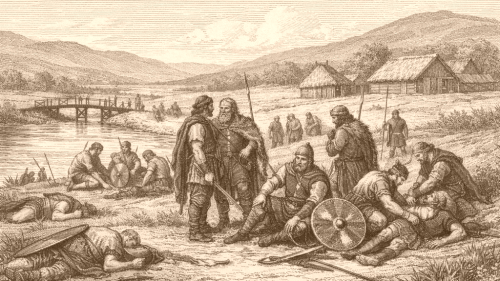
The clearest recorded battle notice for 627 in the Four Masters is Ath Abla. The entry identifies Dicul son of Fearghus as the person slain and says that he was killed by the Munstermen. Nothing in the wording adds a location, a wider troop list, or an explanation of the result. The notice remains an annalistic record of a named battle and a named death, and nothing more. [1]
Chronicon Scotorum does not repeat that Ath Abla notice in the provided 627 excerpt. Instead, its year entry names Ard Corann and Carn Feradaig. The first is described as a battle won by the Dál Riata in which Fiachna son of Demán fell, while the second gives Failbe the Red as victor and names Guaire of Aidne among those routed. The overlap with the Four Masters lies in the shared year, not the battle names. [3]
Named Death
In the Four Masters, the death attached to Ath Abla is precise. Dicul son of Fearghus is the only casualty named in that notice, and the wording ties his death directly to the Munstermen. The passage does not indicate whether he was a leader, an ally, or a prisoner, and it does not identify any broader political setting. It is a terse memorial entry within the year 627. [1]
The Chronicon Scotorum 627 excerpt names a different casualty set. Fiachna son of Demán is said to have fallen at Ard Corann, and the notice for Carn Feradaig lists Conall son of Mael Dub, Mael Dúin, Mael Ruain, Mael Calcaigh, and Conall son of Mael Dub son of Mael Bresail as names recorded in the notice. Because the text gives these names without elaboration, the evidence supports only identification, not fuller reconstruction. [3]
Monastic Notice
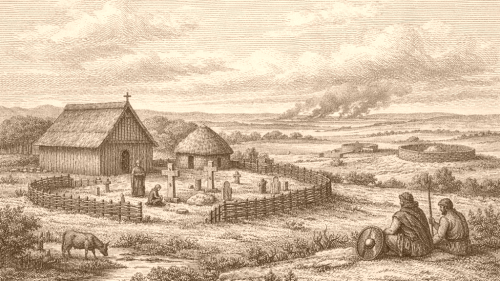
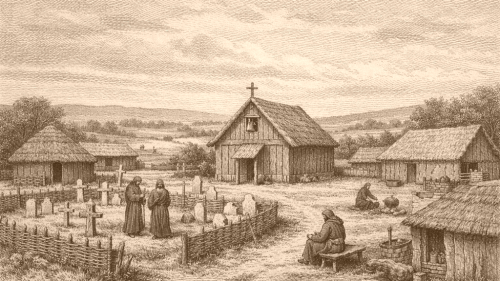
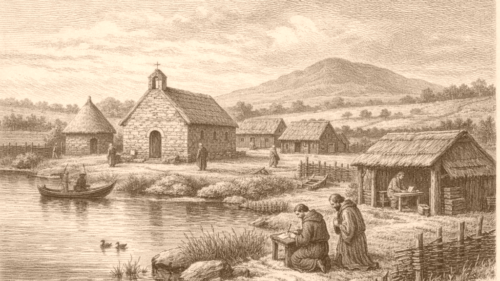
The Four Masters adds a second 627 notice beyond warfare. It says that the monastery of Inis Medcoit was founded by Bishop Aedhan. The statement is direct and compact, but it does not explain whether the foundation was new work, a relocation, or a reform of an existing place. The entry therefore gives a precise year, a named ecclesiastical figure, and a named monastery, while leaving the circumstances unstated. [1]
No corresponding foundation notice appears in the provided Chronicon Scotorum 627 excerpt. Instead, the annal entries there remain focused on warfare and named casualties. That absence is an omission in the supplied passage, not a conclusion about the wider chronicle. Within the excerpt itself, Inis Medcoit and Bishop Aedhan are not mentioned, so they cannot be carried over into this witness for 627. [3]
Regnal Frame
The Four Masters embeds 627 within a regnal sequence by calling it the fourth year of Domhnall. This is a chronological frame, not a separate event. It places the year inside a sequence that the same annal uses for nearby years as well. For 627 specifically, the entry combines that regnal marker with the battle of Ath Abla and the foundation of Inis Medcoit. [1]
Chronicon Scotorum frames the same year differently. The excerpt marks the annal as 627 and lists its notices, but it does not give the regnal count used by the Four Masters in the quoted 627 passage. The comparison is limited to wording on the page: one witness supplies a regnal count, while the other presents the year as an annal heading followed by notices. [3]
Adjacent Years
Nearby notices show why 627 should not be expanded beyond its own entry. In the Four Masters, 626 contains different material, including Finntan Maeldubh, Mobhai mac Ui Aldai, and the battle of Leathairbhe, while 628 moves to Ath Goan and the death of Crimhthann son of Aedh son of Seanach. These adjacent-year entries are separate from 627 and do not justify transferring their contents into the year under review. [1]
Chronicon Scotorum likewise keeps its years distinct. The excerpt for 626 gives the battle of Leithet Midind, and the 628 entry lists the battle of Bolg Luatha, the battle of Both, the slaying of Suibne Menn, the killing of Cuman son of Colmán, and the devastation of Laigin by Domnall. These notices belong to other years in the same annal sequence and should remain separate from 627. [3]
Editorial Frame
The edition pages help explain how these annals are presented, without changing what the year entries say. The Chronicon Scotorum front matter states that the digital edition is based on an edited text, that its dating for 550 to 1150 follows a chosen editorial tradition, and that some uncertainty remains around the dates overall. Those are editorial statements about the text, not additions to the 627 entry itself. [4]
The Chronicon Scotorum editorial page also explains the structure of the work as a sequence divided into annals and individual entries. The Four Masters page presents its own numbered annal entries. These observations concern arrangement only. They do not authorize merging one witness with another, and they do not fill gaps in the year 627 notices. They simply clarify that each year entry must be read where it stands on the page. [2] [4]
Comparative Reading
Read together, the witnesses show a narrow and uneven evidential field for 627. The Four Masters supplies two notices: Ath Abla with the death of Dicul son of Fearghus, and the foundation of Inis Medcoit by Bishop Aedhan. Chronicon Scotorum instead gives Ard Corann and Carn Feradaig, with different named casualties and victors. The overlap is the year itself, not the event list, and the evidence does not support harmonizing the two entries. [1] [3]
That comparison also limits interpretation. The surviving passages allow one to say that 627 was recorded in annalistic form in both witnesses, but they do not explain why the notices differ or how the compilers selected them. The safest historical statement is therefore modest: 627 is securely attested as a year of brief battle and foundation notices, with each witness preserving its own version of what belonged there. [1] [3]
Historical Bounds
For Ireland in 627 CE, the recorded evidence in these excerpts is limited. One witness records Ath Abla, Dicul son of Fearghus, and Inis Medcoit with Bishop Aedhan. The other witness records Ard Corann and Carn Feradaig, together with several named figures. Beyond these notices, the supplied passages do not provide a fuller narrative for the year, and they do not support adding events from neighboring years. [1] [3]
The best-supported conclusion is therefore a boundary rather than a story. 627 can be described as an annal year containing short martial and ecclesiastical notices, but the evidence does not permit a combined reconstruction of a single event sequence across the two witnesses. Each passage stands on its own, and the differences between them are part of the historical record available here. Any broader account would go beyond the text. [1] [3] [4]
Source References
Hover over a number to see the source. Select it to open the source.