Saxon Defeat599 CE
Annals tied to 599 CE preserve a small cluster of entries, but they do not offer a full narrative for the year. In the Annals of Ulster, the year labeled AD 599 includes the repose of Ailither of Clonmacnoise, the repose of Cainnech of Aghaboe, and notices of the battle of the Saxons in which Aedán was defeated and the slaying of Suibne by Aed Sláine. The Annals of Inisfallen cross-reference related notices to other years, showing differing placement rather than a single settled chronology.
Dateline
Year Limits
In the Annals of Ulster, the material around AD 599 must be read with care because the sequence markers show the year boundary is not as simple as a single clean heading. The notices for Ailither, abbot of Cluain Moccu Nóis, and Cainnech of Achad Bó appear in the sequence marked U599.1 and U599.2, before the heading that gives “AD 599” at U600.0. The excerpt therefore preserves two nearby obituary notices, but its numbering requires caution. [1]
The same Ulster sequence then moves on to the next annal unit. After the “AD 599” heading at U600.0, it records the repose of St Cainnech, the battle of the Saxons in which Aedán was vanquished, and the slaying of Suibne by Aed Sláine. These notices are explicitly placed in the following numbered sequence, so they should not be merged back into the earlier notices or treated as if they were all part of the same annal marker. [1]
Monastic Notices
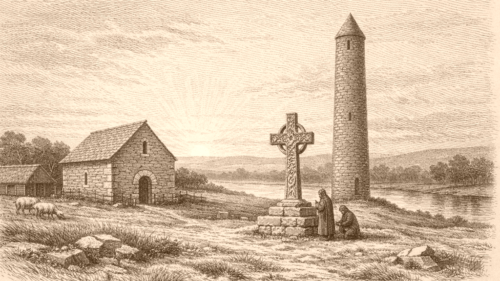
The two Ulster notices associated with the 599 sequence are both brief obituary-style entries. Ailither is named as abbot of Cluain Moccu Nóis, and Cainnech is identified through Achad Bó, with Cuanu cited for the latter. No narrative detail, cause of death, or wider political setting accompanies either notice in this excerpt. Their value lies in the naming of the dead and the monastic offices or places attached to them, not in any fuller account of events. [1]
The Annals of Inisfallen preserve nearby obituary material, but their own dating system must not be collapsed into Ulster’s. AI601 includes the slaying of Aed, son of Ainmire, and AI603 includes the repose of Ailithir, abbot of Cluain Moccu Nóis, and the repose of Cainnech moccu Dálann. These notices show that similar names appear in related annal traditions, yet they are not themselves presented here as 599 entries in Inisfallen. [3]
Battle Notices
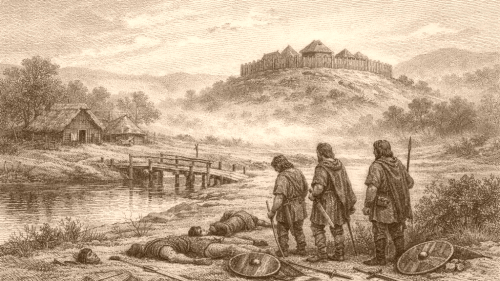
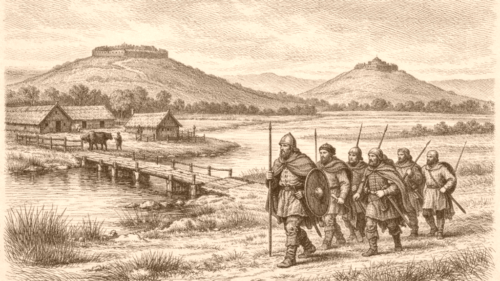
In the Ulster sequence, the battle of the Saxons is a distinct military notice linked to Aedán’s defeat. The entry gives only that battle and the fact of Aedán’s being vanquished; it supplies no place-name and no fuller narrative. Because it sits in the numbered sequence immediately after the boundary marker, it should be described as part of the surrounding annal sequence rather than turned into a broader historical summary. [1]
The Annals of Tigernach preserve a related battle notice, but under a different annal label. In T598 they record the battle of the Saxons by Aedán, naming Eanfraith, brother of Aethelferth, and Mael Uma son of Baetán. That wording is useful for comparison with Ulster, yet the Tigernach placement is its own sequence and should not be merged mechanically with the Ulster numbering or treated as identical dating. [2]
Kingship Death
Ulster also records the slaying of Suibne son of Colmán Mór by Aed Sláine in Brí Dam in the Suaine, with the place-name glossed as a stream. The notice is precise about the persons named and the location given, but its position belongs to the sequence following the 599 heading rather than to the earlier notices. It is therefore best treated as a nearby annal entry, not as a securely placed 599 event in a simplified reading. [1]
Tigernach gives the same death in a different form: the murder of Suibne, son of Colmán the Great, by Aod Sláine at Bridon on the stream Suane. The similarity of the names and place makes the comparison clear, but the Tigernach entry stands under T598. That different placement matters, because it shows the event circulating across annal traditions without allowing the Ulster and Tigernach year labels to be collapsed into one. [2]
Cross References
The Annals of Inisfallen also demonstrate that annal compilers worked with cross-references and parallel traditions. AI600 includes the battle of Sliab Cua gained against Mumu by the Connachta, marked with references to AU 597 and 603, and the death of the son of Cumuscach, identified with the plundering of the poetic company by Brandub son of Eochu, marked with AU 597. These references show comparison across annals, not a simple one-to-one dating scheme. [3]
Inisfallen’s AI599 is a chronological notice, not a local narrative event. It states that the years from the Passion of the Lord were 572 in that year. Read beside Ulster’s numbered sequence, it shows how annals could combine chronological formulae with narrative entries of different kinds. The result is a sparse record for this period, but not a blank one: the evidence is uneven, and the year systems must be kept distinct. [3] [1]
Historical Frame
Taken together, the excerpts preserve a small cluster of notices around the 599 sequence, but they do not all belong to a single year label in the same way. Ulster gives two obituary notices before the “AD 599” marker, then further notices after it; Tigernach and Inisfallen supply related or cross-referenced forms under their own numbering systems. The comparison is useful, yet the annal years remain separate witnesses that should not be flattened into one continuous narrative. [1] [2] [3]
What can be stated securely is limited. The material around 599 CE consists mainly of obituary entries, with the battle of the Saxons and the slaying of Suibne appearing in the adjacent Ulster sequence and in related forms in Tigernach. Inisfallen adds a chronological formula and cross-references. None of these excerpts by itself provides a full narrative of causes or consequences, so the record should be presented as dated notices rather than as a complete history. [1] [2] [3]
Source References
Hover over a number to see the source. Select it to open the source.