Saint Kevin of Glendalough
Saint Kevin of Glendalough was a pivotal figure in early Irish Christianity, credited with founding one of the most significant monastic settlements in Europe during the sixth century. While historical records from his era are sparse, tradition preserves the story of a man deeply committed to asceticism, solitude, and a profound harmony with the natural world. He is primarily remembered as the abbot who established the monastic city at Glendalough in County Wicklow. Tradition identifies Kevin’s parents as Caomhlugh and Caoimheall. According to hagiographical accounts, his early years were marked by spiritual promise; legendary narratives describe a blessing by an angel during his baptism by a priest named Cronan, which gave him the name Coemgenus, meaning ‘beautiful born’.
Dateline
Saint Kevin of Glendalough was a pivotal figure in early Irish Christianity, credited with founding one of the most significant monastic settlements in Europe during the sixth century. While historical records from his era are sparse, tradition preserves the story of a man deeply committed to asceticism, solitude, and a profound harmony with the natural world. He is primarily remembered as the abbot who established the monastic city at Glendalough in County Wicklow.
Early Life
Tradition identifies Kevin’s parents as Caomhlugh and Caoimheall. According to hagiographical accounts, his early years were marked by spiritual promise; legendary narratives describe a blessing by an angel during his baptism by a priest named Cronan, which gave him the name Coemgenus, meaning ‘beautiful born’. He received his early spiritual formation at the monastery of Kilnamanagh in Tallaght, near Dublin, where he studied under three holy men: Eoghan, Lóchán, and Éanna.
Ascetic Pursuits
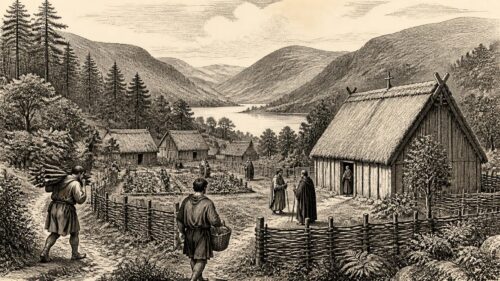
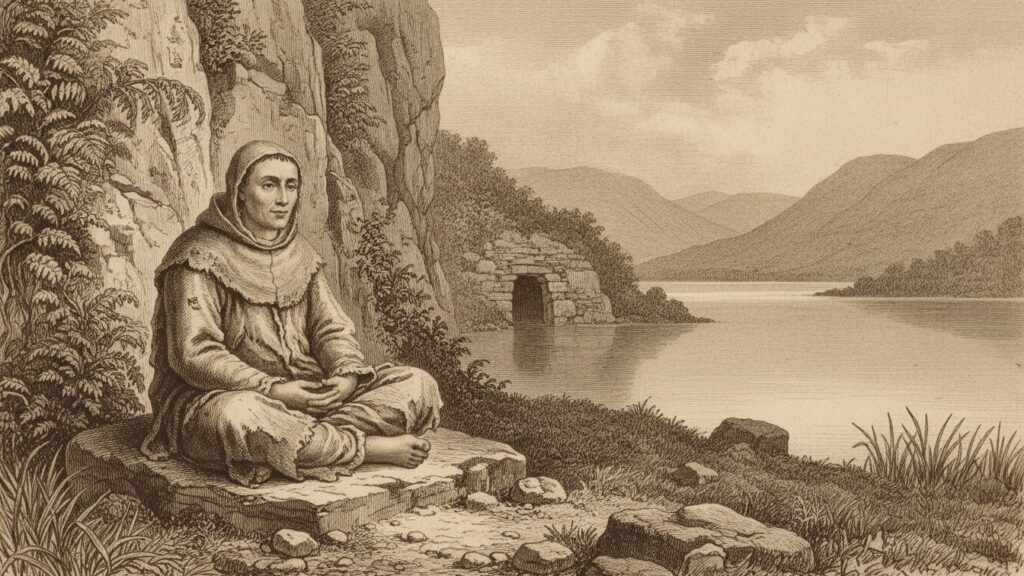
Driven by a desire for solitude, Kevin eventually sought isolation in the Wicklow Mountains. He is said to have spent time at Hollywood near Blessington before settling in the valley of Glendalough. His commitment to a rigorous ascetical life is exemplified by his choice of residence; tradition states he lived in a narrow cave in a rock above the upper lake, a site still known today as St Kevin’s Bed. In this secluded environment, he reportedly wore only animal skins, slept on a stone slab, and practiced penitential prayers by standing in the cold waters of the lake.
Divine Nature
The legends surrounding Kevin frequently emphasise his kinship with animals and nature. Traditional tales describe an otter returning a dropped psalm book from the lake and a blackbird nesting in his outstretched palm during Lent, with Kevin remaining still until the bird had fledged. Another narrative tells of a wild boar seeking refuge in his oratory, where the pursuing hunters were deterred by the sight of the saint’s peaceful coexistence with the birds perched upon him. These stories reflect the Celtic ideal of the saint as a protector and companion of creation.
Monastic Foundation
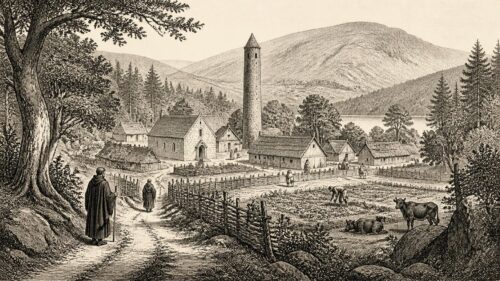
Despite his preference for the life of a hermit, Kevin’s reputation attracted disciples. This led to the establishment of a monastic settlement in the lower valley of Glendalough. While he served as an abbot and oversaw the growth of this community, he chose to remain a priest rather than ascend to the rank of bishop. He maintained a balance between the communal life of the monastery and his personal solitude, continuing to spend time at a hermitage near his cave at Templenaskellig.
Uncertain Dates
Establishing precise dates for Kevin’s life is challenging, as the primary sources—including the Codex Kilkenniensis and various Irish Lives—rely heavily on oral tradition and later transcriptions. Some records suggest a birth date of 498 and a death date of 618, though the Annals of Ulster are cited for the latter. Historians note that a lifespan of 120 years is unlikely, suggesting instead that he was more likely born in the middle of the sixth century. Because of this discrepancy, his exact dates of birth and death remain uncertain.
Lasting Legacy
Following his death, the settlement he founded evolved into a renowned monastic city. The ruins currently found at Glendalough, including the iconic 30-metre round tower, St Kevin’s Church (often called St Kevin’s Kitchen), and various medieval stone crosses, stand as a testament to the enduring influence of his foundation. His legacy persists as a symbol of the spiritual integration of nature and faith in the Irish landscape.
Source References
Hover over a number to see the source. Select it to open the source.