Marked Year622 CE
The annals for 622 present a compact but uneven record of Ireland in that year. Ulster gives the year heading and records battles, a drowning, and several deaths, while the Four Masters and Inisfallen preserve partly overlapping notices. This narrative distinguishes securely dated entries from broader contextual material and avoids supplying missing detail. It compares the wording, order, and scope of the notices as they stand, and it treats omissions as part of the evidence rather than as gaps to be filled by speculation.
Dateline
Year Entry
The year 622 appears in these annals as a set of brief notices rather than a single connected story. Ulster opens with the year label and then lists a battle, a drowning, deaths, another battle, and further deaths. The Four Masters similarly mark 622 and continue with battles and obits. In both witnesses, the year heading is the secure anchor, while the notices remain compact and separate. [1] [2]
Inisfallen also preserves the year, but it does so through later cross-references to AU 622. Those references attach Cennbag and Cenn Delgthen to the same year as Ulster. The wording is not identical across the witnesses, and the order of notices differs. The safest reconstruction therefore keeps the annual frame shared, while resisting any attempt to merge all entries into one continuous chronology. [3] [1]
Dating Marks
The dating formulae differ from one witness to another. Ulster gives U622 and adds a calendrical note at the head of the year; the Four Masters write the Age of Christ, 622; Inisfallen places its own annal sequence before linking selected notices back to AU 622. These forms are not the same, but each serves to place particular notices inside the year 622 rather than inside a narrower date. [1] [2] [3]
The evidence does not support a finer dating of the battles than the year itself. Ulster gives month-and-day style precision for two ecclesiastical deaths, but the battle notices remain placed under the annual heading. Inisfallen likewise connects Cennbag and Cenn Delgthen to AU 622 without adding a day or month. The secure result is therefore annual, not seasonal or daily, for the fighting recorded here. [1] [3]
Battle Cennbag
Inisfallen’s notice for Cennbag is brief but precise within its own limits. It states that Colmán son of Cobthach son of Ailill son of Cellach fell in that battle. The same year in the Four Masters contains a different battle title, Carn Fearadhaigh, where Failbhe Flann gained the victory and named men fell. The two notices belong to the same year, but the texts do not identify them as the same event. [3] [2]
Because the passages keep their own place-names and casualty lists, no secure identification can be made between Cennbag and Carn Fearadhaigh. The evidence only allows a comparison of format: one witness records a short battle death, while another gives a fuller battle notice with a named victor and several deaths. Any stronger identification would go beyond what these excerpts themselves state. [3] [2]
Battle Delgthen
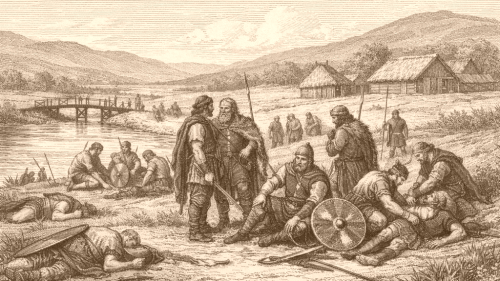
Ulster’s clearest battle notice for 622 is Cenn Deilgthen. It says that Conall son of Suibne was victor and that two sons of Librén, son of Illand son of Cerball, fell. Inisfallen also places Cenn Delgthen under AU 622 and again names Conall son of Suibne son of Colmán as victor. These are matching year assignments, not separate reconstructions. [1] [3]
The two notices agree on the battle name and on the victor, but they do not give a narrative of causes or sequence. Ulster also places other notices in the same year, while Inisfallen keeps its battle line compressed to a single sentence. The secure facts are limited to the named battle, the victor, and the named dead who are attached to it. [1] [3]
Death Notices
Ulster’s 622 entry contains several deaths in addition to the battles. It records the drowning of Conaing son of Aedán, the death of Mael Mracho son of Rímid son of Colmán son of Cobthach, the battle death of Colmán son of Cobthach at Cennbag, the killing of Ailill son of Cellach, and the death of Colgu son of Cellach. These are year entries, but the text does not connect them by explanation. [1]
The Four Masters add a different cluster of deaths under the same year, including Feargna Brit, abbot of Iona and a bishop; Lachtnain son of Torben, abbot of Achadh Ur; and Mac Laisre, bishop and abbot of Ard Macha. Their 622 notices do not overlap exactly with Ulster’s named deaths, and Inisfallen’s 622 line for Cennbag is a battle death rather than an obituary. The year is crowded, but not uniform. [2] [3]
Church Entries
The ecclesiastical notices are short and locally specific. The Four Masters identify Feargna Brit as abbot of Iona and a bishop, Lachtnain as abbot of Achadh Ur, and Mac Laisre as bishop and abbot of Ard Macha. Ulster’s year entry does not repeat those clerics, but it does include deaths and battle notices within the same annual frame. The witnesses therefore preserve clerical deaths alongside lay deaths without turning them into one account. [2] [1]
The excerpts do not support a broader claim about church politics, institutional change, or coordinated action in 622. What they do show is that clerical deaths can stand beside battles and other deaths in the same annal year. In that sense, the evidence is documentary rather than explanatory: it records who died, where a battle was placed, and how each witness framed the notice, but not why the events occurred. [1] [2] [3]
Witness Comparison
Seen together, the witnesses agree on the basic shape of the year while preserving different details. Ulster assigns Cenn Deilgthen and several deaths to 622; Inisfallen links both Cennbag and Cenn Delgthen back to AU 622; and the Four Masters place a distinct set of battle and death notices under the Age of Christ, 622. The strongest secure result is not a merged chronology, but overlapping annual notices. [1] [3] [2]
The differences matter as much as the agreements. Ulster includes the drowning of Conaing and then further deaths after the battle notices; Inisfallen keeps its battle entries terse; the Four Masters present their own battle naming and clerical obits. The passages should not be flattened into one story, because they do not say the same things in the same order. They simply converge on the year 622. [1] [3] [2]
Record Limits
The most striking feature of the evidence is its brevity. None of the passages gives a battle sequence, a casualty total, or a broader narrative explanation. None spells out motives or consequences. What survives is strictly annalistic: a year heading, a place-name, a named victor or dead person, and short notices of death. That compression is itself part of what can be described responsibly for 622. [1] [2] [3]
The safest conclusion is therefore narrow. Ireland in 622 is securely represented here by two named battles, several deaths, and one drowning, with clerical obits appearing in the same year in another witness. Beyond those notices, the excerpts remain silent. That silence should not be filled with invented background or inferred sequence; it should be preserved as silence, because the texts support only the specific events they actually record. [1] [2] [3]
Source References
Hover over a number to see the source. Select it to open the source.