Saint Aidan of Lindisfarne
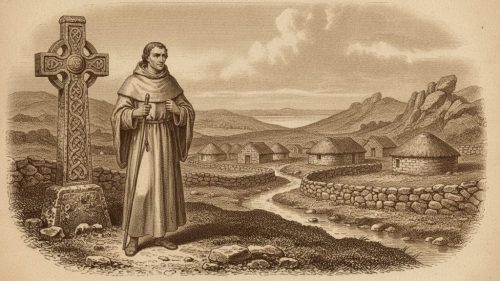
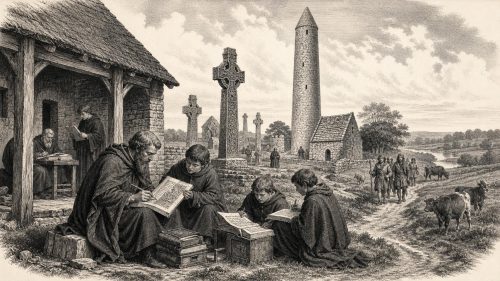
Saint Aidan of Lindisfarne was a pivotal figure in the early medieval Christianisation of Northern Britain. Born in Ireland around 590 AD, he spent his early years as a monk on the island of Iona, off the west coast of what is now Scotland. This monastery, founded by Columba, served as a primary centre for the Irish Church and became the spiritual home for Aidan during his youth. While very little is known of his earliest life, his tenure at Iona prepared him for the missionary work that would eventually define his legacy in the kingdom of Northumbria.
Dateline
Saint Aidan of Lindisfarne was a pivotal figure in the early medieval Christianisation of Northern Britain. Born in Ireland around 590 AD, he spent his early years as a monk on the island of Iona, off the west coast of what is now Scotland. This monastery, founded by Columba, served as a primary centre for the Irish Church and became the spiritual home for Aidan during his youth. While very little is known of his earliest life, his tenure at Iona prepared him for the missionary work that would eventually define his legacy in the kingdom of Northumbria.
Royal summons
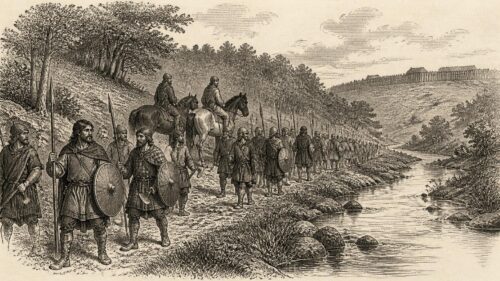
The trajectory of Aidan’s life changed through his connection to King Oswald of Northumbria. Oswald, a noble youth who had spent years in exile, had been raised at the monastery of Iona and was baptised as a Christian there. Upon gaining the crown of Northumbria in 634, Oswald sought to restore Christianity to his people, who had largely returned to Anglo-Saxon paganism following the collapse of Roman military rule. Initially, Oswald requested missionaries from Iona rather than the Roman-sponsored monasteries of Southern England. While the monastery first sent a bishop named Cormán, he failed to connect with the local population. Consequently, Aidan was summoned to serve as bishop, arriving in 635 AD to lead the spiritual rebirth of the region.
Island foundation
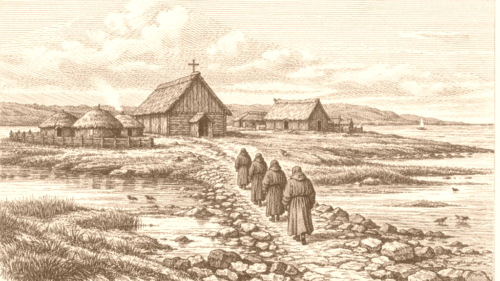
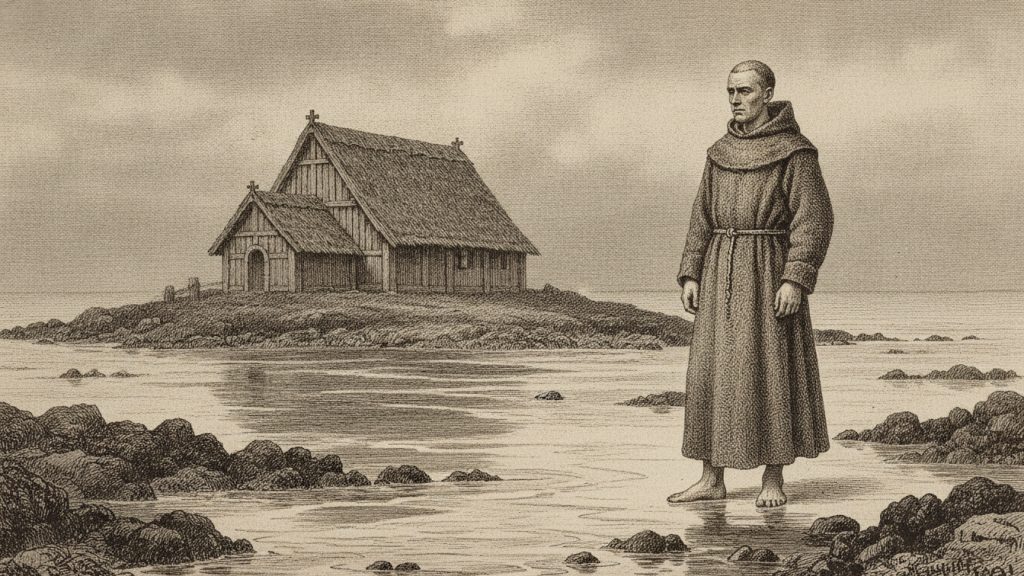
King Oswald granted Aidan and his companions a small tidal island known as Lindisfarne, located approximately six miles from the royal palace at Bamburgh. On this site, Aidan founded a monastery that would become one of the most significant centres of learning and Christianity in early England. The community was established as a bishopric, and for nearly thirty years, it remained the sole seat of a bishopric in Northumbria. This strategic location, situated within the political heart of the Bernician dynasty, ensured the mission’s success and the monastery’s long-term wealth. The community’s early structures were modest; according to the historian Bede, the church was built of hewn oak thatched with reeds, a fact for which Bede expressed some criticism.
Missionary efforts
Aidan is frequently remembered as the “Apostle of Northumbria” due to his tireless devotion to evangelism. He did not remain confined to the walls of his monastery but travelled ceaselessly across the landscape. His preaching was inclusive, reaching both the Anglo-Saxon nobility and the poor. This approach is credited with the widespread restoration of the faith across the Northumbrian kingdom. Beyond the borders of Northumbria, the influence of Aidan’s community extended further, as Lindisfarne served as a base for successful missions into the kingdom of Mercia.
Ascetic legacy
Contemporary accounts, particularly the meticulous writings of the Venerable Bede, describe Aidan as a man of strict asceticism. He lived a life of simplicity and discipline, mirroring the traditions of the Iona community. His leadership laid the groundwork for future figures of the Northumbrian church, most notably Saint Cuthbert, who would later join the monastery and become its most famous monk-bishop. Aidan’s influence persisted long after his death, establishing a tradition of scholarship and spirituality that would eventually produce the Lindisfarne Gospels in the early 8th century.
Final days
Aidan’s active ministry concluded in the year 651. Tradition records that he died on 31 August 651 at the royal castle at Bamburgh. He was subsequently recognised as a saint by both the Catholic and Anglican churches, honoured for his role in the conversion of the English people and his commitment to a disciplined, monastic life.
Source References
Hover over a number to see the source. Select it to open the source.