Sparse Year614 CE
The surviving annalistic evidence for 614 CE is extremely sparse. One Irish sequence records only the burning of Bennchor under that year, while another tradition places a battle in Britain under 614 and notes that other annals assign it to 613. A fragmentary annal sequence also records a star seen in the third hour of the day for 614. These notices are brief, separate, and not linked by the texts themselves. This account distinguishes those securely dated entries from nearby or cross-referenced material, and it avoids filling gaps with conjecture about causes, participants, or wider consequences.
Dateline
Year Bounds
The evidence for 614 CE is narrow, and the surviving notices do not create a continuous narrative. In one annalistic sequence, the year marker for 614 is followed only by the burning of Bennchor. In another tradition, a 614 entry concerns a battle in Britain. A fragmentary sequence also places a star sighting under 614. These notices are separate, brief, and differently framed, so any account of the year has to stay close to each entry’s own wording. [1] [2] [3]
The immediate surrounding years help define the limits of the record, but they do not enlarge 614 itself. In the same Tigernach sequence, 613 includes a battle and several deaths, while 615 includes the burning of Donnán Ega, the devastation of Tory Island, and the burning of Connere. Those entries show that nearby annal years can carry more detail than 614, yet they remain adjacent notices rather than evidence for the year under study. [1]
Bennchor Burning
The clearest Irish notice for 614 is concise: the burning of Bennchor. The entry gives no names, no cause, and no sequence of events beyond the burning itself. Because the wording is so spare, the only secure statement is that Bennchor is said to have burned in 614 within this annalistic tradition. Nothing in the entry identifies who was responsible or what followed afterward. [1]
Bennchor appears elsewhere in the annals as a named ecclesiastical place, but those other notices do not add details to the 614 entry. The same Tigernach sequence mentions the death of Sillán son of Cumaine, abbot of Bennchor, in an earlier year, and Inisfallen later records a burning of Bennchor of Ulaid. These comparisons show that the place was a recurring annalistic landmark, while still leaving the 614 fire undescribed. [1] [2]
British Battle
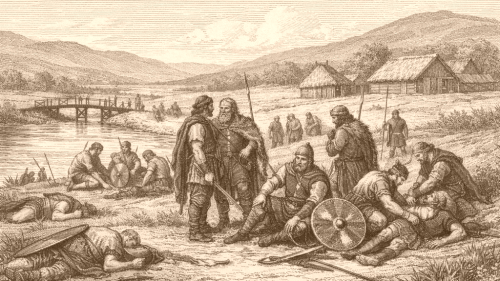
Another 614 notice places a battle in Britain between Saxons and Britons. The entry says that many holy men fell, but it does not name them or explain the course of the fighting. The bracketed place name also signals editorial uncertainty in the transmitted wording. What remains secure is the battle’s British setting, the opposing groups, and the reported deaths of holy men. [2]
That same entry includes a cross reference that points to AU 613, which means the notice is not isolated from annalistic comparison. The cross reference does not change the wording of the 614 item itself, but it shows that the tradition is aware of another chronological assignment. For a cautious account, this is important mainly as evidence that the year placement is not uniformly transmitted across the annals. [2]
Star Sighting
The fragmentary annals offer a different kind of 614 notice: a star was seen in the third hour of the day. This is an observational record rather than a battle, death, or burning. The notice is brief and self-contained, and it gives no explanation for the sighting or any connection to the other 614 entries. It is nonetheless a securely dated item within the surviving fragment. [3]
The same fragmentary sequence places 612 as the beginning of Mael Coba’s reign and 615 as the year of his slaying, so the 614 star entry sits inside a compact chronological framework. That framework helps locate the notice in relation to neighboring years, but it does not convert the star sighting into a political or military event. The record preserves only the observation, not an interpretation of it. [3]
Chronology Notes
The annals around 614 show that year labels can be unevenly transmitted while the entries remain short. Inisfallen places the British battle under 614 but appends a note pointing to AU 613. The same text also places the repose of Fintan, abbot of Bennchor, and Luicell, abbot of Cluain, with notes pointing to other years. These cross references are part of the evidence, but they also warn against flattening different dating systems into one smooth sequence. [2]
Tigernach and the fragmentary annals show a different pattern: short notices are placed directly under a year marker with little commentary. In Tigernach, 614 contains only the burning of Bennchor. In the fragmentary sequence, 614 contains the star sighting. The comparison is limited but useful: both traditions preserve a single, terse notice for the year, and neither expands it into a fuller event narrative. [1] [3]
Adjacent Context
The adjacent years provide context without supplying new facts for 614. In Tigernach, 613 includes the battle of Fidnach and the death of Rónán son of Colmán, king of Leinster, while 615 includes the burning of Donnán Ega and other destruction. In the same broad annalistic horizon, Inisfallen records other deaths and rests in neighboring years. These surrounding notices show that 614 is part of a denser chronological field, but the year itself remains sparsely documented. [1] [2]
Because the neighboring entries differ in subject matter, they should not be merged into a composite 614 narrative. One text records a battle, another a church burning, and another a star. The overlap is chronological, not descriptive. That means the historian can compare the entries as annalistic witnesses to the same year, but cannot legitimately infer that they refer to a single connected sequence of events. [1] [2] [3]
Secure Limits
For 614 CE, the securely dated material is limited to three kinds of notice: the burning of Bennchor, the battle in Britain, and the star sighting in the third hour. Each appears in a different annalistic setting, and each is stated briefly. The evidence does not identify a shared cause, a linked campaign, or a broader sequence joining the notices together. It preserves isolated claims, not a stitched narrative. [1] [2] [3]
What the record leaves out is as important as what it states. No surviving excerpt here explains the burning of Bennchor, names the holy men killed in Britain, or interprets the star. The year can therefore be described only within the strict limits of the notices themselves. A careful historical account must stop at those limits and avoid adding events that the texts do not actually preserve. [1] [2] [3]
Historical Rest
The surviving evidence for 614 CE is therefore best read as a set of brief entries set beside one another rather than as one coherent story. Tigernach records Bennchor’s burning; Inisfallen records a battle in Britain; the fragmentary annals record a star. None of these texts, in the excerpts available here, extends the notice into a fuller account of politics, society, or causation. Their value lies in their restraint. [1] [2] [3]
The safest conclusion is modest. There is evidence for 614, but it is thin, uneven, and distributed across separate annalistic traditions. The year is not empty, yet the record does not permit a richer reconstruction than the texts themselves allow. The historian can name the notices, compare their placement, and mark the omissions, but should not use them to supply a narrative that the annals do not provide. [1] [2] [3]
Source References
Hover over a number to see the source. Select it to open the source.