Columba’s Passing597 CE
The annals for 597 CE preserve a small but usable set of notices from Ireland and its wider world. They date the death of Colum Cille to 9 June, record the slaying of Aed son of Ainmire in one tradition, and place several battles and deaths in the same year or in closely adjacent annalistic systems. The entries do not give a continuous narrative, and some manuscripts shift the same events by a year. This makes 597 best read as a year with a few securely dated items and several overlapping chronological formulations, not as a full political chronicle.
Dateline
Year Frame
The annalistic material does not present 597 CE as a continuous story. In the Four Masters, the year appears as a formal heading followed by brief notices; in Inisfallen, the same year is likewise reduced to short entries; and in Ulster and Tigernach the notices are arranged under year headings that sometimes disagree by a year or more. The secure point is that the surviving texts preserve a cluster of notices placed by their compilers under 597 or its immediate equivalents, not a coordinated narrative of one political season. [1] [2] [3] [4]
The same cluster also shows that the annalists did not always agree on where a notice belonged. Ulster places the repose of Baethéne and the killing of Aed son of Ainmire under AD 597, while Inisfallen places the repose of Colum Cille in 597 and adds Gregory of Rome only as a secondary notice; the Four Masters gives deaths and battles under 597 without those cross-references. Tigernach, by contrast, places the beginning of the joint rule of Colmán Rimedha and Aodh Sláine in the surrounding years. [1] [2] [3] [4]
Monastic Death
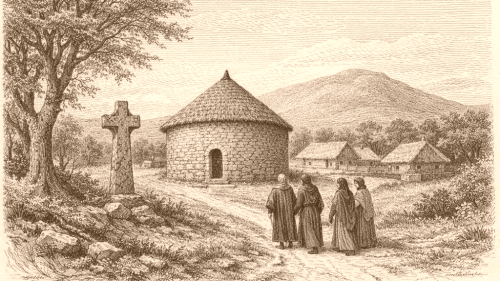
Inisfallen places Colum Cille’s repose on Sunday night, 9 June, in the thirty-fifth year of his exile and the seventy-sixth year of his age. Ulster also records his repose in June, on the fifth of the Ides, and again gives his age as seventy-six. The Four Masters entry for 595 records only Baeithin, abbot of Ia Choluim Cille, who died on 9 June; it does not assign Colum Cille’s death to that year in the cited notice. [2] [3] [1]
The surrounding annals show a cluster of notices across nearby years, but they do not all align on a single 597 frame. In Inisfallen, AI597 includes Gregory of Rome, marked “according to others,” while AI598 begins with the battle of Ráith in Druad and the battle of Ard Sendaim. Tigernach, by contrast, places Gregory under T604.2 and moves related battle notices into later annal years. The evidence therefore supports proximity and variation, not a unified year-by-year equivalence. [2] [4]
Royal Violence
The annals place political violence prominently in the same year, though the wording varies. The Four Masters records the sword blows of Bran Dubh in Breagh, the death of Brenainn son of Cairbre, the battle of Sleamhain, and the battle of Cuil Cael under 597. Ulster assigns the killing of Cumascach son of Áed by Brandub son of Eochu, the battle of Sliab Cua in the territories of Mumu, and the death of Tipraite son of Calgach to AD 597. [1] [3] [4]
Inisfallen links some of this material to the same year while also preserving a different ordering. It notes the battle of Ráith in Druad, the battle of Ard Sendaim, and the flight of the Uí Fhinn, followed by later cross-references that connect Sliab Cua and the death of the son of Cumuscach to 597 in adjacent annalistic placement. Tigernach, too, places a battle horizon nearby, including the battle of the Saxons and the later killing of Brandub in the following sequence of years. [2] [4]
Kingship Notice
The kingship notices around this period are formulaic, but the year labels differ from one annal to another. In the Four Masters, M595 gives the first year of Aedh Slaine and Colman Rimidh, M596 the second year, and M597 the third year. Tigernach places the beginning of the rule of Colmán Rimedha and Aodh Sláine in T596.3. Ulster adds the beginning of the joint-reign of Colmán Rímid and Aed Sláine under U598.5. The record is overlapping rather than uniform. [1] [4] [3]
This overlap helps explain why the year cannot be treated as a single fixed political snapshot. Ulster’s heading for AD 597 sits beside the joint-reign notice and the killing of Aed son of Ainmire, while Tigernach places the same joint rule near entries for other deaths. The Four Masters also keeps the reign formula close to deaths and battles rather than giving a separate political narrative. [1] [3] [4]
Textual Limits
The evidence for 597 is strongest when restricted to what the annals actually date. Colum Cille’s death is the clearest securely placed event, while battles and royal deaths cluster around the same year in several annalistic systems. Beyond that, the records become less exact, with some events shifted, duplicated, or accompanied by explanatory additions such as alternative attributions. [1] [2] [3] [4]
The annals also show what cannot be safely claimed. They do not provide enough detail to reconstruct battlefield movements, policy, or causation from the year 597 alone. They do, however, consistently present death notices for churchmen and kings alongside battles, and they sometimes preserve named individuals with family relationships and places. That is the limit of the evidence: a compact annual record with clear dates for some deaths, approximate placement for several conflicts, and no warrant for filling the gaps with invented continuity. The cautious conclusion is not emptiness, but restraint. [1] [2] [3] [4]
Annual Picture
Taken together, the annals show death, conflict, and reign notices in a compressed chronological band, but not all of them belong to a single fixed year. Four Masters M597 contains Bran Dubh’s blows, the death of Brenainn son of Cairbre, the battle of Sleamhain, the battle of Cuil Cael, Uata’s death, and Eochaidh son of Diarmaid’s death. Ulster places Cumascach son of Áed, Sliab Cua, and Tipraite son of Calgach under AD 597. Tigernach, however, places only Ailithir, Gartnaidh, and the Saxons’ conversion under T597. [1] [3] [4]
That proximity is the most responsible historical conclusion that can be drawn for this specific year. Where the annals agree, 597 contains a major monastic death and several violent notices; where they differ, the differences themselves are part of the record and must be retained. The result is a careful outline rather than a narrative reconstruction, and the outline is enough to show what can be dated securely and what remains uncertain. In that sense, the annals preserve not a smooth chronicle but a series of dated memorials, each one a fragment of larger historical change. [1] [2] [3] [4]
Source References
Hover over a number to see the source. Select it to open the source.