Annal Year615 CE
The surviving annals preserve only brief notices for the year commonly discussed as 615 CE, and they do so in different chronological frames. The Annals of Ulster places its relevant material under a heading marked AD 614, while the Annals of Tigernach uses T615, and Inisfallen later cross-references one battle notice to AU 615. This essay keeps those systems separate and identifies only the items explicitly placed in or linked to the year. It distinguishes securely dated notices from adjacent-year material and avoids filling the annal gap with conjecture.
Dateline
Year Markers
The surviving record for 615 must begin with chronology, because the relevant annals do not present the year in exactly the same way. In the Annals of Ulster, the notices grouped here appear after a heading that reads AD 614, followed by the year marker and then the brief entries. In the Annals of Tigernach, the comparable material appears under T615. The difference is plain in the text and requires caution in any modern summary. [1] [2]
That caution is strengthened by Inisfallen, which does not simply repeat the same wording but cross-references the battle of Sliab Tuath to AU 615. Its editorial notices also point some items to adjacent years, showing that year-equivalence is not automatic across the compilations. For that reason, the secure approach is to keep each annal’s own dating system distinct before comparing the notices themselves. [1] [3]
Battle Notices
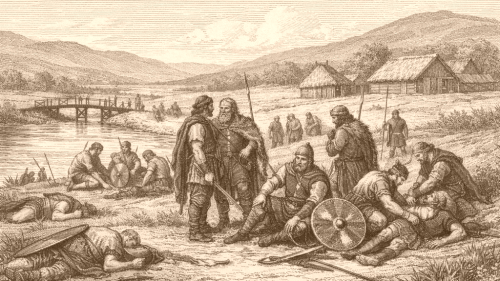
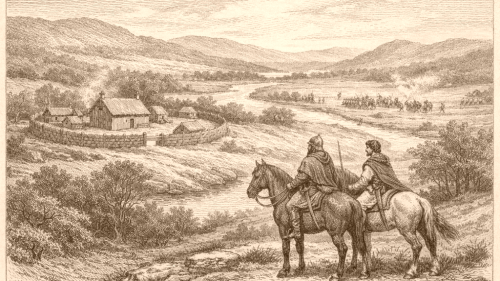
Within the Annals of Ulster’s material for this year, the clearest military notice is the slaying of Mael Coba son of Áed in the battle of Sliab Tuath Bélgadhain, also called Sliab Truim. The entry adds that Suibne Menn was victor. Nothing in the wording supplies a fuller narrative of strategy, motive, or wider consequences, so the notice must be treated as a brief record of an event rather than an explanation of it. [1]
The same conflict appears in Inisfallen, where the battle of Sliab Tuath is attributed to the Laigin over Mael Coba son of Aed, and Mael Coba is said to have fallen. In that notice, Suibne reigned after him. The comparison is useful only as a comparison: it shows that the event was remembered in more than one compilation, but it does not erase the different wording or the separate chronological framing. [3]
Monastic Deaths
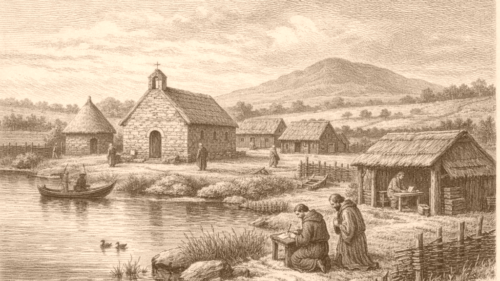
The Ulster entry for this year also records the repose of Diarmait, identified as the third abbot of Cluain Iraird. This is a compact obituary notice and, within the annal’s own sequence, belongs with the year’s securely placed items. The wording gives office and death, but no further account of his life, his monastery, or the circumstances of his repose. [1]
A second monastic death notice in the same Ulster block is the repose of Caemán the Speckled. Tigernach, by contrast, places some ecclesiastical deaths in nearby years rather than under the same heading, and Inisfallen cross-references several monastic deaths to surrounding years rather than to one fixed date. The secure point is therefore limited: Ulster preserves these two rests in its year-entry, while the other annals do not align identically in wording or placement. [1] [2] [3]
Burning Notices
Tigernach’s entry for 615 preserves a notably different cluster of notices. It records the burning of Donnán of Ega on the fifteenth of the Kalends of May, together with one hundred and fifty martyrs, and adds the devastation of Tory Island and the burning of Connere. The entry is terse, but it is concrete, and the internal date attached to Donnán of Ega is the most precise day-level reference in the surviving 615 material. [2]
The same Tigernach passage then turns to a non-Irish chronological note, stating that Isidore wrote his chronicle down to this year. That statement belongs to the annalist’s framework and not to an Irish event. It should therefore be kept separate from the burning notices. The Irish material in the entry remains the destruction of Donnán of Ega, Tory Island, and Connere, not the chronicle note that follows them. [2]
Chronology Caution
The juxtaposition of Ulster, Tigernach, and Inisfallen shows that the year commonly called 615 cannot be flattened into a single uniform list. Ulster’s relevant notices stand under a calendar formula for AD 614; Tigernach labels its block T615; Inisfallen later ties one battle notice to AU 615. These forms of dating overlap, but they are not interchangeable, and the differences matter for any secure summary. [1] [2] [3]
This means that some entries can be compared across compilations, while others should remain within their own annal’s chronology. The battle of Sliab Tuath is one such comparandum; the burning of Donnán of Ega is another notice preserved in a different compilation; the monastic rests in Ulster remain Ulster’s own notices. The evidence does not justify merging them into one undifferentiated narrative of a single year. [1] [2] [3]
Adjacent Years
The surrounding years help define the limits of the 615 material without becoming part of it. In Ulster, the nearby notices include a star seen in the preceding year and deaths and a burning in the following year. In Tigernach, the sequence moves from 614 to 615 and then to 616, where it continues with rests, deaths, a ravaging, and an earthquake in Gaul. Those items are adjacent, not part of the 615 record. [1] [2]
Inisfallen also demonstrates how nearby material can be grouped around the same chronological window without belonging equally to it. Its entries link one battle to AU 615 and place other notices beside 613, 614, 616, 617, and 618. The visible pattern is therefore one of editorial clustering rather than a single continuous narrative. Only the items explicitly assigned or cross-referenced should be treated as evidence for the year under discussion. [3]
Secure Record
With chronology kept separate, the securely evidenced 615 material is short but definite. Ulster preserves the slaying of Mael Coba at Sliab Tuath, the repose of Diarmait, and the repose of Caemán. Tigernach preserves the burning of Donnán of Ega with one hundred and fifty martyrs, the devastation of Tory Island, and the burning of Connere. These are the direct notices visible in the surviving excerpts, and nothing more should be added. [1] [2]
The record does not support filling its gaps with invention. There is no continuous account of Irish affairs for this year in the excerpts, no explanation of cause, and no securely dated sequence that links the notices into one narrative. What survives is a set of brief annalistic entries, some singular to one compilation and some echoed or cross-referenced in another. Their limits are as important as their contents. [1] [2] [3]
Historical Outline
Taken together, the notices for this year show a pattern of battle, death, and burning, but they do so only in the narrow form that annalistic record permits. The Ulster and Tigernach entries overlap in broad date-range, yet differ in content and chronology, while Inisfallen confirms at least one battle by later cross-reference. The result is a restrained outline rather than a full narrative. [1] [2] [3]
The most careful conclusion is also the narrowest one. Ireland in 615, as these excerpts preserve it, consists of a few named deaths, one battle notice with a named victor, and several burnings or devastations recorded in one annal or another. The year is therefore recoverable only in fragments, and those fragments should remain tied to the exact wording and chronology of the individual annals that preserve them. [1] [2] [3]
Source References
Hover over a number to see the source. Select it to open the source.