Saint Senan
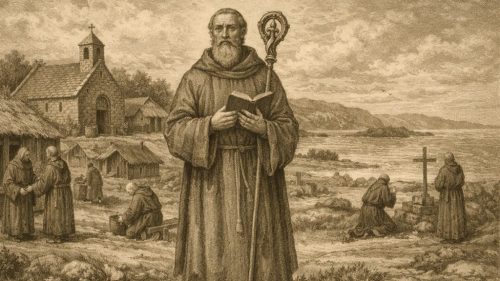
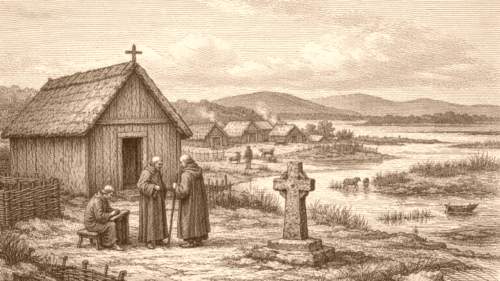
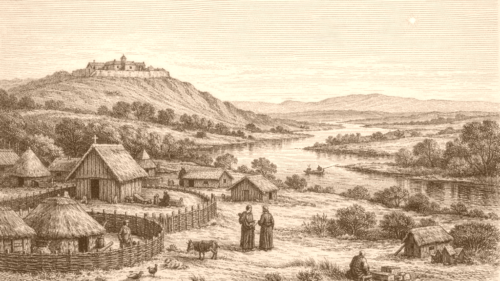
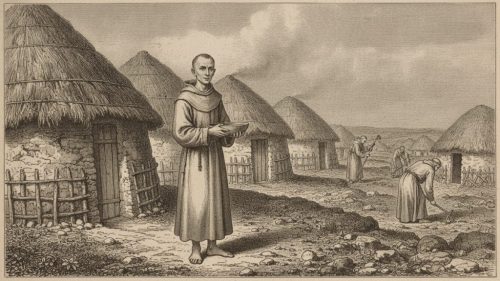
Saint Senan is remembered in Irish religious tradition as the saint most closely associated with Scattery Island in the Shannon estuary. The evidence supplied for his life is not a contemporary biography, but a mix of later medieval miracle literature, antiquarian description, and modern heritage interpretation. For that reason, only a limited historical outline can be stated with confidence: Scattery was a major monastic site linked with Senan, the island’s sacred identity remained tied to his name, and later writers continued to present it as a place of devotion and antiquity. The strongest evidence in the supplied sources concerns Scattery itself.
Dateline
Saint Senan is remembered in Irish religious tradition as the saint most closely associated with Scattery Island in the Shannon estuary. The evidence supplied for his life is not a contemporary biography, but a mix of later medieval miracle literature, antiquarian description, and modern heritage interpretation. For that reason, only a limited historical outline can be stated with confidence: Scattery was a major monastic site linked with Senan, the island’s sacred identity remained tied to his name, and later writers continued to present it as a place of devotion and antiquity.
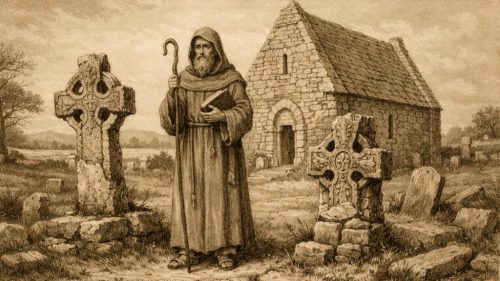
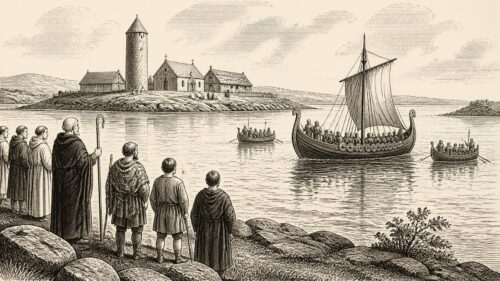
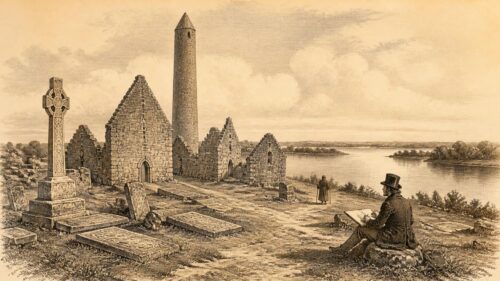
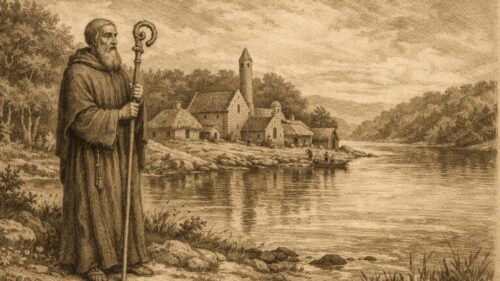
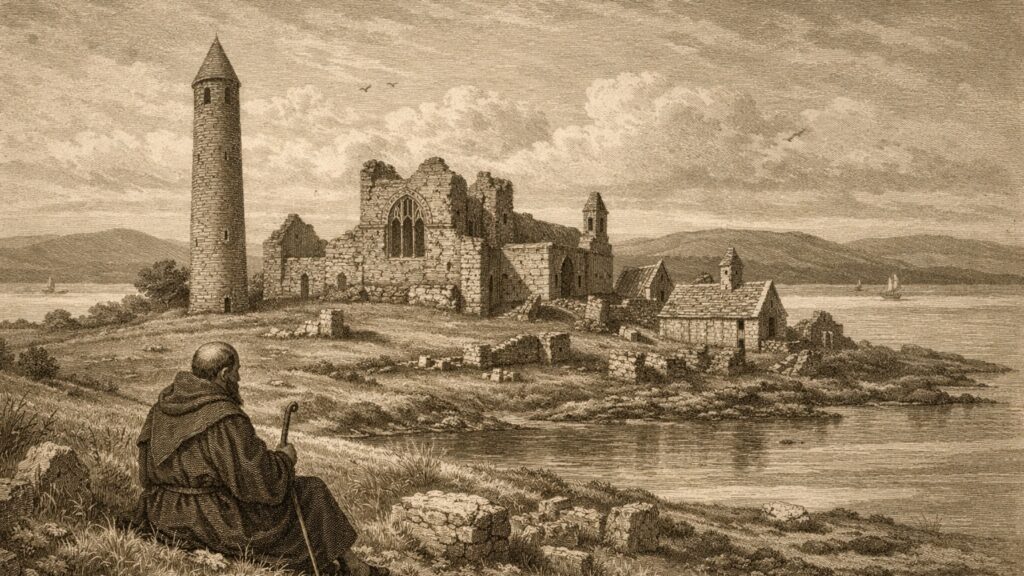
The strongest evidence in the supplied sources concerns Scattery itself. Heritage Ireland describes Scattery Island as containing “the remains of ancient monastic heritage” with a round tower, the cathedral, and several medieval churches. Its visitor information also states that guided tours explain “St. Senan’s brave battle against the serpent Cathagh” and his founding of “a monastic settlement dating back to the early sixth century.” These are presented as the island’s traditional story, and they show how closely Senan’s memory is bound to the site. The same source also notes that the island remains a protected historic place with visible remains from different periods, including ecclesiastical structures and later lighthouse and battery features.
Island Tradition
In the early modern travel account from John Lloyd’s A Short Tour, Scattery is described as “famous for it’s being the Residence of that pious and early Christian St. SENAN.” Lloyd adds that Senan was “born near KILLRUSH,” that people came there in earlier times “to perform Penance, and offer large Donations before this Holy Shrine,” and that the island had “five or six large and small Churches” and “perhaps, the loftiest old Steeple in the Kingdom.” The same passage repeats the island legend that it was once occupied by “CATHAGH,” the monster who was expelled by Senan. This text is valuable as evidence for how the island was understood in the eighteenth century, but it is also a later devotional and descriptive account rather than a secure record of sixth-century events.
The scholarly notice recorded by Irish History Online is also cautious but important. It identifies Jeremiah Newman’s article “Scattery : an unknown part of the diocese of Limerick” and lists Senan as a saint associated with Scattery Island in County Clare. This supports the fact that the saint’s memory remained a subject of historical and ecclesiastical study. The record itself does not provide a detailed biography; instead, it confirms the importance of Scattery in the church history of the region.
Miracle Texts
The digital edition of The Miracles of Senan helps explain how his reputation was preserved and expanded. Charles Plummer’s introduction states that the work is drawn from manuscript witnesses and that the writer “calls attention to the fact that these Miracles of Senan are modern miracles,” meaning that they were not miracles from the saint’s own lifetime. The text is therefore evidence for later devotion, not for direct historical biography. Plummer also says that some of the miracles concern “the relations of the chiefs of Thomond of the O’Brien family to Scattery and its dependent churches in the early 14th century.” This shows that Senan’s cult continued to matter in later medieval ecclesiastical and lordship contexts.
Plummer further describes Scattery as “the principal foundation of St. Senan,” and says that the miracles provide evidence for “other churches and communities which ascribed their origin to him.” That wording is important because it does not prove a fixed historical network of foundations in Senan’s own lifetime, but it does show that later communities claimed him as their founder. The text also includes a poem listing saints with whom Senan had made alliance, suggesting a wider cultic memory attached to his name. These references should be read as part of the saint’s tradition of commemoration rather than as literal historical reporting.
Historical Limits
Because the supplied evidence is mainly traditional and retrospective, it does not support a detailed life of Senan beyond his association with Scattery. Claims about his exact birthplace, lineage, wider travels, or personal chronology are not securely established by the sources given here. Even the date of the foundation is only presented in traditional form, with Heritage Ireland describing the settlement as dating to the early sixth century. Similarly, Lloyd’s eighteenth-century account and the miracle literature preserve stories of Senan’s sanctity, but they cannot by themselves establish the factual details behind those stories.
What can be said safely is that Senan occupied an enduring place in the religious memory of Scattery Island. The island’s surviving round tower, cathedral, and churches, together with the repeated references in heritage, antiquarian, and medieval-text evidence, show that his cult remained central to how the site was understood. Senan’s historical importance, then, lies not in a fully recoverable biography, but in the lasting association between his name and one of Ireland’s most notable monastic islands.
Source References
Hover over a number to see the source. Select it to open the source.