Year Markers624 CE
The annalistic record for 624 CE is brief but not empty. In the Annals of Ulster, the year is marked as AD 624 and described as a dark year, with several deaths recorded under that heading. The Annals of the Four Masters give the Age of Christ, 624 and the first year of Domhnall son of Aedh son of Ainmire in the sovereignty of Ireland. They also place clerical deaths and two battle notices in the year. Comparison with Inisfallen shows that some close material appears under adjacent years there, so the year must be read text by text. No broader narrative is added beyond what the notices directly state.
Dateline
Year Markers
The year 624 CE is fixed most clearly in the Annals of Ulster, where the calendrical notice gives AD 624 and immediately characterizes the year as dark. That opening does not narrate events in itself, but it does frame the notices that follow as belonging to that year. The same compilation then lists several deaths under the same year heading, allowing the year to be identified without importing material from elsewhere. [3]
The Annals of the Four Masters also mark the year explicitly, giving the Age of Christ, 624, and then noting the first year of Domhnall, son of Aedh, son of Ainmire, in the sovereignty of Ireland. That is a chronological marker rather than a developed narrative. It shows that 624 was remembered in at least one annal as the opening year of Domhnall's reign, while leaving the surrounding events to separate entries. [1]
Clerical Deaths
Within the Four Masters' 624 entry cluster, the clearest notices are ecclesiastical deaths. St. Colman Stellan of Tir Da Ghlas is said to have died on 26 May, St. Maedhog, bishop of Fearna, on 31 January, and Ronan son of Colman is also recorded as dead. These are compact death notices, and the dates given for two of them make the year's internal chronology especially direct. [1]
The Annals of Ulster likewise preserve death notices for the year, naming Áedán son of Cumuscach, Colmán son of Comgallán, Rónán son of Tuathal king of Ind Airthir, and Mongán son of Fiachna of Lurga. The passage is terse and lists several deaths in sequence, with no explanatory detail attached. Its value for 624 lies in the secure dating of named deaths, not in any broader account of why they occurred. [3]
Royal Reckoning
The Four Masters connect 624 with Domhnall's first year in the sovereignty of Ireland. That notice is precise as a regnal marker, but it does not narrate the manner of accession or any political transition. Read on its own terms, it simply places Domhnall at the beginning of his reign in the same year that other entries record deaths and battles. [1]
In the available excerpts from Inisfallen, royal death notices appear in nearby years rather than in the same form as the Four Masters' regnal statement. The death of Cathal son of Aed, king of Mumu, is placed under AI628, and the death of Aed Damán, king of Iarmumu, under AI633. These entries help show that royal deaths are recorded in the surrounding sequence, but they do not shift those deaths into 624. [4] [5]
Battle Notices
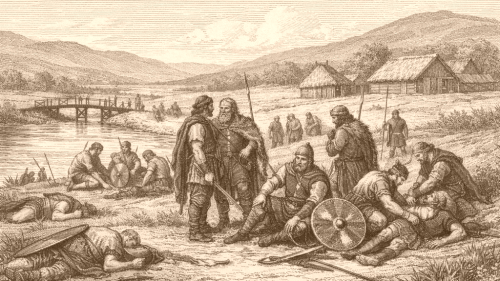
The strongest event notice securely placed in 624 by the Four Masters is the battle of Dun Ceithern. It is said to have been gained by Domhnall son of Aedh son of Ainmire over Congal Caech, or Claen, son of Scannlan, with Guaire Gaillseach son of Forannan and many others slain. The entry is explicit about combatants and casualties, making it the most concrete military notice for the year in these excerpts. [1]
The same compilation also places the battle of Ard Corainn in the 624 entry group, where Connadh Cerr, lord of Dal Riada, is said to have won and Fiachna son of Deman, king of Ulidia, to have been slain. This second battle notice widens the year's military record without requiring any conjecture about sequence or cause. The annal simply records a victor, a defeated ruler, and a death. [1]
Textual Contrast
The value of comparison lies in restraint. Inisfallen places Colmán Stélláin, abbot of Tír dá Glas, under AI625, while the Four Masters place Colman Stellan of Tir Da Ghlas under M624. The same broad clerical memory therefore appears with different year placement in the two compilations. That difference matters, because it shows that identical or near-identical notices cannot be transferred automatically from one annal to another. [1] [4]
The Inisfallen sequence also preserves a destruction notice for Ráith Guala by Fiachna son of Baetán under AI624, while the Ulster notice for 624 stays focused on deaths and the dark-year framing. These contrasts do not create a shared narrative for the year; they only show that different compilations distribute notices differently. For 624 itself, the safest course is to keep each annal's own chronology separate. [5] [3]
Nearby Years
The nearby sequence in Tigernach and Inisfallen helps define the limits of the 624 evidence. Tigernach places a star seen in 612, a battle of Odba in 610, and later rulership and death notices in the surrounding years, but the excerpted material here does not provide a separate 624 battle. Inisfallen likewise distributes its notices across adjacent years rather than gathering them into one continuous story. [2] [4]
This matters because it prevents a false compression of the record. The annals do not all place the same kind of notice in the same year, and some entries are offset from one another. For 624, that means the secure record is not a unified event sequence but a set of dated notices, some shared in theme and some not, that have to be read within each text's own chronology. [1] [3] [4]
Sparse Record
Taken together, the securely dated notices for 624 are brief but varied: a dark-year marker, a regnal beginning for Domhnall in the Four Masters, several clerical deaths, and two battle entries in the same compilation. The Ulster annals provide a second cluster of deaths under AD 624, but no battle notice in the excerpted passage. What survives is concentrated in names, offices, and combatants rather than in extended narrative. [1] [3]
That spareness should not be filled with speculation. No excerpt here explains motives, wider consequences, or a broader settlement after the battles. The evidence permits only a careful statement of what is actually written: 624 was marked as a year, death notices were recorded, Domhnall's reign was counted from it in one compilation, and fighting was entered under the same year in that compilation alone. [1] [3]
Historical Limits
A disciplined reading of 624 therefore stops at the edge of the record. The annals securely establish the calendar year, the dark-year description in Ulster, the regnal marker for Domhnall in the Four Masters, several named deaths, and two battles in the same Four Masters entry cluster. Beyond those notices, the excerpts do not justify claims about causation, strategy, or political outcome. [1] [3]
The year can thus be described as an annalistic snapshot rather than a continuous narrative. Different compilations preserve different combinations of clerical death, royal notice, and warfare, sometimes with adjacent-year variation. The safest historical account remains a close one: what is securely dated to 624 is limited, but it is still specific enough to show the year as one of deaths, reign marking, and conflict in the surviving annalistic record. [1] [3] [4] [5]
Source References
Hover over a number to see the source. Select it to open the source.