Muirchú Moccu
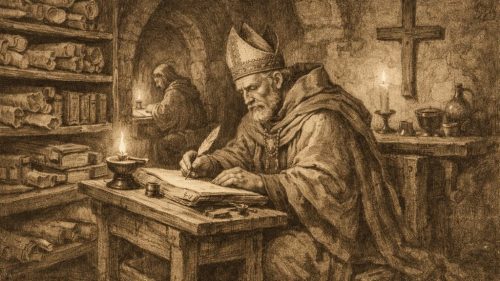
Muirchú moccu Machtheni is known as the writer of a Latin Life of Patrick, the Vita Sancti Patricii. The work survives with the statement that Muirchú moccu Machtheni wrote it at the request of Áed, bishop of the see of Sléibte. In the extant text, Patrick is presented as a Briton by race, born in Britain, the son of Cualfarnius, a deacon, and of Concessa. The narrative then tells of Patrick’s captivity in Ireland as a boy of sixteen, his six years of service in the house of a harsh pagan king, his many vigils and prayers, the hardships he endured there, the visits of the angelic Victoricus, and the divine messages he received.
Dateline
Muirchú moccu Machtheni is known as the writer of a Latin Life of Patrick, the Vita Sancti Patricii. The work survives with the statement that Muirchú moccu Machtheni wrote it at the request of Áed, bishop of the see of Sléibte. In the extant text, Patrick is presented as a Briton by race, born in Britain, the son of Cualfarnius, a deacon, and of Concessa. The narrative then tells of Patrick’s captivity in Ireland as a boy of sixteen, his six years of service in the house of a harsh pagan king, his many vigils and prayers, the hardships he endured there, the visits of the angelic Victoricus, and the divine messages he received. It also relates that he left for Britain at the age of twenty-three, after which the text continues with further episodes of travel, captivity, rescue, and return.
Written Witness
The surviving material associates Muirchú with a Latin hagiographical account of Patrick that opens by presenting Patrick as a Briton by race, the son of Cualfarnius and Concessa, and then follows the familiar sequence of captivity, service, escape, return, and later mission. The narrative reports that Patrick was taken captive at sixteen, served a pagan king for six years, and later sailed back to Britain at the age of twenty-three. It continues with his journeys, his religious formation, and his movement through Gaul in search of the apostolic see. Muirchú’s name stands at the head of this retelling, making him the author through whom the tradition is framed in the surviving text.
Commissioned Context
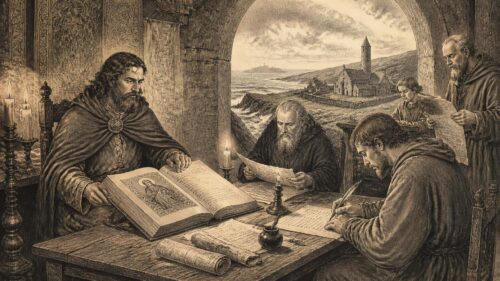
The extracts explicitly say that Muirchú wrote at the request of Áed, bishop of the see of Sléibte. A modern study cited in the retrieved material places Muirchú’s work, Vita Sancti Patricii, around 690. The text also says that Patrick set out to visit and honour the apostolic see in order to learn and understand divine wisdom and the holy mysteries, and in order to preach and bring divine grace to peoples beyond the Empire. It then says that he crossed the sea to the south of Britain and travelled through Gaul on the way, intending to cross the Alps and proceed to Rome. On that journey he found Germanus, bishop of Auxerre, and stayed with him for a considerable time, where he learned, loved, and practised knowledge, wisdom, chastity, and other good dispositions of spirit and soul.
Patrick’s Story
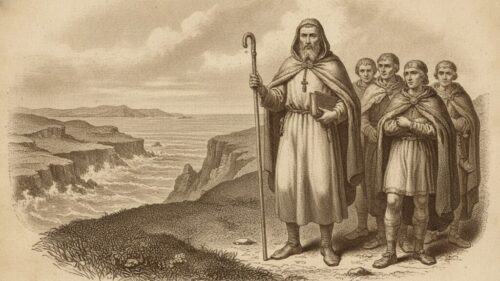
The text relates that Patrick, as a boy of sixteen, was taken captive with others and brought to Ireland, where he served a harsh pagan king for six years. It says that after many hardships in that country, including hunger, thirst, cold, and nakedness, he tended sheep, received frequent visits from the angelic Victoricus sent by God, worked miracles, and received divine messages. The narrative gives examples of these messages, including words that he would soon go home to his country and that his ship was ready. It also says that on another occasion, after many years, he was taken captive by strangers, heard the message that he would be with them for two months, and on the sixtieth day the Lord rescued him from their hands. These details are presented in the sequence of the Life as Patrick’s experiences in captivity, release, and return.
Learning Shape
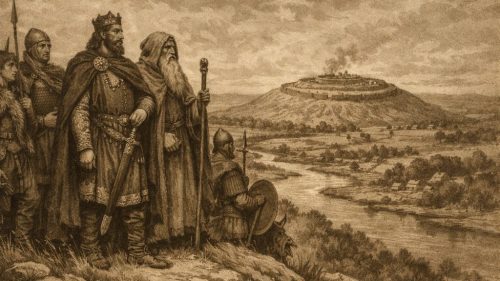
The same text says that Patrick, at about the age of thirty, set out to visit and honour the apostolic see in order to learn and understand and practise divine wisdom and the holy mysteries to which God had called him, and to preach and bring divine grace to peoples beyond the Empire, converting them to belief in Christ. It adds that he crossed the sea to the south of Britain and travelled through Gaul, intending to cross the Alps and proceed to Rome. On the way he found Germanus, bishop of the city of Auxerre, and stayed with him for a considerable time. The text also includes later episodes from Patrick’s preaching in Ireland, including the conversion of Dubthach maccu Lugair and Fiacc Finn Sléibte, the conversion of Macc Cuill at Patrick’s word, and the story of Daire and his horse, with the offering of Armagh to Patrick.
Literary Place
The retrieved material says that Muirchú moccu Machtheni wrote Vita Sancti Patricii at the request of Áed, bishop of the see of Sléibte. The text preserves Patrick’s birth in Britain, his captivity in Ireland, his many hardships, his visits from Victoricus, his journey to Britain, his later travels, his meeting with Germanus in Gaul, and episodes concerning Dubthach, Fiacc, Macc Cuill, and Daire.
Source References
Hover over a number to see the source. Select it to open the source.