Gormflaith Murchada
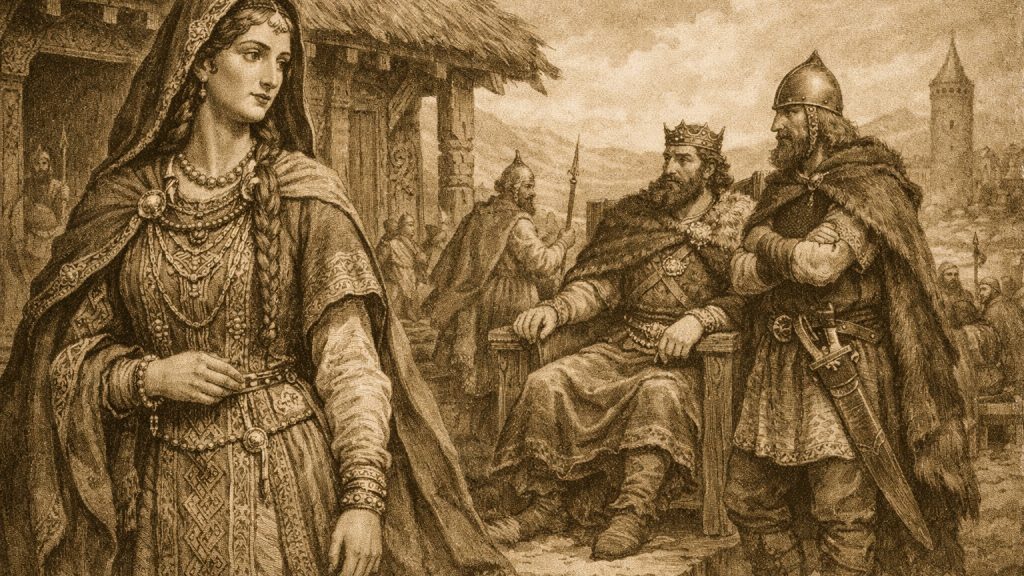
The surviving material identifies her as the daughter of Murchad mac Finn of Leinster and as queen of Munster. It also links her to two sons who are named in the annals: Sitric, son of Amlaíb Cuarán, and Donnchad, son of Brian, king of Munster. The annalistic tradition associates Gormflaith with Murchad mac Finn, king of Leinster, and with the Leinster political family more broadly. Later genealogical writing, as summarised in modern reference material, presents her as a princess of Leinster and as sister to Máel Mórda mac Murchada.
Dateline
The surviving material identifies her as the daughter of Murchad mac Finn of Leinster and as queen of Munster. It also links her to two sons who are named in the annals: Sitric, son of Amlaíb Cuarán, and Donnchad, son of Brian, king of Munster.
Royal Family
The annalistic tradition associates Gormflaith with Murchad mac Finn, king of Leinster, and with the Leinster political family more broadly. Later genealogical writing, as summarised in modern reference material, presents her as a princess of Leinster and as sister to Máel Mórda mac Murchada.
Marriage Links
The annals and later historical summaries agree that Gormflaith was married to Amlaíb Cuarán, the Viking king of Dublin and York, and later to Brian Boru. Her marriage to Brian Boru is connected to her appearance in the political story of the late tenth and early eleventh centuries. The historical summaries also mention an alleged marriage to Máel Sechnaill mac Domnaill, but the same material states that this point is contentious and that the sources for it are less reliable. That uncertainty should be kept in view, because the extant evidence does not establish the marriage to Máel Sechnaill as securely as the other two marriages.
Children Named
The most secure family relationships attached to Gormflaith are her sons. The Annals of Tigernach, as quoted in modern discussion, name her as the mother of Sitric, son of Amlaíb Cuarán, king of the foreigners, and of Donnchad, son of Brian, king of Munster. These notices matter because they show her connection to two ruling lines. One son belonged to the Dublin Scandinavian royal house, while the other belonged to the Munster kingship. Her motherhood therefore linked the politics of Dublin and Munster in a way that was memorable enough to enter the annals.
Annalistic Record
The annalistic notice for her death is brief and formal. The Annals of Inisfallen identify her as “the daughter of Murchad son of Finn, queen of Munster”, while the Annals of Tigernach add the detail that she was the mother of Sitric and Donnchad. They do not provide a narrative biography, but they do supply a concise historical profile: lineage, royal title, and maternal links to named rulers.
Literary Image
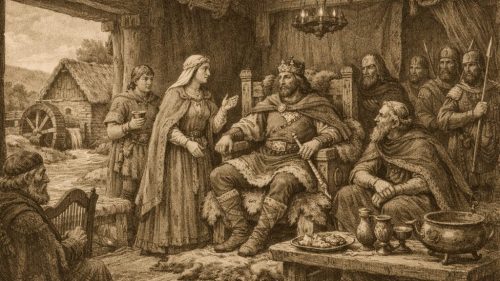
Later medieval writing gave Gormflaith a far more dramatic role. In the literary account known as Cogadh Gaedhel re Gallaibh, she appears in a famous scene at Kincora in which she taunts her brother Máel Mórda and is said to encourage conflict. The Dublin City Library discussion of the battle tradition notes this episode and explains that later chroniclers and writers developed the story over time. That means the scene belongs to literary tradition rather than to secure contemporary record. It is best treated as a shaped narrative about dynastic rivalry, not as an eyewitness account of her actual conduct.
Three Leaps
Genealogical tradition also preserves the well-known motif of Gormflaith’s “three leaps”, associated with Dublin, Tara, and Cashel. Modern summaries note that some scholars have taken this as evidence for three marriages, while others read it differently and do not accept it as proof of a third marriage. The tradition is important because it shows how medieval writers linked her to several centres of kingship. It does not, however, remove the uncertainty already signalled by the annalistic evidence about the disputed marriage to Máel Sechnaill.
What can be said with confidence is that she was a Leinster princess, queen of Munster, and mother of rulers tied to both Dublin and Munster.
Source References
Hover over a number to see the source. Select it to open the source.