Membership is completely free, giving members unlimited access to all available resources, services, features, and benefits without any restrictions or fees.
Welcome back. Sign in to continue enjoying unlimited access to all available resources, services, features, and member benefits at no cost.
Henry III was Lord of Ireland, but royal authority depended on the cooperation of magnates, ecclesiastics, local officials and military households. The justiciar was Henry of London, archbishop of Dublin, whose government had to preserve royal castles and revenues while managing ambitious Anglo-Norman lords. The greatest private lordship was that of William Marshal, earl of Pembroke and lord of Leinster. In 1223 Marshal drew men and resources from Ireland for his successful campaign in south Wales. That movement of forces mattered in Ireland: it reduced the immediate availability of one of the lordship’s most powerful military patrons and helped create an opening for rivals.
Henry III had succeeded his father, King John, in October 1216, while still a child and while England was in civil war. Ireland was not the main battlefield of that struggle, but its administration and magnates mattered to the royal government. Geoffrey de Marisco, justiciar of Ireland since 1215, remained the Crown’s chief executive on the island. His job joined military command, financial supervision, judicial authority and the management of royal land. The regime in England, led by the aged William Marshal during Henry’s minority, needed the Irish lordship to remain loyal, solvent and defensible.
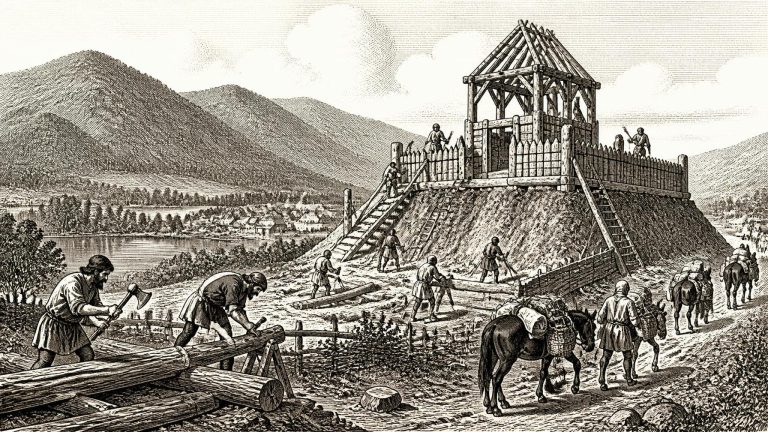
The clearest sequence assigned to 1214 in the Annals of Loch Cé concerns the central plain. It reports that “Foreigners” – the annalists’ usual term for Anglo-Norman settlers and their forces – built castles at Clonmacnoise and Durrow. Neither entry supplies a precise day, construction history or named patron, but their placement together is revealing. Clonmacnoise, on the Shannon, remained a religious centre of exceptional prestige as well as a strategically valuable crossing-point. A castle there was therefore not merely a military building: it announced an attempt to command movement, land and resources around an old ecclesiastical settlement. Durrow likewise lay within a region where control was disputed rather than settled.
The evidence requires care. Medieval Irish annals did not all reckon years in precisely the same way, and later compilations sometimes place an event a year apart from other annals. The Annals of Ulster enter the building of Clones castle, the raid into Tír Eógain and the destruction at Derry under 1212. The Annals of the Four Masters, compiled centuries later, place several of those same episodes under 1211, while recording a further sequence of fighting and castle-burnings under 1212. Rather than treating this as a reason to discard the evidence, it is best to see 1212 as a campaigning season extending across annalistic boundaries. The firmly attested picture is of an intensifying frontier war in Ulster, accompanied by serious disturbances in the midlands and Munster.
The central political story was the confrontation between Meiler fitz Henry, King John’s justiciar in Ireland, and leading Anglo-Norman lords. Meiler was the king’s chief executive in Ireland, responsible for administering royal lands and justice, but he was also an ambitious landholder with long-standing local alliances. The distinction between enforcing the king’s rights and advancing his own interest could be difficult to sustain. In the winter of 1206–7, royal forces took the honour of Limerick from William de Briouze, its lord; Walter de Lacy, lord of Meath and de Briouze’s son-in-law, became embroiled in the dispute.
The Annals of Loch Cé record an unusually prolonged frost and snow, lasting from the Kalends of January—1 January—to the feast of St Patrick, 17 March. The notice does not quantify hunger, mortality or lost livestock, so it would be unsafe to turn it into a general famine. Nevertheless, more than ten weeks of severe winter weather mattered in a predominantly rural society. Travel over roads and tracks, movement of cattle, access to mills and markets, and the routine journeys of clerics, tenants and messengers would all have been more difficult. Its preservation in the annals is a reminder that weather was a political as well as a domestic fact: hosts could not easily move, and communities dependent upon stored food faced a demanding season.
Meiler fitz Henry, King John’s justiciar in Ireland, was the crown’s principal officer on the island. His task was not simply to fight Irish rulers. He also had to contain Anglo-Norman barons whose castles, retinues and private alliances could make them almost independent. The collapse of much of John’s continental inheritance to Philip II of France in 1204 sharpened the king’s need for dependable revenue, loyal service and defensible authority in Ireland. That wider crisis helps explain why Irish affairs were being handled with unusual attention from the royal court.
The most securely dated political acts of the year came from King John’s court. On 7 July, William de Burgh was summoned to answer before the king over complaints arising from his activity in Connacht. On the following day, the king removed his control of the city of Limerick and granted it, at farm, to William de Braose, already lord of the honour of Limerick. The distinction mattered. Limerick was not merely a wealthy settlement at the head of the Shannon estuary: it was a strategic river port, a military base and an outlet through which power in Munster and western Ireland could be supplied and financed.
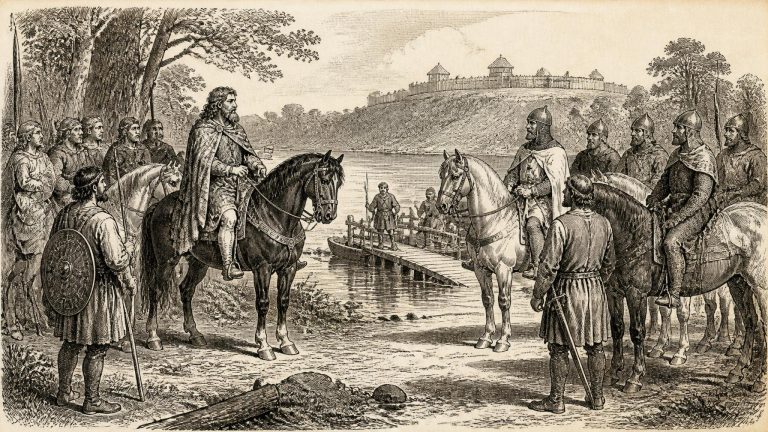
The pivotal development was Cathal Crobderg Ua Conchobair’s intervention beyond Connacht. Cathal was king of Connacht, though his position was neither uncontested nor secure from internal rivals. The Annals of Loch Cé record a great muster at Athlone, a strategic Shannon crossing where Connacht met the lordship’s midland frontier. Cathal reportedly assembled 1,200 men or more. There John de Courcy, Walter de Lacy—the son of Hugh de Lacy—and leading Anglo-Norman nobles came to meet him, and peace was made.
The evidence for 1194 is substantial by contemporary standards, though it needs careful handling. The Annals of Ulster, Annals of Inisfallen, Annals of Loch Cé, Mac Carthaigh’s Book and the later Annals of the Four Masters preserve overlapping but not identical accounts. Their year-numbers do not always align: material placed under 1194 by one compilation can appear a year earlier in another. The safest approach is therefore to treat the principal notices as belonging to the 1194 annalistic horizon, while avoiding invented days, months or sequences where the sources provide none.
The most substantial narrative assigned to 1191 is Ruaidrí’s journey from Connacht. The Annals of Ulster and Annals of Loch Cé, which preserve a terse common notice, state that he left Connacht and went into Cenél Conaill, the powerful kingdom centred on what is now much of Donegal. The much later Annals of the Four Masters expands this into a striking itinerary: Ruaidrí sought forces first in Tír Chonaill, then in Tír Eógain, from the Ulstermen, from the English of Meath, and finally in Munster. That expanded account says that the northern rulers and the English of Meath declined to help him recover Connacht, while Síl Muiredaig, Ruaidrí’s own wider dynastic community, granted him lands in Tír Fhiachrach and in Cineaál Echtge instead.
The most politically significant Irish business of the year centred on Connacht. The killing in 1189 of Conchobar Máenmaige Ua Conchobair, who had held the provincial kingship, had opened a contest among his relatives. Cathal Crobderg Ua Conchobair, a younger half-brother of the former high-king Ruaidrí Ua Conchobair, sought supremacy against Cathal Carrach, the dead ruler’s son and therefore Cathal Crobderg’s grand-nephew. This was not a simple contest between an Irish ruler and an outside conqueror. It was a dynastic conflict within the powerful Síl Muiredaig kindred, fought in a province whose leaders had already learned that Anglo-Norman support, opposition and neutrality could affect the balance of power.
The most consequential firmly dated development was the assassination of Donnchad Ua Máel Sechlainn, king of Meath. The Annals of Ulster and Annals of Tigernach describe his death as treacherous, naming Murchad Ua Finnalláin, ruler of Delbna Mór, and his son as the killers. The later Annals of the Four Masters adds that old grievances and Donnchad’s own actions lay behind the attack. This judgement reflects his deeply troubled recent career. In 1157 he had violated a guarantee upheld by leading churchmen and kings, after which an ecclesiastical assembly excommunicated him and removed him from power. Mac Lochlainn nevertheless restored him, making Donnchad dependent upon northern support.
The central event was the death of Conchobar Ua Conchobair, a son of Tairdelbach Ua Conchobair, king of Connacht and leading claimant to the high-kingship of Ireland. Conchobar had been installed as king of Meath in the preceding year after his father displaced Murchad Ua Mael Sechlainn. According to the Chronicon Scotorum, he had ruled for only half a year. This was not his first royal appointment: earlier in his career his father had briefly placed him over Dublin. Such appointments reveal Tairdelbach’s method of extending power beyond Connacht by positioning close relatives in strategically important kingdoms.
Tairdelbach Ua Conchobair, king of Connacht and the leading claimant to the high-kingship of Ireland, remained the island’s most powerful ruler. His authority, however, was not that of a centralised monarch. It depended upon alliances, hostages, military expeditions and the management of subordinate kings. In 1136 the greatest immediate threats to his position came from within his own extended family.
The most substantial campaign recorded for 1117 began with an incursion by Diarmait Ua Briain and the Munstermen into Connacht. The Annals of Tigernach name Tír Fhiachrach and Tír Briain among the districts ravaged. Such an expedition was intended not simply to destroy. Armies seized cattle, provisions and captives, damaged a rival’s standing and demonstrated that its ruler could not protect dependent communities. It continued the war between Connacht and Munster that had intensified as Muirchertach Ua Briain’s authority declined.
The titles assigned to powerful rulers in medieval chronicles require care. Later tradition often presents a single “High King of Ireland”, yet contemporaries recognised overlapping claims based upon military success, hostages, tribute, ancestry and alliances. Domnall Ua Lochlainn was the leading king of the northern half of Ireland, while Muirchertach Ua Briain exercised authority across Munster and intervened repeatedly in Leinster, Mide, Connacht, Dublin and the Irish Sea region. Each could claim a standing beyond that of an ordinary provincial king, but neither had eliminated the other.
Toirdelbach Ua Briain had ruled Munster since the 1060s and, following the death of the Leinster overking Diarmait mac Maíl na mBó in 1072, had become the dominant ruler across much of Ireland. His authority rested not upon a unified state but upon personal submissions, hostages, tribute, military alliances and control or influence over other kings. Irish annalists consequently varied in their titles. Some called him king of Ireland, while others more cautiously described him as king of most or the greater part of Ireland. The later Four Masters added the significant qualification “with opposition”.
The most powerful Irish ruler was Tairdelbach Ua Briain, king of Munster and grandson of Brian Bórama. Since the death of his former patron, Diarmait mac Máel na mBó, in 1072, Tairdelbach had extended his influence over Leinster, Dublin, Osraige and parts of the midlands. His supremacy remained an overlordship maintained by campaigning and political management, however, rather than direct administration. Connacht was divided by competition among Ua Conchobair and Ua Ruairc leaders, while the north was developing a formidable centre of power under Domnall Ua Lochlainn of Cenél nÉogain.
The chronology itself needs care. The Annals of Ulster head their relevant entry “AD 1009 alias 1010”, while the Annals of the Four Masters place the same cluster under “1009 recte 1010”. Chronicon Scotorum and the Annals of Inisfallen preserve parallel notices for 1010. This is not an invitation to move events about at will: it is a reminder that medieval annalistic dating systems do not always match modern calendar years cleanly. The events discussed here are those which the main Irish chronicle traditions connect with 1010, or explicitly correct to that year.
The most unstable region in the record for 1007 is Ulaid, roughly north-eastern Ireland. The annals name a grim succession of deaths. Máel Ruanaid son of Ardgar, styled king of Ulaid in Chronicon Scotorum and killed by Matudán son of Domnall, appears first. Matudán himself was then killed by a figure called “the Torc” in the middle of Dún dá Lethglas, modern Downpatrick, in Brigit’s church. The annalists stress the sacred setting and, in one version, say that this happened despite the protection of the saints of Ireland. Later notices add that the Torc, also called king of Ulaid, was killed by Muiredach son of Matudán in revenge for his father, and that Domnall son of Dub Tuinne, another king of Ulaid, was killed by Muiredach son of Matudán and Uargaeth of Sliab Fuait.