Cahir O’Doherty
Cahir O’Doherty is identified in the record as an Irish chieftain and as Lord of Inishowen. The same source gives his life dates as 1587 to 1608. It also states that he was knighted for his bravery in the Battle of Augher. These details place him among the Irish figures whose status in Ulster was shaped by both local authority and royal recognition. The available evidence records that he was received in London by Queen Elizabeth I. It says that his territorial rights were confirmed at that time. After his return to Ireland, he was made Justice of the Peace and alderman of the new city of Derry.
Dateline
Ulster Lordship
Cahir O’Doherty is identified in the record as an Irish chieftain and as Lord of Inishowen. The same source gives his life dates as 1587 to 1608. It also states that he was knighted for his bravery in the Battle of Augher. These details place him among the Irish figures whose status in Ulster was shaped by both local authority and royal recognition.
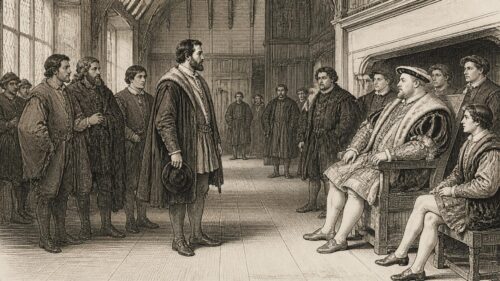
The available evidence records that he was received in London by Queen Elizabeth I. It says that his territorial rights were confirmed at that time. After his return to Ireland, he was made Justice of the Peace and alderman of the new city of Derry. These appointments show him holding office within the political structures then being established in the north-west of Ireland.
Public Office
The sources further state that O’Doherty served as foreman of the jury that found those participating in the Flight of the Earls in 1607 guilty of treason. That detail places him directly within one of the central political proceedings connected with early seventeenth-century Ulster. The record does not add his personal reasoning, and nothing further can be safely claimed beyond the office described and the verdict he helped to deliver.
One later account describes him in strongly hostile language, calling him “the Scotchman’s curse and scourge”. That wording belongs to a printed nineteenth-century narrative and should be understood as later commentary rather than contemporary fact. The same account associates him with the rock of Doune, or rock of Kilmacrenan, as the place where he closed his life. Its dramatic phrasing is part of a tradition of retelling rather than documentary understatement.
Quarrel Rising
The Dublin Penny Journal account and the Ulster biography both agree on the fatal quarrel with Sir George Paulet, the Governor of Derry. The Ulster biography states that Paulet charged O’Doherty with treason and struck him during an argument in 1608. It then says that O’Doherty killed Paulet, slaughtered the garrison, and sacked and burnt Derry. These events are the central actions linked to his rebellion in the surviving summaries.
Another historical study recorded in Irish History Online concerns “the rebellion of Sir Cahir O’Doherty and its legal aftermath”. A second study, also listed there, examines “Cahir O’Doherty and the Dove of Cartemyne, 1603-4: a sidelight on Gaelic admiralty jurisdiction”. Those titles show that later scholarship has treated his life not only as a military and political episode, but also in relation to law and jurisdiction.
Final Action
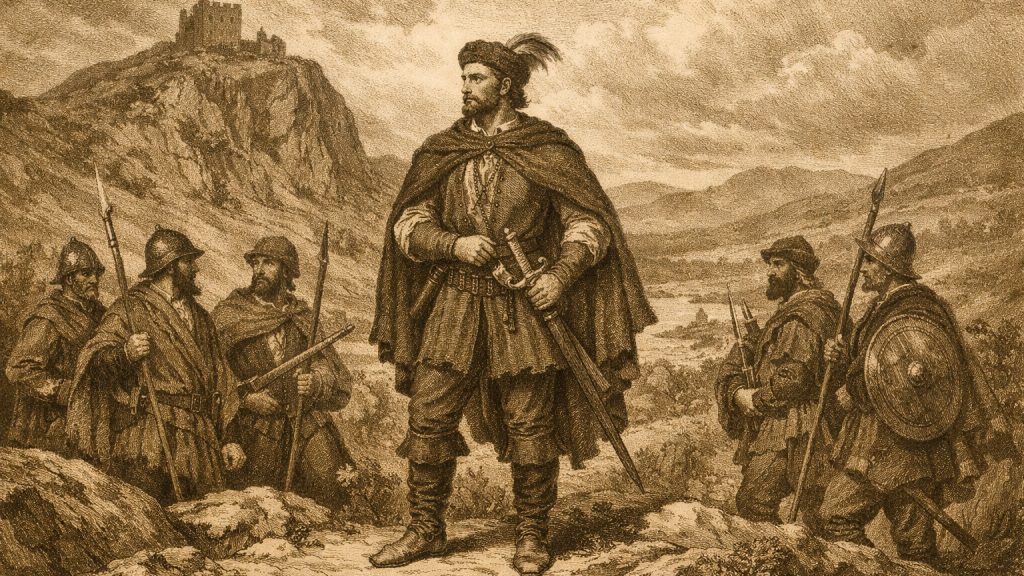
The Ulster biography states that a force dispatched from Dublin shot him at the Rock of Doon near Kilmacrenan, County Donegal. The nineteenth-century account likewise places his death at the rock of Doune or Kilmacrenan. Both sources therefore locate his end in the same district, while the earlier source identifies the attacking force as coming from Dublin. The verified material does not supply additional particulars about his last hours beyond the place and manner of death.
In the surviving evidence, Cahir O’Doherty appears as a nobleman, office-holder, and rebel whose career moved from royal recognition to open conflict. He is associated with Inishowen, Derry, the Flight of the Earls, the quarrel with Sir George Paulet, and his death near Kilmacrenan. The record that survives is enough to trace those connected stages of his life without extending beyond what is stated.
Source References
Hover over a number to see the source. Select it to open the source.