Belfast
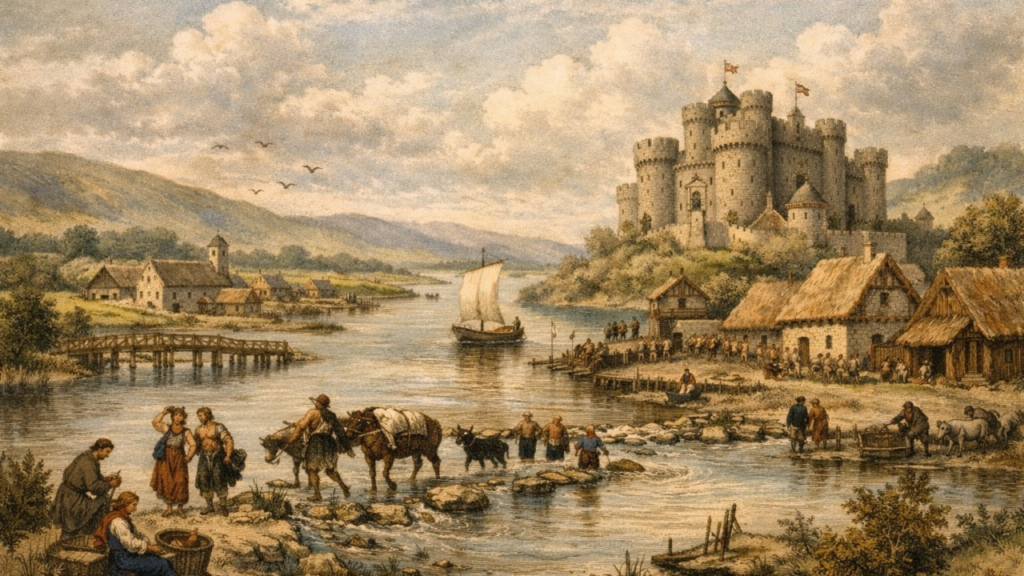
Belfast is securely identifiable as a historical settlement on the Lagan. A scholarly review of the town’s early history notes that Belfast is first mentioned as a place in the early Christian period, while the earliest recorded evidence for settlement dates to the thirteenth century, when a castle and associated manor belonged to the Anglo-Norman earldom of Ulster 1. That places Belfast well before its later urban expansion and confirms that it was already an established site in medieval Ulster rather than a purely modern creation. Earlier historical references also connect the area with the battle-entry tradition preserved in Irish annals.
Dateline
Settlement and early record
Belfast is securely identifiable as a historical settlement on the Lagan. A scholarly review of the town’s early history notes that Belfast is first mentioned as a place in the early Christian period, while the earliest recorded evidence for settlement dates to the thirteenth century, when a castle and associated manor belonged to the Anglo-Norman earldom of Ulster 1. That places Belfast well before its later urban expansion and confirms that it was already an established site in medieval Ulster rather than a purely modern creation.
Earlier historical references also connect the area with the battle-entry tradition preserved in Irish annals. Patrick McKay’s study explains that the Annals of the Four Masters record a battle under the year 668 at Cath Feirsti / Fertas, and that John O’Donovan identified this ford with Belfast on the River Lagan 2. McKay notes that this identification has been argued over, but the Belfast reading remains a serious historical interpretation of the annalistic evidence 2.
Name forms and language
The Irish-language form is Béal Feirste, and this is the authoritative Irish form used by the Irish place-name authority 3. The same form is supported in the scholarly place-name literature, which explains it as “the mouth of the sand-bank ford” and relates it to the older element fearsaid / fertas, meaning a sand-bank ford 24. The historical record therefore preserves both the English settlement-name Belfast and the Irish form Béal Feirste, while the medieval annalistic spellings Cath Feirsti and Fertas show an older stage of the same place-name tradition 234.
County assignment
Historically, Belfast belonged to County Antrim. Samuel Lewis’s 1837 topographical dictionary describes Belfast as “chiefly in” the barony of Upper Belfast, county of Antrim, and province of Ulster [5]. That is a contemporary historical gazetteer rather than a modern retrospective summary, so it is strong evidence for the town’s county assignment in the nineteenth century. Later historical county references likewise treat Belfast as part of County Antrim, even when noting its special municipal status [5].
In sum, the settlement identity, county placement, and name-forms are all well attested: Belfast was a medieval settlement on the Lagan, historically in County Antrim, with the Irish form Béal Feirste and older recorded spellings in the annalistic tradition 123[5].