Glenarm
Glenarm is securely identifiable as the post-town and village in the parish of Tickmacrevan, barony of Upper Glenarm, County Antrim. Samuel Lewis’s nineteenth-century topographical dictionary places it exactly there, describing it as “Glenarm, a post-town, in the parish of Tickmacrevan, barony of Upper Glenarm, county of Antrim, and province of Ulster” and noting its situation by the Glenarm river and bay 1. That same county assignment is confirmed by the Irish place-name authority, which records the barony Glenarm Lower within county Antrim and gives the Irish form of the barony as Gleann Arma Íochtarach 2. The place-name itself has a clear Irish-language form.
Dateline
Historical settlement
Glenarm is securely identifiable as the post-town and village in the parish of Tickmacrevan, barony of Upper Glenarm, County Antrim. Samuel Lewis’s nineteenth-century topographical dictionary places it exactly there, describing it as “Glenarm, a post-town, in the parish of Tickmacrevan, barony of Upper Glenarm, county of Antrim, and province of Ulster” and noting its situation by the Glenarm river and bay 1. That same county assignment is confirmed by the Irish place-name authority, which records the barony Glenarm Lower within county Antrim and gives the Irish form of the barony as Gleann Arma Íochtarach 2.
The place-name itself has a clear Irish-language form. Logainm records the Irish for Glenarm as Gleann Arma, and its place-name materials cite Glenarm as an example of gleann meaning “glen, valley” 3. The 20th-century Irish gazetteer likewise lists Gleann Arma as the Irish entry for Glenarm, reinforcing that this is the accepted historical Irish form rather than a later reconstruction 4.
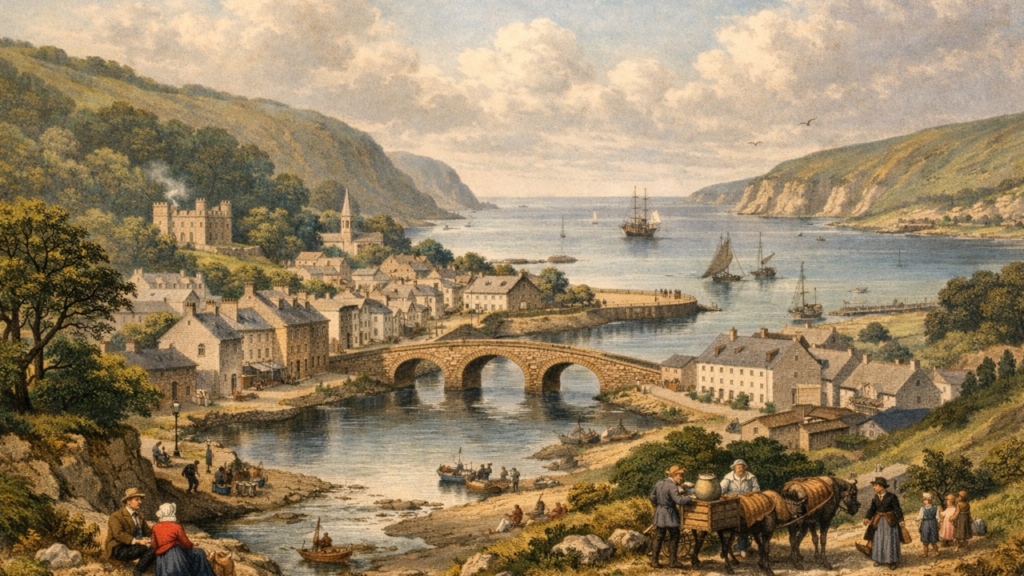
Historical writing from the Glens of Antrim also preserves older English spellings and usage. Richard Dobbs’s 1683 notes on County Antrim refer to Glenarm as a local place of importance, and the modern transcription explicitly flags “Glenarm” in the text and related editorial notes [5]. Together with Lewis, this shows continuity of the settlement name in early modern and nineteenth-century sources, with no serious doubt about the identity of the place or its county. The historical record places Glenarm within the Antrim coastlands and the Glenarm barony tradition, with the village functioning as a coastal post-town tied to the river mouth and bay 12.
Historical significance
What emerges from the historical references is not a grand urban history but the record of a small coastal settlement whose importance lay in its administrative and maritime setting. In the eighteenth and nineteenth centuries, writers consistently treated Glenarm as a local centre within the Antrim Glens, and the barony name itself preserved the settlement’s prominence in regional geography 123. The place-name evidence therefore supports both the village’s historical reality and its long-standing location within County Antrim, while the Irish forms Gleann Arma and Gleann Arma Íochtarach document the Gaelic naming tradition attached to it 234.