Carnlough
Carnlough is securely identifiable as the coastal village on Carnlough Bay in County Antrim. Nineteenth-century and later historical references place it in the parish of Ardclinis, barony of Lower Glenarm, County Antrim; a modern historical gazetteer likewise describes Carnlough as a village on the east coast of County Antrim. A townland-and-landlord compilation for c.1860 also lists “Carnlough Town” in Civil Parish Ardclinis, Barony Glenarm Lower, Poor Law Union Larne, confirming the settlement’s historical county assignment within Antrim 12. The place-name appears in historical English spellings including “Carnalough” and “Carnalloch,” showing that the modern form was not yet fully fixed in older usage.
Dateline
Historical settlement and county placement
Carnlough is securely identifiable as the coastal village on Carnlough Bay in County Antrim. Nineteenth-century and later historical references place it in the parish of Ardclinis, barony of Lower Glenarm, County Antrim; a modern historical gazetteer likewise describes Carnlough as a village on the east coast of County Antrim. A townland-and-landlord compilation for c.1860 also lists “Carnlough Town” in Civil Parish Ardclinis, Barony Glenarm Lower, Poor Law Union Larne, confirming the settlement’s historical county assignment within Antrim 12.
Names and language forms
The place-name appears in historical English spellings including “Carnalough” and “Carnalloch,” showing that the modern form was not yet fully fixed in older usage. An Irish-language gazetteer gives the standard Irish form as Carnlach and the genitive Charnlaí, while a historical language dictionary entry explains the name as “Carn an locha,” glossed as “the cairn of the lake” / “the harbour cairn.” This gives a documented record of both a settled Irish form and older variant renderings in English and Irish scholarship 13.
Early modern and nineteenth-century development
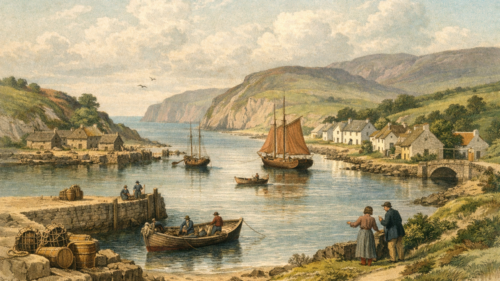
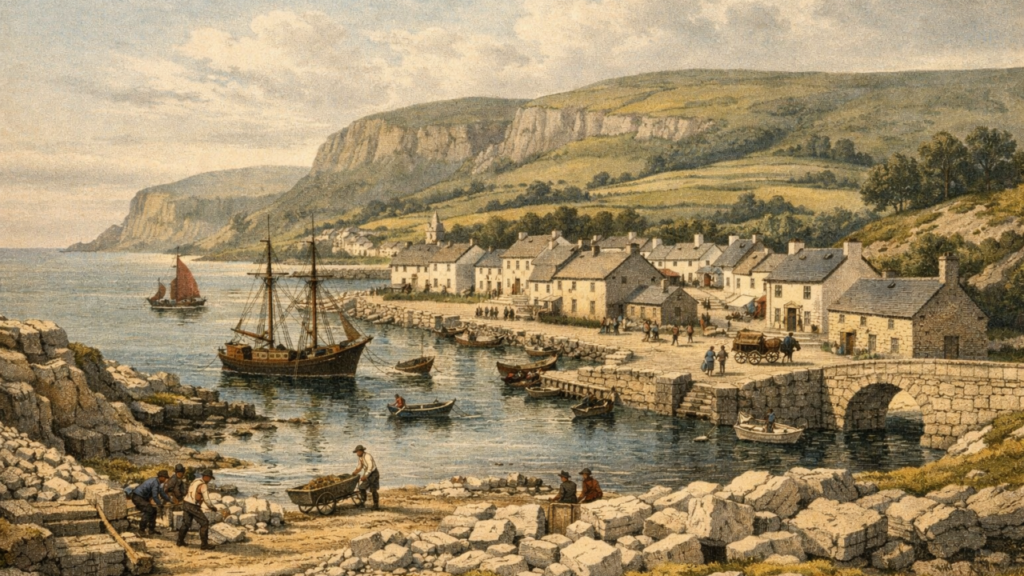
The strongest local historical account describes Carnlough as a linear coastal settlement with only a few substantial dwellings recorded in 1683, implying a very small early modern nucleus. It notes that Philip Gibbons, a sea captain, settled there in the late eighteenth century, after marrying Anne Stewart, and built a small stone pier at his own expense. By the 1830s the Ordnance Survey memoir tradition portrays Carnlough as a local fishing and farming centre, with stone houses, inns, mills, schools, and a Methodist meeting house; this is consistent with a village that was expanding before the harbour works of the mid-nineteenth century 2.
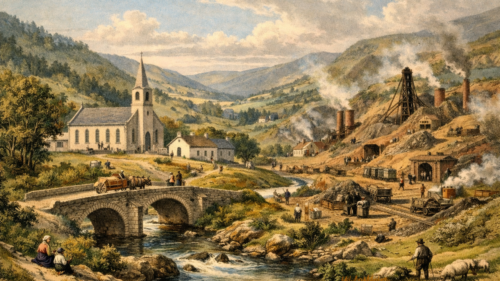
The conservation-area history also records that the harbour was built from 1853 to 1855, later becoming a key feature of the village’s development. Together, the historical references show a settlement that moved from a small bay-side cluster in the seventeenth and eighteenth centuries to a more structured nineteenth-century village economy linked to fishing, agriculture, and limestone extraction 2.