Annaghmore
Annaghmore is verified as a historical settlement in County Armagh: modern place-name authorities identify it as both a village and a townland, with the standard Irish-language form Eanach Mór and the English form Annaghmore 12. Gazetteer evidence also places it as a dispersed village in County Armagh, within the townland of Annaghmore and the civil parish of Loughgall 3. The county assignment is consistent across the consulted records. Contemporary place-name and land-record authorities place Annaghmore in Armagh, and the 1926 Census Topographical Index likewise lists Annaghmore in County Armagh, under the Loughgall parish grouping 234.
Dateline
Settlement identity
Annaghmore is verified as a historical settlement in County Armagh: modern place-name authorities identify it as both a village and a townland, with the standard Irish-language form Eanach Mór and the English form Annaghmore 12. Gazetteer evidence also places it as a dispersed village in County Armagh, within the townland of Annaghmore and the civil parish of Loughgall 3.
Historical county assignment
The county assignment is consistent across the consulted records. Contemporary place-name and land-record authorities place Annaghmore in Armagh, and the 1926 Census Topographical Index likewise lists Annaghmore in County Armagh, under the Loughgall parish grouping 234. This matches the settlement’s later administrative description as part of the Armagh area rather than any neighboring county 34.
Names and forms in the record
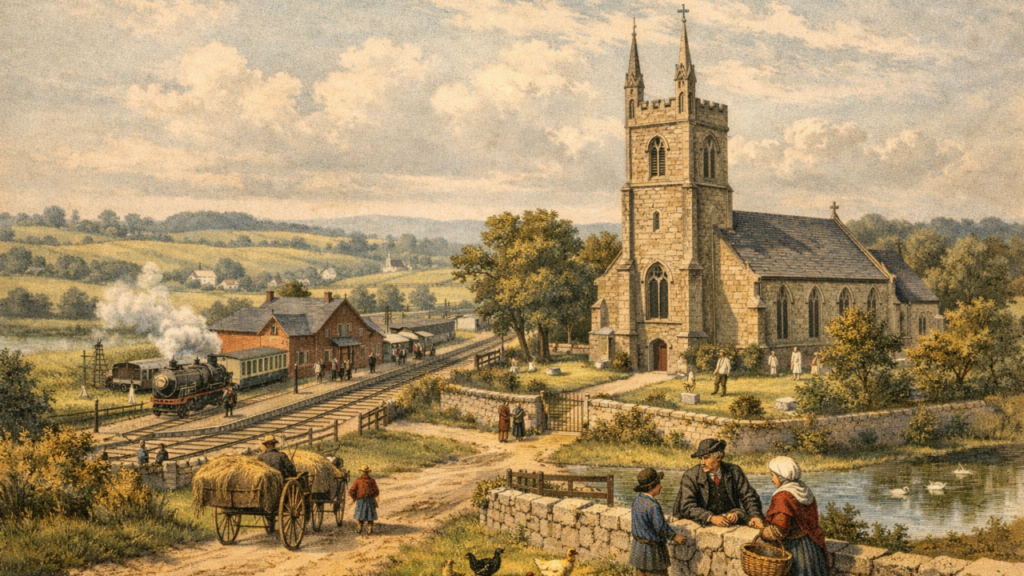
The principal historical spelling recorded by place-name authority is Annaghmore, with the Irish form Eanach Mór 12. The Irish elements are glossed as eanach (“marsh”) and mór (“great, big”), though the authority cautions that the full meaning depends on local history and the complete Irish form 1. The same authority also notes that Annaghmore’s nineteenth-century church and former railway station represent two different links between this rural Armagh community and the wider world 1.
Nineteenth-century landmarks
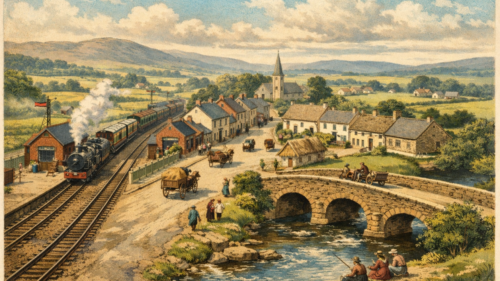
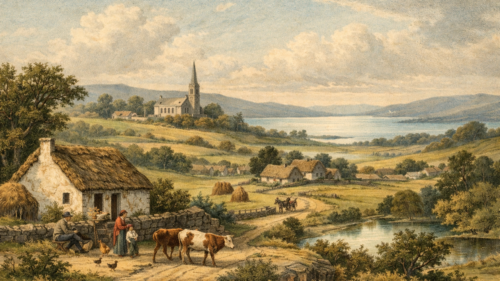
The historical footprint of Annaghmore is especially visible in its church and transport history. The Gazetteer of British Place Names states that St Francis’ Church was designed by Joseph Welland and consecrated in 1861, placing the settlement firmly in the period of nineteenth-century ecclesiastical expansion 3. Placenames.ie likewise singles out the church and the former railway station as defining features of the community’s historical relationship to the wider district 1. Together, these sources suggest a rural settlement that gained prominence through parish life and rail connection rather than through urban growth 13.
By the early twentieth century, administrative records continued to treat Annaghmore as a distinct townland and census place. The 1926 index gives it a substantial acreage entry in Armagh, under Loughgall, confirming that the settlement remained a recognized local unit well after the nineteenth-century developments noted above 4.