Adomnán’s October Return729 CE
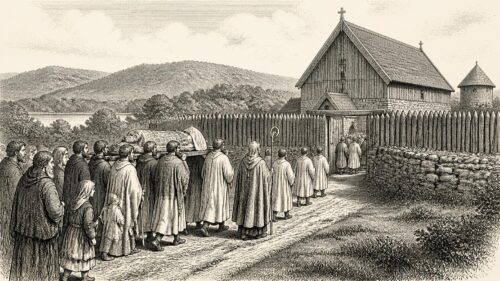
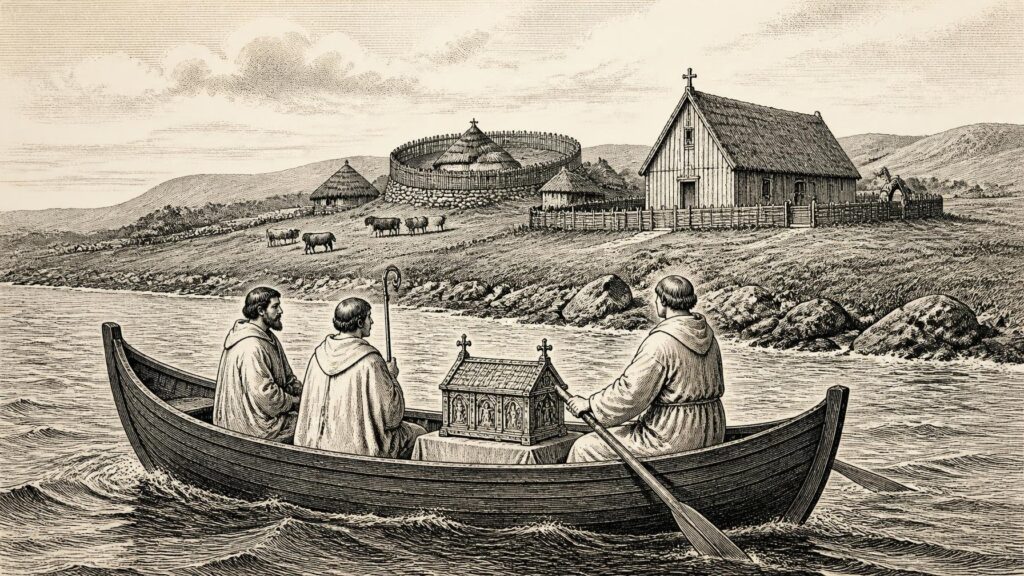
In October 729, Adomnán’s relics returned from Ireland to Iona, providing the year’s clearest securely dated Irish-connected event. The journey demonstrates enduring Columban links across the North Channel and the practical importance of maritime transport, sacred objects and ecclesiastical custodianship. It occurred amid contested northern Uí Néill politics following Flaithbertach mac Loingsig’s victory in 728, although no battle is securely recorded for 729. Later claims that Flaithbertach resigned or died that year, and that Armagh’s bishop Suibne died then, are chronologically unreliable. Ireland comprised competing regional rulers, influential churches and rural communities whose labour sustained monasteries, travel and political power.
Dateline
In 729 CE, the clearest securely dated Irish-connected event is not a battle or royal inauguration but a movement across the sea: the Annals of Ulster record the return of Adomnán’s relics from Ireland in October. The notice is exceptionally brief, yet its wording matters. It confirms that relics associated with the former abbot of Iona had spent time in Ireland and then travelled back across the North Channel. It also offers a rare fixed point in a year otherwise thinly recorded for Irish affairs. The journey linked Ireland, Iona and the wider Columban world at a moment when political power in the north remained fiercely contested.
Such precision is important. Medieval Irish annals do not always align their year-numbers with modern calendar dating, and later compilations sometimes rearranged or misdated earlier material. A much later account, the Annals of the Four Masters, places Flaithbertach mac Loingsig’s supposed resignation and death at Armagh in 729. That cannot be accepted as a description of this year: Flaithbertach was still politically active afterwards and died only in 765. Similarly, some annalistic traditions place the death of Suibne, bishop of Armagh, under 729, while the more securely aligned evidence places it in 730. These are valuable reminders that 729 should not be crowded with attractive but chronologically unsafe events.
Relics on the North Channel
Adomnán had died in 704, but his authority remained very much alive a quarter-century later. Abbot of Iona, biographer of Columba, churchman, traveller and lawgiver, he had helped make Iona a centre whose influence reached through the Gaelic-speaking regions of Ireland and western Britain. Relics could include bodily remains, possessions, or objects closely associated with a saintly figure. The annal does not identify the precise relics, their Irish destination, their custodians, their route or the reason for their return. None of those details should be invented. What it does demonstrate is that Adomnán’s memory was materially present in Ireland, and that moving sacred objects by ship was practical enough to be recorded as a significant event.
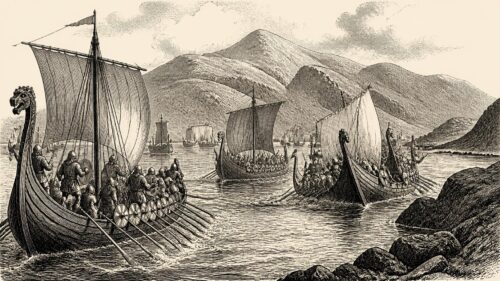
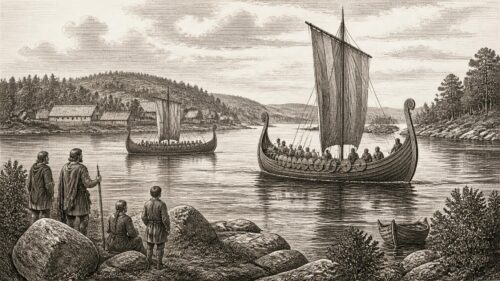
The October date also makes the record more vivid without permitting romance. A crossing between Ireland and Iona required a seaworthy vessel, crews experienced in coastal waters, and the ability to transport an object—or collection of objects—held in deep reverence. It was not necessarily a grand procession. Yet the phrase “return of the relics” implies recognised ownership or custodianship and a relationship between communities on either side of the channel. Iona was geographically offshore but culturally entangled with Ireland. Columba’s foundation had long depended on Irish patrons, clerics and travellers; its saints, books, legal traditions and political friendships circulated well beyond the island itself.
A Northern Kingship Still Contested
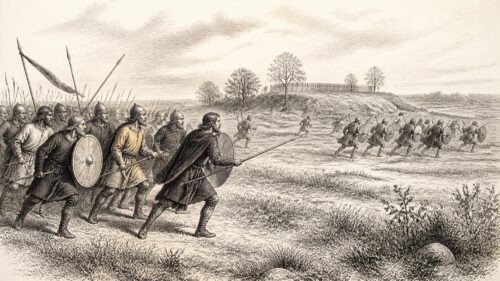
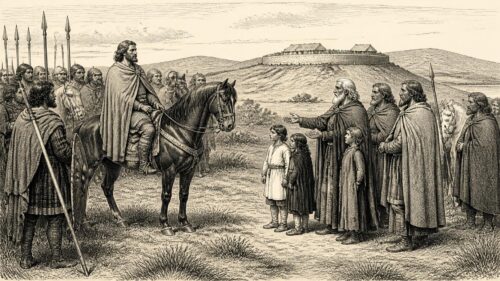
In political terms, 729 fell shortly after Flaithbertach mac Loingsig of Cenél Conaill had defeated Cináed mac Írgalaig at Druim Corcain. The battle belongs to 728, not 729, but it explains the following year’s conditions. Cináed’s death removed a leading member of the southern Uí Néill dynasty of Síl nÁedo Sláine, while Flaithbertach emerged as the foremost claimant to over-kingship among the Uí Néill. Later writers often call this the high-kingship of Ireland. The title should not suggest a single centrally governed kingdom. Authority was negotiated among powerful dynasties, subordinate rulers, churches and local populations; it could be asserted through tribute, hosting, alliances and force, but was rarely uniform across the island.
Flaithbertach’s position was particularly vulnerable because his own northern Uí Néill rivals, Cenél nEógain, had not disappeared. Áed Allán, son of Fergal, was an ambitious ruler from that rival branch. The annals do not attach a specific clash between the two men to 729, and it would be wrong to manufacture one. Nevertheless, the year lay within an active struggle whose earlier and later battles centred on the north-west and the approaches to Mag nÍtha, the fertile plain around the River Finn. In 729, therefore, political life in the north was shaped by the aftermath of recent warfare and by the likelihood of renewed mobilisation, even if no securely dated campaign survives for that calendar year.
Elsewhere, rulers retained considerable room for manoeuvre. In Leinster, Fáelán mac Murchado had taken the provincial kingship after fighting among the Leinster dynasties in 728. In Munster, Cathal mac Finguine remained a formidable king whose authority reached beyond his own province. Connacht, too, had recently lost its king Domnall mac Cellach. These changes did not automatically make 729 a year of island-wide succession crises. Rather, they show how politics operated through several regional centres at once. A northern overking’s prestige mattered, but Leinster, Munster, Connacht, the Ulaid, Brega and numerous smaller territories were not passive provinces awaiting commands from Tara.
Iona, Armagh and Ecclesiastical Power
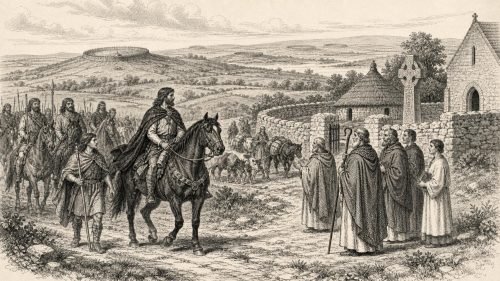
The relics’ return illuminates a second form of power: ecclesiastical connection. Monasteries were not isolated retreats outside politics. They were communities of prayer and worship, but also landholders, centres of learning, employers of craftspeople, destinations for guests and pilgrims, and repositories of valuable books and sacred objects. Major churches cultivated relationships with kings, and kings in turn sought the prestige that association with saints could bring. Adomnán’s own career had joined Columban religious authority to the interests of Cenél Conaill, the dynasty from which Flaithbertach came. It is reasonable to see the October movement within this interwoven religious and political landscape, though the annal alone does not prove a particular royal purpose.
Armagh was another great centre within that landscape. Its bishop in this period, Suibne mac Crundmaíl, belonged to the Uí Nialláin of the Armagh region. He was alive during 729, despite the later dating confusion around his death. The contrast between Armagh’s Patrician associations and Iona’s Columban inheritance should not be exaggerated into two fixed, hostile institutions. Clerics and relics moved, and communities could share ideas as well as compete for prestige and patronage. Still, ecclesiastical alliances mattered. The later rise of Áed Allán was closely associated with the increasing prominence of Armagh and the law of Patrick, while the Adomnán relic notice preserves a glimpse of Iona’s continuing reach before that political balance shifted decisively.
Learning Carried by Water
Adomnán’s reputation rested on more than sanctity. His Life of Columba, written around the turn of the eighth century, is sophisticated Latin prose drawing on monastic testimony, biblical learning and stories from Ireland, Iona and Pictish lands. A manuscript of the work was copied within a few years of 729. That surviving evidence does not tell us that a particular copy travelled with the relics, nor that the voyage was a book-carrying mission. It does, however, place the year in a world of disciplined writing, copying and reading. Religious communities preserved memory through both portable objects and texts, each reinforcing the authority of the other.
Irish churches had long participated in international debates about calculation, liturgy and the proper dating of Easter. The generation before 729 had seen major changes in the Columban sphere, including acceptance of Roman Easter practice at Iona in 716. By 729, Adomnán was a figure claimed across different communities, not merely an abbot remembered on one small island. The return of his relics is thus evidence of a connected sea-world: vessels moved people and precious objects, while shared Latin Christianity gave those movements meaning across political boundaries.
What the Year Does Not Reveal
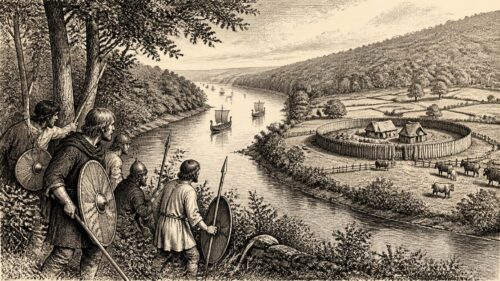
For ordinary households, the evidence is less exact. No trustworthy record describes the harvest, weather, prices, disease or local disputes of 729 in Ireland. It would be unsafe to infer prosperity or hardship from silence. Archaeology nevertheless supplies the broader setting in which most people lived. Across early medieval Ireland, families commonly occupied enclosed farmsteads—ringforts or stone cashels—containing houses, outbuildings, livestock space and places for storing food. Cattle were central to wealth and status, while grain cultivation, dairying, weaving, leatherworking, ironworking and domestic labour sustained daily life. The people who farmed, herded, repaired buildings and maintained boats made the political and religious world of kings and monasteries possible.
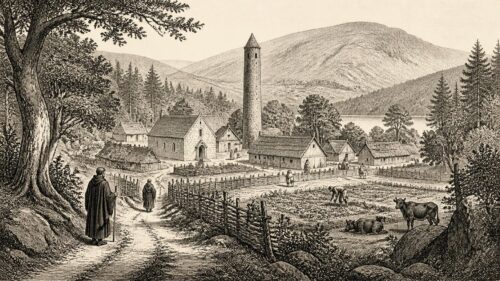
Monastic settlements, too, were working places. Their churches and burial grounds stood within larger enclosures that could include dwellings, workshops, gardens, fields, guest accommodation and storehouses. The famous stone high crosses visible at many Irish sites mostly belong to a later phase, and should not be projected wholesale onto 729. Timber buildings, smaller churches, boundary banks and perishable everyday objects better suit the period. The October relic journey depended on this material infrastructure: a community able to guard sacred possessions, arrange a vessel, feed travellers and receive them at the far shore.
Thus 729 is best understood not as a blank year but as a carefully bounded one. It offers no securely dated Irish battle, no safely demonstrable royal abdication and no documented famine or environmental crisis. Its firm event is quieter, yet historically rich: Adomnán’s relics returned from Ireland in October. That crossing reveals enduring ties between Irish churches and Iona, the practical capabilities of maritime communities, and the importance of saints’ material presence in a politically unsettled island. Around it stood a society of competing kings, powerful churches and working rural communities, preparing the ground for the sharper confrontations of the 730s.
Primary Sources
- The Annals of Ulster
- Part 300 of The Annals of Ulster
- Part 56 of Annals of the Four Masters
- Part 56 of Annals of the Four Masters (Irish text)
- Part 10 of Fragmentary Annals of Ireland
- Part 11 of Fragmentary Annals of Ireland
- The Life of Columba, written by Adamnan
- Part 1 of The Life of Columba, written by Adamnan
- Part 3 of The Life of Columba, written by Adamnan
- Part 8 of The Life of Columba, written by Adamnan
- Part 39 of The Life of Columba, written by Adamnan
- Part 78 of The Life of Columba, written by Adamnan
- Flaithbertach mac Loingsig: (d. 765), high-king of Ireland
- Atoning for Killing: The Practice of Penance and the Perception of Bloodshed among the Early Medieval Irish, Fifth to Ninth Century
- I. Annals: Annals of Ulster
- The Irish Field Monuments
- Earthen Banks and Broken Walls
- Early Medieval Farmsteads
- High Crosses
- Irish School of Illumination, c. 650–1100
- Ringforts / Ráthanna
- Churches and Ecclesiastical Enclosures / Shéipéil agus Ráthanna
- History of Sceilg Mhichíl
- Aspects of the Monastic Landscape in Adomnán’s Life of Columba