Castleconnell, Co. Limerick
From the ancient Ó Conaing chieftains to the Ryans, Bourkes, O’Briens, Enrights and generations of families who shaped one of Ireland’s most historic riverside communities.
Dateline
From the ancient Ó Conaing chieftains to the Ryans, Bourkes, O’Briens, Enrights and generations of families who shaped one of Ireland’s most historic riverside communities.
Introduction
Standing on the eastern banks of the River Shannon, approximately eleven kilometres northeast of Limerick City, Castleconnell is a place where the history of Ireland can be explored through its landscape, ancient buildings, traditions and, perhaps most significantly, the surnames of its people.
For centuries, this picturesque community has witnessed the rise and fall of Gaelic dynasties, the arrival of Anglo-Norman settlers, the transformation of medieval lordships, religious upheaval, political conflict, agricultural change, famine, emigration and the emergence of modern Ireland.
Through all these developments, generations of families established their homes along the Shannon, leaving behind a remarkable inheritance of surnames, stories and traditions that continue to connect their descendants with this corner of County Limerick.
For people of Irish ancestry living in America, Canada, Australia, New Zealand, Britain and elsewhere, Castleconnell may represent considerably more than a village on a map. It may be the birthplace of a great-grandparent, the location of an ancestral farm, the parish where generations of a family were baptised or the last Irish home of an emigrant who departed during the nineteenth century.
Among the surnames historically associated with Castleconnell are Gunning, Cunning, Ryan, Bourke, Burke, O’Brien, Enright, Ahern, McMahon, Tuohy, Quinn, Tucker, Daly, Hickey, McNamara, Carroll, Mackey, McCarthy, Murphy, Gleeson, Moloney, Hartigan and numerous others.
Some of these families belonged to ancient Gaelic dynasties. Others arrived through conquest, migration, marriage, employment or commerce. Some became prominent landowners, while others earned their livelihoods as agricultural labourers, fishermen, boatbuilders, craftsmen, shopkeepers and domestic servants.
Together, they created the community that became Castleconnell.
1. The origins of the name Castleconnell
The history of Castleconnell begins with its name, which preserves a connection with an ancient Gaelic family whose importance has largely disappeared from popular historical memory.
The officially recognised Irish name of Castleconnell is Caisleán Uí Chonaill. However, historical placename research identifies the earlier form as Caisleán Uí Chonaing, referring to the castle of the Ó Conaing family.
Nineteenth-century placename material preserved by Limerick Local Studies explicitly distinguishes these forms and identifies Ó Conaing as the family associated with the original name. This distinction is particularly important for genealogists because the modern English name Castleconnell might naturally suggest an association with the O’Connell surname. The historical evidence instead points towards the family whose surname became anglicised as Gunning or Cunning.
The Irish word caisleán means castle, while Uí Chonaing identifies the family or descendants of an ancestor named Conaing. The placename therefore preserves the memory of the fortress associated with this Gaelic dynasty.
Before the widespread establishment of English as the dominant language of administration in Ireland, settlements were frequently identified through their relationship with prominent families, geographical features, religious foundations or local traditions. Such names provide historians with an invaluable means of reconstructing the geographical distribution of medieval Irish families.
Castleconnell is particularly significant because its name survived long after the political power of the family that gave rise to it had declined. The castle itself eventually passed into the possession of other dynasties. Nevertheless, the ancestral name remained embedded in the identity of the settlement.
For descendants of the Gunning and Cunning families, Castleconnell consequently represents a potentially important historical location, particularly where their ancestry can be independently traced to the ancient families of Munster.
2. The ancient Ó Conaing family
The earliest identifiable family directly associated with the historical origins of Castleconnell is the Ó Conaing dynasty.
According to the Reverend Patrick Woulfe, whose Irish Names and Surnames was published in 1923, the Ó Conaing family belonged to the Dál gCais, the influential Gaelic grouping that produced Brian Boru and numerous other dynasties associated with the medieval kingdom of Thomond.
Traditional genealogies identify the Ó Conaing family as descendants of Donnchuan, a brother of Brian Boru. Brian Boru, who became High King of Ireland and died following the Battle of Clontarf in 1014, remains one of the most celebrated figures in Irish history. His wider family established an enduring political and cultural influence throughout Munster.
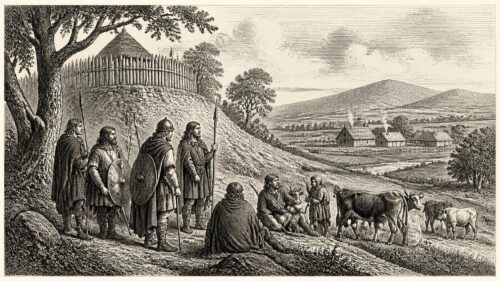
The Ó Conaing dynasty traditionally controlled a territory known as Aos Greine, associated with the later barony of Clanwilliam in County Limerick. Castleconnell served as their principal stronghold.
Its geographical position was of considerable strategic importance. The River Shannon provided a natural route of communication between settlements while simultaneously presenting an obstacle to hostile forces. A fortified position overlooking the river offered opportunities to defend territory and exercise influence over movement through the surrounding countryside.
The wealth and authority of Gaelic ruling families depended substantially upon their relationships with the population living within their territories. Political power involved obligations, alliances, military service, agricultural production and the maintenance of hereditary claims. The Ó Conaing family would have occupied a leading position within this regional society.
However, their authority was challenged by the arrival of the Anglo-Normans during the late twelfth century. By the opening decades of the thirteenth century, the family had lost its principal territorial position to a branch of the de Burgh dynasty, later known as Burke or Bourke.
The disappearance of the Ó Conaing family from political prominence did not necessarily mean that its descendants ceased to exist. Families deprived of their ancestral territories could disperse, establish themselves elsewhere, enter the service of other dynasties or survive under altered surname forms.
Woulfe observed in the early twentieth century that the surname had disappeared from County Limerick. His observation is especially poignant when considered alongside the continued survival of Castleconnell as a placename. The name of the family remained where its political authority had once stood.
3. Gunning, Cunning and the descendants of Ó Conaing
The principal anglicised surnames associated with Ó Conaing include Gunning, Cunning and O’Gunning.
These variations illustrate the difficulties encountered when Irish personal names were transferred into English-language administrative records. Clerks, officials, priests and land agents frequently recorded names according to their pronunciation rather than a universally accepted spelling. A family might consequently appear under one spelling in a baptismal register and another in a land valuation or census return.
The Gunning surname also has origins outside the Irish Ó Conaing tradition. Some families bearing the name may derive from entirely unrelated British or other ancestral lines. It would therefore be historically incorrect to assume that every person named Gunning living anywhere in the world descends from the chieftains of Castleconnell.
Nevertheless, the relationship between the Ó Conaing dynasty and Castleconnell provides a valuable starting point for investigating the Irish origins of particular Gunning and Cunning families. Descendants researching these surnames should examine the geographical origins of their earliest documented ancestors before attempting to establish connections with medieval Gaelic genealogies.
The survival of an ancestral name is important evidence of cultural continuity, but it is not, by itself, proof of direct biological descent from a particular historical individual. Castleconnell preserves the memory of the Ó Conaing family regardless of whether individual modern descendants can establish an unbroken genealogical connection with its medieval rulers.
4. The O’Brien dynasty
Few Irish surnames possess a historical reputation comparable to O’Brien. Derived from the Irish Ó Briain, the name identifies descendants of an ancestor named Brian and is particularly associated with the dynasty of Brian Boru.
The O’Briens established themselves as one of the most influential Gaelic ruling families in medieval Munster. Their kingdom of Thomond encompassed territories associated with present-day County Clare and neighbouring parts of Limerick and Tipperary. Castleconnell’s position close to these modern county boundaries placed it within a region where O’Brien authority and influence were historically significant.
Historical accounts identify Castleconnell as a fortress associated with the O’Briens before the establishment of Anglo-Norman power in the locality. The family’s influence is also reflected in the religious geography of the district. Castleconnell belongs to the Diocese of Killaloe, despite being situated in County Limerick. Local historical tradition connects this unusual arrangement with the medieval importance of the O’Brien dynasty and its determination to retain influence over the district.
The wider landscape preserves another particularly obvious association with the family through the nearby settlement of O’Brien’s Bridge in County Clare.
The O’Brien surname continued to be strongly represented in Castleconnell centuries after the decline of the medieval Gaelic lordships. A published compilation of the 1901 census records identifies 64 people bearing the surname O’Brien in the Castleconnell area, making it the third most frequently recorded surname in that compilation.
Modern descendants may encounter historical variations including O’Brian, O’Bryan, Brien and Bryan. However, the surname’s extensive geographical distribution means that establishing a Castleconnell connection requires documentary investigation.
The historical importance of the dynasty should be distinguished from the individual circumstances of the ordinary O’Brien families who lived in the district during later centuries. Their history is equally deserving of preservation.
5. The arrival of the de Burgh, Burke and Bourke families
The Anglo-Norman intervention in Ireland during the late twelfth century transformed the political landscape of Munster. Among the most influential families associated with this transformation were the de Burghs.
In 1199, King John granted lands that included Castleconnell to William de Burgh, with an obligation to establish a fortified castle. The resulting stronghold became an important centre of Norman authority in the region.
Over subsequent generations, the de Burgh surname developed several forms: De Burgh, De Burgo, De Burgho, Burke and Bourke.
The history of Castleconnell became closely associated with branches of this extensive family. Although the de Burghs originated within the Anglo-Norman aristocracy, many of their descendants became deeply integrated into Irish society. They established relationships with Gaelic families through marriage, political alliances and participation in regional conflicts. Different branches developed distinct territorial interests and cultural identities.
The history of the Bourkes demonstrates that Irish ancestry cannot always be divided into simple categories of Gaelic and foreign origin. A family introduced into Ireland during the medieval period could, over several centuries, become inseparable from the history and traditions of an Irish locality.
By the nineteenth century, descendants associated with the de Burgho name remained significant landowners in Castleconnell. The University of Galway’s Landed Estates database records that Richard Bourke adopted the surname De Burgho and was created a baronet in 1785. The title continued through successive generations until the death of Sir Richard Donellan de Burgho in 1873.
During the period covered by Griffith’s Valuation, the De Burgho family held property in at least ten townlands in the civil parish of Stradbally, including much of Castleconnell itself. This remarkable continuity demonstrates how medieval family associations could survive through later transformations in landownership and social organisation.
In the 1901 surname compilation, Bourke ranked second in Castleconnell, with 69 recorded individuals. Descendants researching the Burke or Bourke surnames should therefore consider Castleconnell an important historical location, while recognising that many unrelated branches of the surname developed throughout Ireland.
6. The Ryan family: Castleconnell’s most numerous recorded surname
Of all the surnames historically associated with the Castleconnell district, Ryan stands out because of its numerical prominence. The published 1901 census-based surname compilation records 207 individuals named Ryan, considerably more than any other surname in the area. This concentration reflects the wider historical importance of the Ryan families throughout eastern County Limerick and neighbouring County Tipperary.
The surname Ryan has more than one Irish origin. One important Munster family derives its name from Ó Maoilriain, also historically written Ó Maoilriaghain. Its anglicised forms included Mulryan and O’Mulryan before Ryan became widely established. Another ancestral family, associated particularly with County Carlow and Leinster, bore the surname Ó Riain.
The Munster Ryans became associated with the territories of Owney, encompassing districts now situated in Limerick and Tipperary. Castleconnell lies close to this historical territory. Consequently, its large Ryan population at the beginning of the twentieth century is consistent with the broader geographical distribution of the surname.
The family name should not, however, be interpreted as representing one single identifiable household or recent common ancestor. Numerous Ryan families lived throughout the region, and different branches might have occupied neighbouring farms without retaining knowledge of their precise genealogical relationship.
This creates a particular challenge for researchers attempting to reconstruct Ryan family histories. A Patrick Ryan baptised in Castleconnell might have had several contemporaries bearing precisely the same name. Researchers must therefore establish additional identifying details, including the names of parents, spouses, siblings, baptismal sponsors, occupations and individual townlands. The abundance of the Ryan surname makes these supporting details especially important.
For the descendants of Ryans who emigrated from Castleconnell, the discovery of a specific ancestral address may unlock several generations of family history.
7. The Enright family and Castleconnell’s fishing heritage
The Enright surname occupies a special position in the history of Castleconnell because its local associations extend beyond ancient genealogy into the commercial and cultural life of the village. The Irish surname Mac Ionnrachtaigh developed into the anglicised Enright, with historical variants including MacEnright, Enraght and Inright. Woulfe identifies the family as being of Dalcassian origin.
In Castleconnell, the Enright name became particularly associated with the village’s celebrated salmon-fishing industry. During the nineteenth and early twentieth centuries, Castleconnell developed an international reputation as a destination for anglers. Fishing attracted wealthy visitors and created employment for local boatmen, guides, craftsmen and hospitality businesses.
Among the best-known contributions to this industry was the manufacture of the Castleconnell fishing rod. The Enright family became famous for its craftsmanship, and John Enright achieved international distinction through his fly-casting abilities. Local historical sources identify 1906 as the year in which he became world fly-casting champion.
The Enright family was also associated with the Shannon Hotel, a building that subsequently became an important centre for preserving the heritage of the community.
This history demonstrates how an ordinary Irish surname can acquire a distinctive international association through the achievements of a particular local family. The Enrights were not remembered exclusively because of their ancient lineage. Their reputation also arose from skill, enterprise and participation in an industry that supported generations of Castleconnell residents.
In the 1901 surname compilation, Enright ranked fourth, with 35 recorded individuals. For descendants of Castleconnell Enrights, old fishing equipment, commercial advertisements, newspaper reports, photographs and hotel records may prove as valuable as traditional genealogical documents.
8. The Ahern and Aherne families
The surnames Ahern, Aherne and Ahearn are traditionally associated with the Irish Ó Eachthighearna and related historical forms. The ancestral personal name contains elements associated with horses and lordship. The family belonged to the wider historical world of the Dál gCais and was particularly associated with territory in the vicinity of Sixmilebridge in County Clare.
Medieval territorial conflicts contributed to the dispersal of branches of the family throughout Munster. By the nineteenth century, the surname had become well established in Counties Limerick and Cork. Castleconnell’s proximity to County Clare provides an important geographical context for investigating its Ahern families.
The Shannon should not be regarded as an absolute historical barrier separating the people of Clare from those of Limerick. Marriage, trade, employment, religious connections and movement between neighbouring settlements frequently created family networks extending across the river.
The 1901 compilation records 29 people under the surname Ahern in the Castleconnell area. Further individuals may appear under alternative spellings. Researchers should particularly examine Ahearn and Aherne when investigating parish registers or handwritten nineteenth-century documents.
9. The McMahon family
McMahon is another important surname associated with the medieval history of Thomond. Derived from Mac Mathghamhna, now commonly represented in Irish as Mac Mathúna, the surname originated independently among different Irish dynasties. One prominent branch belonged to the ruling families of Thomond, while another developed in the territories associated with present-day County Monaghan.
The McMahons of Thomond were historically connected with the O’Brien dynasty. Their presence throughout County Clare and adjoining parts of Munster makes Castleconnell a natural location in which to investigate the surname’s regional history.
The 1901 compilation identifies 28 individuals bearing the McMahon surname in the district. Historical spelling variations include MacMahon, McMahan and other forms. The existence of distinct McMahon dynasties demonstrates the importance of geographical evidence. A person bearing the surname cannot automatically be assigned to the Thomond family without establishing the location of their ancestors. Castleconnell records may assist descendants in identifying the correct regional branch.
10. The Tuohy, Tuohey and Toohey families
The Tuohy surname, together with its numerous spelling variations, has a particularly interesting historical presence in Castleconnell. The surname is associated with the Irish Ó Tuathaigh, an ancestral name found in several regions of Ireland. Anglicised forms include Tuohy, Touhy, Toohey, Twohy and Tuohey.
The 1901 compilation separately records 23 individuals named Tuohey and 14 named Tuohy in Castleconnell. These spellings together account for at least 37 individuals, although their precise family relationships require investigation.
This example illustrates how historical surname statistics can become misleading when spelling variations are treated as entirely separate names. A man recorded as Tuohy at the time of his marriage might subsequently appear as Tuohey in a census or property valuation. An emigrant might adopt Toohey after settling in America or Australia.
The surname also possesses an important modern connection with the preservation of Castleconnell’s heritage. Local historian Paddy Tuohy formally opened the Castleconnell Heritage Centre, helping to celebrate the community’s historical identity.
For genealogists, the Tuohy family illustrates the importance of searching alternative spellings and recognising the relationship between historical families and modern custodians of local memory.
11. The Hickey family: an ancient medical tradition
The Hickey surname derives from the Irish Ó hÍceadha or related forms. The ancestral name is associated with healing. Historically, a prominent Hickey family belonged to the medical tradition of Gaelic Ireland and served as hereditary physicians to the O’Briens and other important families in Thomond.
Medieval Gaelic society included hereditary learned families specialising in medicine, law, poetry, genealogy and historical scholarship. Their professional knowledge could be transmitted between generations and occupy an important position within the political and cultural life of Gaelic lordships. The Hickeys represent one of these distinctive traditions.
The surname became widespread beyond its original professional associations. By 1901, the Castleconnell surname compilation identifies 21 individuals named Hickey. It cannot be assumed that these households directly descended from the medieval hereditary physicians. Nevertheless, the historical origins of the name provide an important cultural context for descendants investigating their ancestral identity. Alternative spellings include O’Hickey and Hickie.
12. The McNamara family
The McNamara surname derives from the Irish Mac Conmara. The family became one of the most important Gaelic dynasties in County Clare, where its members established extensive territories and constructed numerous fortified residences. The historical territory associated with the McNamaras included Upper and Lower Tulla.
Castleconnell’s position close to the traditional lands of eastern Clare provides a geographical context for the occurrence of the surname in the district. The 1901 compilation records 21 individuals under the spelling McNamara.
Family connections extending between Clare and Limerick could arise through marriage, agricultural employment, commerce or other forms of migration. For modern researchers, this means that the discovery of a McNamara ancestor in Castleconnell should not necessarily restrict further investigation to County Limerick. Neighbouring Clare parishes may contain records relating to earlier generations. Alternative surname forms include MacNamara and MacNamarra.
13. The Quinn, Daly, Carroll and McCarthy families
Several other important Gaelic surnames were strongly represented in Castleconnell during the early twentieth century.
Quinn, generally associated with forms of the Irish surname Ó Cuinn, was recorded 22 times in the 1901 compilation. The name originated among several Irish families and became widely distributed. Historical variations include Quin and O’Quinn.
Daly, commonly derived from Ó Dálaigh, was recorded 21 times. The surname has notable historical associations with Gaelic poetry and scholarship, although later bearers pursued many different occupations.
Carroll, generally associated with Ó Cearbhaill, appeared 20 times. Several distinct Gaelic dynasties adopted forms of this surname, making geographical identification particularly important.
McCarthy, derived from Mac Cárthaigh, appeared 19 times. The name is especially associated with the ancient ruling families of southern Munster, particularly Cork and Kerry.
The presence of these surnames in Castleconnell reflects the interconnected nature of Irish society. Families could establish themselves far from the ancestral territories traditionally associated with their surnames. Such movement occurred long before the nineteenth-century age of mass emigration. Consequently, the distinction between the medieval origins of a surname and the later birthplace of a particular family is essential to understanding Irish ancestry.
14. The Tucker and Mackey families
The diversity of Castleconnell’s ancestral population is further illustrated by the Tucker and Mackey surnames. Tucker was recorded 22 times in the 1901 compilation. Unlike many of Castleconnell’s Gaelic surnames, Tucker is generally associated with an English occupational surname connected with the finishing of cloth.
However, the origin of a surname does not establish when a particular family arrived in Ireland. The Castleconnell Tuckers may have possessed longstanding Irish connections, but their precise origins must be established through individual family records.
Mackey, recorded under the spelling MacKey in the same compilation, appeared 20 times. Mackey has several possible ancestral origins, including Gaelic surname forms. Its spelling can overlap with Mackay, McKay and other names, although these should not automatically be treated as genealogically identical.
Local historical writing also remembers Anthony Mackey in connection with eel fishing. This association provides a further example of how the history of a Castleconnell surname can be connected with the economic traditions of the Shannon. Both surnames deserve investigation independently of the more celebrated medieval ruling families. Their histories may reveal patterns of migration, settlement, employment and marriage that would otherwise receive little attention.
15. Castleconnell’s principal surnames in 1901
The surviving Irish census returns provide an invaluable means of identifying families living in particular communities at the beginning of the twentieth century. A published census-based surname compilation for Castleconnell identifies the following leading surnames:
| Surname | Recorded individuals |
|---|---|
| Ryan | 207 |
| Bourke | 69 |
| O’Brien | 64 |
| Enright | 35 |
| Ahern | 29 |
| McMahon | 28 |
| Tuohey | 23 |
| Quinn | 22 |
| Tucker | 22 |
| Daly | 21 |
| Hickey | 21 |
| McNamara | 21 |
| Carroll | 20 |
| MacKey | 20 |
| McCarthy | 19 |
| Murphy | 17 |
| Sullivan | 17 |
| Lyons | 16 |
| Healy | 15 |
| Joyce | 15 |
| Power | 15 |
| Butler | 14 |
| Hough | 14 |
| McGrath | 14 |
| Tuohy | 14 |
| Frawley | 13 |
| Gleeson | 13 |
| Mulqueen | 13 |
| Supple | 13 |
| Burns | 12 |
| Hynes | 12 |
| McLeod | 12 |
| Rose | 12 |
| Benn | 11 |
| Boyle | 11 |
| Bugler | 11 |
| Doherty | 11 |
| Hogan | 11 |
| Keane | 11 |
| Kelly | 11 |
| Madden | 11 |
| Moloney | 11 |
| Sheehan | 11 |
| Browne | 10 |
| Buckley | 10 |
| Dwyer | 10 |
| Marnane | 10 |
Source: Forebears, Castleconnell surname distribution, 1901.
These figures count individuals rather than separate households or ancestral family branches. The compilation’s geographical coverage must also be checked against the original census returns before making precise comparisons with the modern village population.
Nevertheless, the information provides a fascinating historical snapshot. It demonstrates that Castleconnell was home to a wide variety of surnames reflecting Gaelic, Anglo-Norman and other ancestral traditions. It also reveals the substantial concentration of certain families that might otherwise receive relatively little attention in national histories. For the Irish diaspora, these lesser-known names may be every bit as significant as the celebrated surnames of O’Brien and Bourke.
16. The landed families of Castleconnell
The eighteenth and nineteenth centuries witnessed important changes in the ownership and occupation of property throughout Ireland. Castleconnell developed a reputation as a fashionable spa resort, attracting affluent visitors and encouraging the construction of substantial residences. Its attractive riverside location became associated with country houses, villas and landscaped grounds.
The history of these properties introduces additional families into the genealogical landscape. The De Burgho family remained particularly prominent. The Landed Estates database also identifies connections with the Bourkes of Thornfield, the Gabbett family, the O’Gradys and other landed families in the surrounding region.
At Belmont, in Stradbally North, Griffith’s Valuation identifies John White as occupying property held from Thomas William O’Grady. At Stormont, in the townland of Coolbane, Joseph Walplate occupied a property held from Sir Richard De Burgho.
These examples demonstrate the importance of distinguishing between landowners and occupiers. A family appearing in nineteenth-century property records might have owned an estate, rented a substantial house, leased agricultural land or occupied a modest dwelling. The relationship between immediate lessor and tenant is valuable genealogical evidence, but it should not automatically be interpreted as evidence of kinship.
The great houses of Castleconnell also supported networks of employees. Gardeners, coachmen, cooks, housekeepers, stable workers, labourers and domestic servants could move between estates, establishing connections with communities beyond their places of birth. Researching the history of an estate may therefore illuminate the lives of families whose names never appeared in aristocratic genealogies.
17. Castleconnell before the Great Famine
Samuel Lewis’s Topographical Dictionary of Ireland, published in 1837, provides a valuable description of Castleconnell before the catastrophe of the Great Famine. Lewis recorded 1,313 inhabitants in the town, with 5,616 people in the much wider parish area described in his entry.
The village was already well known for its mineral waters and attractive surroundings. Visitors travelled to Castleconnell in the belief that its spa waters possessed therapeutic qualities. This commercial activity supported accommodation providers, tradespeople, transport workers and others who supplied the needs of visitors.
The development of fashionable tourism brought different social classes into close geographical proximity. Affluent visitors might spend extended periods in comfortable accommodation, while local families worked in agriculture, domestic employment and commercial services. Such contrasts formed part of the economic structure of pre-Famine Ireland.
Castleconnell’s prosperity as a resort should not be interpreted as evidence that all its inhabitants enjoyed financial security. The agricultural population remained vulnerable to poor harvests, economic downturns and the availability of employment. When potato blight appeared in Ireland in 1845, these vulnerabilities became devastatingly apparent.
18. The Great Famine and the disappearance of families
The Great Famine of the 1840s transformed the demographic history of Ireland. Castleconnell, like numerous other communities, experienced the consequences of hunger, disease, economic insecurity and migration.
Local memories of the Famine were preserved in the Schools’ Collection of the 1930s, now available through Dúchas. One account from Castleconnell recalls severe mortality and describes a building remembered as having served both medical and poor-relief functions.
Such testimony is valuable because it preserves memories that might otherwise have disappeared. However, folklore accounts were generally recorded many decades after the events they describe. Numerical claims about mortality must therefore be independently corroborated before being accepted as established demographic facts.
The tragedy of the Famine cannot be understood exclusively through national statistics. Its consequences were experienced within individual households. A surname that had been common in a particular townland might become considerably less visible following death, emigration or relocation. A family recorded in the Tithe Applotment Books during the 1830s might not appear in Griffith’s Valuation two decades later.
Children might lose their parents, households could become fragmented, and survivors might seek employment far from their ancestral homes. For genealogists, the Famine represents both a historical catastrophe and a major disruption in the documentary continuity of Irish families. The absence of a family from later records should prompt investigation rather than immediate conclusions about its fate.
19. Emigration and the Castleconnell diaspora
The nineteenth and early twentieth centuries witnessed the departure of millions of Irish people for destinations overseas. Castleconnell families participated in this wider history of migration.
Emigrants left Ireland for Britain, the United States, Canada, Australia and New Zealand in pursuit of employment, land, family reunification and improved opportunities. Some departed during periods of acute hardship. Others followed relatives who had established themselves abroad.
For many emigrants, their most valuable connection with Ireland was the network of family members and neighbours who had preceded them. This process, frequently described as chain migration, could result in people from the same Irish parish establishing themselves within particular overseas communities.
A Ryan family from Castleconnell might settle near former neighbours from County Limerick. A Bourke might marry an emigrant from a neighbouring parish. An Enright might find employment through relatives already established abroad. These examples illustrate possible migration patterns rather than identified individual family histories.
Irish emigrants sometimes modified the spelling of their surnames after leaving Ireland. Prefixes such as O’ and Mac might be dropped, restored or inconsistently recorded. Names could also be altered by immigration officials, employers or the families themselves.
For descendants researching Castleconnell ancestry, overseas records often provide the essential starting point. Marriage certificates, naturalisation documents, death certificates, obituaries, cemetery inscriptions and passenger lists may contain information identifying an ancestor’s Irish birthplace. The discovery of the word Castleconnell in one of these records can transform an otherwise general search for Irish ancestry into a focused investigation of a particular historical community.
20. The fishing families of the River Shannon
For generations, the River Shannon provided employment and sustenance to Castleconnell families. The village’s reputation for salmon fishing attracted visitors and created a distinctive local economy.
Fishing required knowledge accumulated through years of experience. Local guides understood the character of the river, while craftsmen manufactured and maintained the equipment required by visiting anglers. Boatbuilding represented another important specialised occupation.
Local historical accounts identify the O’Connor family, commonly known as the Connors, as Castleconnell boatbuilders. The Enrights became renowned for fishing rods and angling expertise. The Hogg family also participated in the tradition of manufacturing greenheart fishing rods.
Other families were associated with accommodation, hospitality, entertainment and the commercial activity generated by visitors. The history of the Hartigan family, for example, is connected with a local entertainment venue remembered as Hartigan’s Hall.
These family histories are particularly valuable because traditional genealogical records often reveal relatively little about professional skill. A census might describe an individual simply as a fisherman, carpenter or labourer. Local newspapers, surviving photographs, oral histories and commercial records can provide the human detail that transforms such an entry into a meaningful biography.
The working families of the Shannon contributed substantially to Castleconnell’s identity. Their stories deserve a place alongside those of the chieftains, aristocrats and landowners who dominate earlier historical accounts.
21. Castleconnell’s churches and parish records
Religious records are among the most important surviving sources for researching Irish ancestry. Castleconnell’s historical Catholic parish is associated with Castleconnell, Ahane and the surrounding district.
The National Library of Ireland holds digitised Catholic parish registers for Castleconnell in the Diocese of Killaloe. The available register images include baptismal entries beginning in February 1850, continuing through the nineteenth century, and marriage records commencing in August 1863.
These documents may identify parents, sponsors, witnesses and occasionally more detailed residential information. The names of baptismal sponsors can be particularly useful. Godparents were frequently relatives or trusted associates, and repeated appearances within a group of baptismal records may suggest connections between neighbouring households. Marriage witnesses can provide similar clues.
Researchers should also investigate the history of All Saints Church of Ireland at Stradbally. Its records and monuments reflect another important dimension of the district’s religious and family history.
The history of Castleconnell cannot be adequately reconstructed through the records of one denomination alone. Families belonged to different religious traditions, and their relationships could change through marriage, conversion and migration. Where records survive, they should be examined collectively.
22. Griffith’s Valuation and the ancestral homes of Castleconnell
Griffith’s Valuation was undertaken throughout Ireland between 1847 and 1864. It provides information concerning property occupation and valuation, making it one of the most valuable sources available to nineteenth-century Irish genealogists.
The valuation identifies occupiers, immediate lessors and the nature and assessed value of properties. When used alongside the associated historical maps, it can enable researchers to identify the approximate location of an ancestral farm or dwelling.
For Castleconnell descendants, this is particularly significant. It may become possible to establish not merely that an ancestor lived in Castleconnell, but that the family occupied a particular property within a particular townland.
Subsequent valuation revision books can sometimes demonstrate how the occupation of a property changed over time. These records may help identify when one generation succeeded another, when a tenancy was transferred or when a family disappeared from an address.
However, the original valuation does not provide a complete household census. Women, children, employees and other household members frequently remain unnamed. The information must therefore be combined with parish registers, civil registration documents and later census returns.
23. The importance of Castleconnell’s townlands
The townland represents one of the most important geographical units in Irish genealogy. Irish families frequently identified their homes through townland names rather than the nearest major village. A person who described their birthplace as Castleconnell after emigrating might actually have been born in a rural townland several kilometres away.
Among the townlands relevant to Castleconnell research are Cloon and Commons, Ballynacourty, Stradbally North, Coolbane and Lacka. These locations can appear in land records, census returns, parish registers and other historical documents.
Understanding the relationship between townlands, civil parishes, electoral divisions and Catholic parishes is essential. The civil parish of Stradbally, for example, appears prominently in historical administrative records connected with Castleconnell.
A genealogist who searches exclusively for the modern village name might overlook important documents catalogued under Stradbally. The same applies to the wider ecclesiastical area associated with Ahane and Killeenagarriff.
The identification of an ancestral townland can considerably improve the accuracy of family-history research. It allows the researcher to distinguish between people bearing identical names and to reconstruct networks of neighbouring families.
24. Women and the hidden history of Castleconnell’s families
Traditional surname studies frequently concentrate upon male lines of descent. However, the women of Castleconnell played an equally important role in creating and sustaining its ancestral families.
Marriage connected households that might otherwise have remained unrelated. A Ryan man marrying a Bourke woman created descendants whose ancestry belonged to both families. Their children might subsequently establish relationships with the Enrights, Aherns, O’Briens or other local households.
Within several generations, an individual’s ancestry could encompass numerous Castleconnell surnames. The concentration upon a single surname can consequently obscure the true diversity of family origins.
Women also contributed to the community through agricultural work, domestic employment, commerce, education, nursing, hospitality and the management of households. Much of this work was poorly represented in official records.
Birth and marriage certificates that preserve maiden surnames are therefore especially valuable. They can reveal maternal ancestors whose identities might otherwise disappear from a family history. An adequate account of Castleconnell’s ancestry must recognise that its heritage was transmitted through mothers as much as fathers.
25. Reconnecting with ancestral Castleconnell
For descendants of Castleconnell families living overseas, the process of rediscovering their Irish origins can be both historically rewarding and personally meaningful. A researcher should begin with the earliest reliably documented ancestor and work backwards systematically.
The principal sources include:
- Overseas birth, marriage and death certificates.
- Immigration and naturalisation records.
- Irish civil registration records.
- Catholic and Church of Ireland registers.
- The censuses of 1901 and 1911.
- Griffith’s Valuation.
- Tithe Applotment Books.
- Historical newspapers and commercial directories.
- Cemetery inscriptions.
- Estate papers and valuation revision books.
- School registers.
- Local folklore and community histories.
Castleconnell Heritage Centre represents an important local initiative dedicated to preserving this inheritance. Community volunteers have undertaken work involving cemetery surveys, parish records, historical photographs and school registers. These collections provide opportunities to investigate the experiences of ordinary people whose lives might otherwise remain largely undocumented.
Researchers should record the source of every discovery, preserve historical spelling variations and avoid connecting individuals solely because they share the same name. The objective is not simply to construct the longest possible family tree, but to establish an accurate account of the lives and relationships of previous generations.
Conclusion: The families that made Castleconnell
The history of Castleconnell is ultimately the history of its people.
Its earliest identifiable ancestral association belongs to the Ó Conaing family, whose name survived in the identity of the settlement long after the decline of its territorial power. The O’Briens contributed to the medieval Gaelic history of the region, while the de Burghs and Bourkes established a dynastic presence that extended across many centuries. The Ryans became the most numerous surname recorded in the Castleconnell area at the beginning of the twentieth century.
The Enrights, Aherns, McMahons, Tuohys, Hickeys, McNamaras and numerous other families helped establish the distinctive character of the community. Alongside them were fishermen, boatbuilders, agricultural workers, teachers, tradespeople, servants, merchants and emigrants whose collective experiences formed the social history of the district.
Their descendants are now scattered throughout the world. Some continue to live within sight of the Shannon. Others have never visited Ireland but preserve a family tradition identifying Castleconnell as their ancestral home.
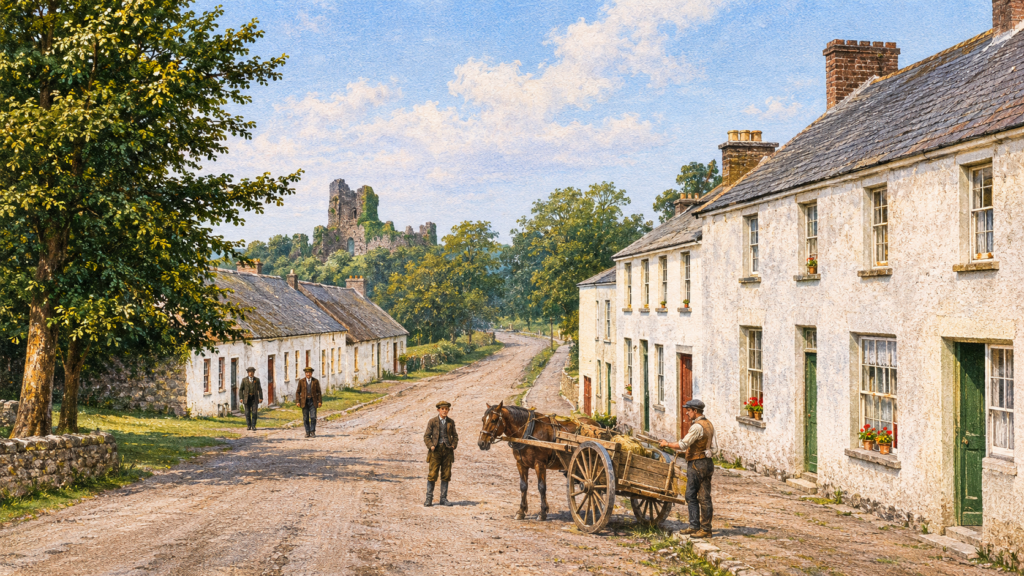
The castle ruins, churches, graveyards, historic houses, townlands and surviving documentary records represent tangible connections with these generations.
Every surname tells part of the story. Every surviving record provides another piece of evidence. Every family, whether celebrated or largely forgotten, contributed to the development of the community.
Castleconnell is more than an Irish placename. It is a place of ancestral memory, a repository of family histories and an enduring connection between Ireland and its worldwide diaspora.
For those whose ancestors once walked its streets, worked its fields or fished its river, Castleconnell remains part of their inheritance.
Irish Roots – Preserving the ancestral families of Ireland, one place at a time.
Historical and genealogical sources
- Reverend Patrick Woulfe, Irish Names and Surnames, 1923.
- Samuel Lewis, A Topographical Dictionary of Ireland, 1837.
- Robert E. Matheson, Special Report on Surnames in Ireland.
- Placenames Database of Ireland, Logainm.
- Limerick Local Studies, historical placename and genealogical collections.
- National Archives of Ireland, Census Returns of 1901 and 1911.
- National Archives of Ireland, Tithe Applotment Books.
- National Library of Ireland, Catholic Parish Registers.
- Griffith’s Primary Valuation of Ireland.
- University of Galway, Landed Estates Database.
- Castleconnell Heritage Centre.
- Castleconnell Parish, historical collections.
- Limerick City and County Council, Castleconnell History and Heritage.
- Forebears, Castleconnell surname distribution, 1901.
- Dúchas, the National Folklore Collection.
- Love Castleconnell, local historical and community publications.
- Historic Graves, Irish cemetery records.
Searchable surnames: Gunning, Cunning, O’Gunning, O’Brien, Burke, Bourke, De Burgh, De Burgo, De Burgho, Ryan, Mulryan, Enright, Ahern, Aherne, Ahearn, McMahon, MacMahon, Tuohey, Tuohy, Toohey, Quinn, Tucker, Daly, Hickey, McNamara, Carroll, Mackey, McCarthy, Murphy, Sullivan, Lyons, Healy, Joyce, Power, Butler, Hough, McGrath, Frawley, Gleeson, Mulqueen, Supple, Burns, Hynes, McLeod, Rose, Benn, Boyle, Bugler, Doherty, Hogan, Keane, Kelly, Madden, Moloney, Sheehan, Browne, Buckley, Dwyer, Marnane, Hartigan, Hogg, O’Connor, White, O’Grady, Gabbett and Walplate.