

Island Arrivals
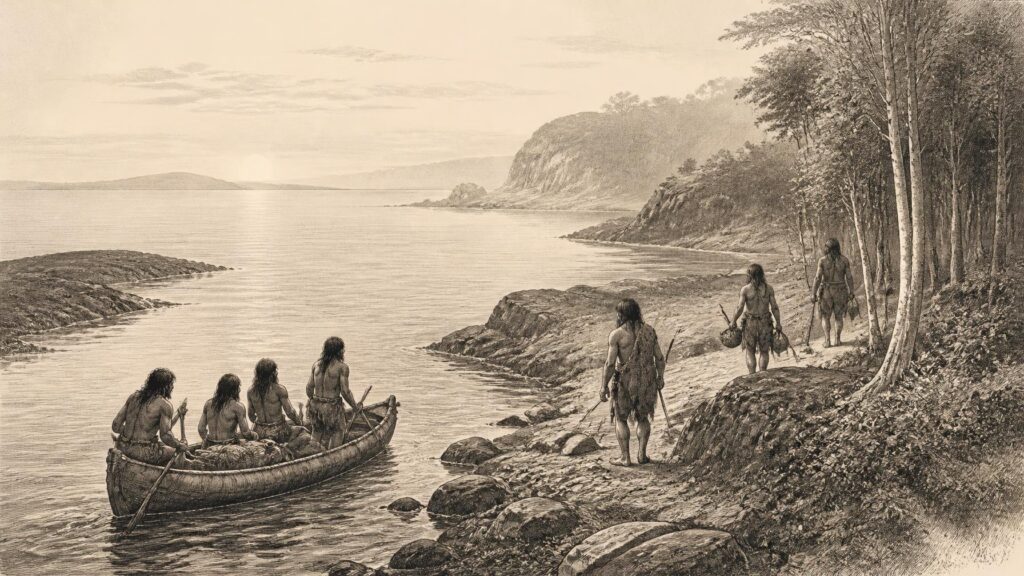
AI generated historical illustration, not a contemporary photograph.
At a Glance
The first people reached Ireland by water. That conclusion is firmer than almost every detail surrounding it. Ireland had become an island before the secure Mesolithic settlement record begins, so no overland migration from Britain was available to the pioneers whose camps, tools and burials appear in the archaeological record. Yet the sea crossing itself remains invisible: no boat from the first arrival has survived, no written account exists, and the surviving evidence cannot identify one single route, vessel or expedition. The history of Ireland’s first arrivals is therefore a matter of carefully weighing traces rather than supplying a picturesque certainty.
The Question
“How did the first people reach Ireland?” appears to ask for a simple answer, but it contains several different questions. Did the first human beings make only a short visit, perhaps to hunt or butcher an animal? When did a population establish a durable presence on the island? From which neighbouring coast did people set out? What sort of craft could have carried them? And did the settlement of Ireland result from one planned movement, a sequence of exploratory voyages, or repeated crossings over generations?
Archaeology can answer parts of these questions, but its evidence is uneven. Stone tools preserve more readily than wood, hide, fibre, food, tents, clothing and boats. Sea level has also risen greatly since the end of the last Ice Age, drowning many shorelines on which first landfalls, temporary camps and landing places may once have stood. The absence of a Mesolithic boat in Ireland is consequently not proof that boats did not exist; it is a reminder that organic objects and coastal sites are exceptionally vulnerable to loss.
The best-supported broad conclusion is that Ireland was colonised from surrounding lands by hunter-gatherers using watercraft. That does not mean historians should imagine a fleet of sizeable vessels confidently heading west across open ocean. The crossing may have involved small groups, short stages where islands or headlands could be sighted, knowledge of tides and currents, and craft designed for waters that were demanding but familiar. Equally, it may have required purposeful journeys beyond the everyday travel represented by fishing, river movement or coastal foraging. The evidence does not decide every point.
It is also important not to confuse the first arrival with the beginning of Irish history in a cultural or ethnic sense. These people left neither names nor a language that can be recovered. They did not call themselves Irish, and they cannot usefully be fitted into much later national, linguistic or folkloric categories. They were hunter-gatherers living in a landscape being remade after glaciation. Their connection to later communities is real in the simple sense that they were among the earliest known people of the island, but the population history of Ireland included major changes long after their arrival.
Frozen Island
To understand why a sea crossing was necessary, one must begin with the changing geography of north-west Europe. During the Last Glacial Maximum, much of Ireland and Britain lay under or beside extensive ice. Large volumes of the world’s water were locked in ice sheets, lowering sea levels and altering coastlines. Britain was at times connected to continental Europe by lowland landscapes now beneath the North Sea. Ireland, however, was not simply the western end of a continuous land bridge extending from Britain. Research synthesised in recent studies of Irish colonisation holds that Ireland had become an island before the end of the last Ice Age.
That point matters. Low sea levels may make maps of prehistoric Europe appear more connected than those of today, but a lowered sea is not the same thing as dry passage everywhere. The waters between Ireland and Britain were narrower in places and their coastlines differently shaped, but they remained a barrier. People who reached Ireland in the late glacial or early Holocene periods had to negotiate water.
The physical obstacle was matched by an ecological one. An ice-damaged, recently deglaciated island could not automatically sustain human communities. Plants, animals and soils needed time to establish themselves. Hunter-gatherers depended on a shifting mixture of game, fish, shellfish, birds, plants, wood and workable stone. They also required a social world beyond the immediate camp: partners, exchange, knowledge of seasons, access to materials and possibly contact with people elsewhere. An island may be reachable without being readily inhabitable.
After the severe cold conditions of the Late Glacial period, temperatures rose sharply at the beginning of the Holocene. Woodlands expanded, and Ireland’s rivers, lakes, coasts and developing forests offered new resources. The timing of the substantial Mesolithic record suggests that enduring settlement became viable within this changing environment. This does not prove that no person had visited earlier; instead, it cautions against turning any isolated early trace into evidence for a large, continuous population.
The contrast with Britain is instructive. Hunter-gatherers were present in Britain during late glacial and early Holocene phases, and Britain had far more direct connections with continental Europe. Ireland lay beyond another stretch of water and had fewer of the large game animals important to earlier mainland hunter-gatherer economies. These circumstances help explain why settlement evidence is later and scarcer in Ireland, without requiring the assumption that early people lacked courage or maritime skill.
Fragile Clue
The oldest widely discussed indication of human activity in Ireland is not a settlement, a skeleton or a boat. It is a brown-bear kneecap, or patella, from Alice and Gwendoline Cave near Clarecastle in County Clare. Excavated during investigations in 1903 and later reassessed in the National Museum of Ireland collections, the bone bears marks interpreted as cuts made by a stone tool while the bone was fresh. Independent radiocarbon measurements placed the bone in the Younger Dryas, a return to severe cold near the end of the Ice Age.
The original study described this as evidence for a Late Upper Palaeolithic human presence. In calendar terms, the dates fall roughly in the later eleventh millennium BC, although a precise year would create a false impression of certainty. If the cut marks genuinely belong to the period represented by the bone, then someone had access to the bear carcass and used a sharp tool upon it. That would take human activity in Ireland considerably earlier than the traditionally recognised Mesolithic settlement record.
But the proper historical language here is possibility and evidence, not finality. The patella is an extraordinarily important find precisely because it is isolated. It was recovered in an antiquarian excavation more than a century ago, rather than from a modern, undisturbed excavation with a complete associated assemblage of tools, hearths, floors and animal remains. Recent reassessment of the cave has improved knowledge of its deposits and fauna, but it has not produced an unequivocal late glacial campsite. The relationship between the dated bone, its markings and the exact place where human activity occurred is therefore a subject for continuing scrutiny.
The distinction is not pedantic. A single butchery event would show that people reached Ireland; it would not by itself demonstrate a resident community, a family migration, or a population surviving through generations. They might have arrived from Britain or elsewhere, made a short visit, and left. They might have been part of a small and short-lived occupation whose sites have disappeared beneath later deposits or rising seas. Or the patella’s interpretation may yet require revision as methods and comparative evidence advance. Responsible history preserves each of those possibilities.
There is additional early evidence from the same cave complex: a human clavicle has been directly dated to the Early Holocene. This is significant evidence for people in Ireland in that broad period, but it still does not reveal the journey that brought them there. Bones and tools can establish presence. They rarely record the route of a voyage.
Lasting Settlement
For a sustained human presence, archaeologists rely chiefly on the Mesolithic record. The Irish Mesolithic conventionally extends from about 8000 BC to the centuries around 4000 BC, when farming practices appeared. The opening date is not a declaration that the first canoe touched shore on one particular morning. It is an archaeological horizon: after about 8000 BC, evidence for settlement becomes substantial enough to show that hunter-gatherer communities had established themselves on the island.
Mount Sandel, beside the River Bann at Coleraine, is central to this understanding. Excavations there revealed concentrations of flint artefacts, hearths and the traces of light structures. The site is often described as one of Ireland’s earliest known settlements, with occupation dated broadly between 7600 and 7900 BC. Its position near the river and a natural weir points to the importance of salmon, while the artefacts show systematic use of the landscape rather than a solitary passing visit.
Mount Sandel does not stand alone, though it has acquired special prominence because excavations exposed features that make domestic life easier to visualise. Mesolithic material has been found in many settings: along coasts, beside rivers and lakes, on raised ground and within landscapes now altered by peat growth, agriculture and development. Flint, chert, quartz and other stone were fashioned into blades, flakes and small tool forms. Hearths, postholes, pits, burnt stone, animal bone and shell deposits can offer brief glimpses of work, meals, shelter and repeated return.
These sites support a picture of people who moved through territories according to seasons and resources, rather than occupying permanent villages in the modern sense. Mobility, however, should not be mistaken for simplicity or aimlessness. A community able to thrive in an insular wooded world required intimate practical knowledge: where fish ran, when plants ripened, how woodland changed, which raw materials could be obtained, and how water could be crossed safely. The first settlers were not merely people who survived a voyage; they were people who made an island into a familiar lived landscape.
The earliest known burial evidence provides another indication that Mesolithic Ireland was more than a place of episodic hunting. At Hermitage on the River Shannon in County Limerick, excavations uncovered cremated human remains in pits, together with evidence of burning and artefacts. One burial is dated to the early seventh millennium BC. Research on the site has shown that a polished stone adze deposited with a cremation was deliberately modified before burial. The interpretation of ritual meaning must remain cautious, yet the evidence demonstrates deliberate practices surrounding death and the repeated significance of a particular place.
Such evidence changes the scale of the question. Once people had settled, crossed rivers and coasts, buried their dead and returned to meaningful locations, the problem was no longer simply how a first boat arrived. It became how island communities maintained themselves in relation to one another and to the wider Irish Sea world.
Crossing Waters
If Ireland was an island, watercraft are unavoidable in the explanation. This is the most secure inference in the entire story. No person could walk from Britain to early Holocene Ireland. Whether the journey was made in a dugout, a skin-covered frame, a bark vessel, a raft or another craft is not securely known. Each proposal has different practical implications, but none can presently be treated as established fact for the first colonists.
A dugout canoe is an attractive possibility because later prehistoric wooden boats are known from Ireland and neighbouring regions. A trunk hollowed by fire and tools can form a capable vessel, particularly in rivers, lakes and protected coastal waters. Yet direct material evidence for an Irish boat contemporary with the very earliest Mesolithic arrivals remains inconclusive. Northern Ireland’s logboat record includes a specimen radiocarbon dated to the middle Mesolithic, several millennia after the first secure settlement evidence. It shows that wooden boats could be made and used in prehistoric Ireland; it does not prove that the original colonists travelled in precisely that form.
Skin boats are another often-mentioned possibility. Light frames covered in hide could have been carried, repaired and launched from a variety of shores. Similar principles are familiar from later currach traditions around Ireland and Scotland, but continuity cannot simply be assumed across thousands of years. Calling the first vessels “currachs” would import a later cultural term and a specific image for which the archaeological evidence is lacking. The prudent formulation is that flexible, skin-covered craft are technically plausible, not archaeologically demonstrated for the initial voyage.
Rafts and bark craft are also conceivable, although they present different limitations in stability, cargo and seaworthiness. Experimental archaeology can demonstrate that certain materials can cross water, but it cannot establish what happened in the past. A successful modern reconstruction depends on modern preparation, weather choices, support arrangements and assumptions about skill. It is useful for testing feasibility, not for identifying a lost prehistoric event.
The sea itself should not be imagined as an empty expanse separating known lands. Coasts were productive environments where people gathered food, observed birds and mammals, collected raw materials and travelled between rivers, estuaries and inlets. Communities living around the Irish Sea could have acquired water knowledge in ordinary activity long before any crossing led to colonisation. Nevertheless, the Irish Sea was hazardous. Weather changes quickly, tidal streams are powerful, and an open-water journey in a small craft required judgement as well as courage.
One interpretation is that pioneers moved from western Britain or south-west Scotland, the nearest general source areas. Scotland is often emphasised because of proximity across the North Channel and because hunter-gatherer populations existed there in relevant periods. But “from Scotland” should not be treated as a proved itinerary. Palaeogeography complicates modern distances, and population movement does not always take the shortest path. People may have travelled through several coastal regions, followed social ties, or departed from points for which no archaeological trace has survived.
It is equally possible that the first arrival was not a single founding expedition. A small group might have reached Ireland during a seasonal journey, returned, and later brought others. A failed landing might leave no identifiable trace. Separate groups might have arrived at different points over centuries. Colonisation is often a process rather than an episode, especially where a new landscape had to be assessed for food, shelter, stone and safe routes. The archaeological record is better suited to recognising that long result than to recreating its first decision.
Island Routes
The likely movement of people must be placed within an Irish Sea zone rather than reduced to a modern national boundary. Ireland, Britain, the Isle of Man, the Hebrides and the coasts of continental Europe formed related but distinct environments. The rising sea that separated Ireland also created or enlarged the maritime routes through which people, objects and information could move. To call the sea a barrier is correct; to call it an impassable wall is not.
Possible routes include crossings from western Scotland, north Wales, north-west England or regions reached through those coasts. The first secure Irish Mesolithic communities shared broad technological backgrounds with hunter-gatherers around Britain and north-west Europe, yet their stone-tool traditions soon developed distinctive features. This combination suggests connection followed by insular history, rather than isolation from the outset or an enduring simple dependence upon one neighbouring coast.
Raw materials offer one line of evidence for contact, although they seldom identify first settlement directly. Stone suitable for knapping was not distributed evenly across Ireland. Choosing a camp near sources of flint or carrying selected stone involved planning. The movement of unusual stone and the recurrence of coastal and riverine sites imply landscapes of travel and knowledge. But a piece of flint can move through exchange or repeated visits; it does not necessarily mark a migration.
Ancient DNA provides a different kind of evidence. Studies of prehistoric Irish genomes indicate that Mesolithic hunter-gatherers in Ireland formed a particularly isolated population after their arrival, while later Neolithic farming communities brought major genetic change. This genetic pattern is consistent with relatively limited contact after colonisation and with the disruptive demographic impact of the arrival of farming. It does not reveal the departure beach of the first Mesolithic pioneers, nor can it turn genetic similarity into a simple map of ancient identity.
Genetic evidence is powerful but limited by the small number of recoverable human remains. Mesolithic burials are rare, and DNA preservation is variable. A genome recovered from one person represents an individual, not an entire people. Furthermore, ancestry describes biological relationships in statistical terms; it cannot tell us what language a person spoke, how they understood kinship, or whether they saw a sea crossing as migration, marriage, exploration or routine travel. The first settlers must remain people whose social lives exceed the categories available to science.
Woodland Worlds
Why settle Ireland at all? The question is related to the mechanics of travel. People do not colonise a difficult island merely because they can build a boat. They do so because circumstances, resources, social pressures and opportunities make the journey worthwhile. Here archaeologists work mainly by inference from environmental evidence and comparative studies.
Early Holocene Ireland was becoming a wooded country. Birch, hazel, elm, oak, pine and other trees formed changing mosaics rather than a timeless blanket forest. Rivers and lakes supplied fish and waterfowl; coasts supplied shellfish and other marine resources; woodlands and clearings offered plant foods, birds and mammals. These were not necessarily the same resources valued by late glacial hunters on more open ground. The changing climate therefore altered both what Ireland could support and what kinds of practical knowledge were useful there.
Some older stories about prehistoric settlement imagine people pursuing herds of familiar large animals from mainland Europe into Ireland. The ecological record makes that model inadequate. Ireland’s post-glacial fauna was selective, and some animals important elsewhere were absent. Initial colonists had to adapt to an island whose opportunities differed from those across the sea. The settlement of Ireland may thus have been delayed not because its coasts were unknown, but because a viable way of life took time to become possible.
Mount Sandel’s salmon evidence illustrates this adaptation. Salmon runs could provide an abundant seasonal resource, and a river location created access to water routes as well as food. Yet no single food source explains colonisation. Hunter-gatherer diets were flexible, and sites reflect particular seasons and local conditions. Coastal shell middens, inland camps and river locations show that people used several environmental zones.
The first settlers may also have brought more than tools. They carried learned ways of reading weather, organising labour, caring for children, preserving food, making fire, treating injuries and maintaining relations between groups. None of these normally survive as artefacts. The apparent sparseness of the Mesolithic record is therefore misleading. A few flakes and hearths are the durable residue of rich human activity.
Changing Evidence
The answer to the question has changed because the evidence has changed. For much of the twentieth century, Irish prehistory was commonly presented as beginning with Mesolithic settlement after the ice. New dating techniques, reassessment of museum collections, palaeoenvironmental analysis and ancient DNA have complicated that picture. The bear patella from County Clare is an example of how an object excavated long ago can acquire new historical significance through modern analysis.
Yet new evidence does not always make the past simpler. The patella has opened the possibility of late glacial human activity, while also sharpening questions about context and continuity. Ancient genomes have demonstrated substantial population change at the Neolithic transition, while leaving the source and social composition of the first Mesolithic arrivals unresolved. Better dating makes chronology stronger, but it also exposes gaps between individual sites.
Submerged landscapes may eventually transform the discussion further. The shorelines used by first arrivals are likely to have been nearer the then-lower sea level, and many may now lie offshore. Marine survey, sediment coring and underwater archaeology have considerable potential, though finding a short-lived camp after ten millennia would be difficult. Inland peatlands and river valleys also preserve buried surfaces, pollen and organic remains that can refine the environmental setting of settlement.
It is therefore sensible to distinguish degrees of confidence. That humans reached Ireland by water is highly secure. That significant Mesolithic settlement existed by about 8000 BC is strongly supported. That the Alice and Gwendoline Cave bear patella records an earlier human presence is a serious and influential interpretation, but one based on a limited body of evidence. The exact starting point, route, kind of boat and sequence of arrivals are unknown. This is not a failure of historical enquiry; it is an accurate account of what the material can bear.
Later Peoples
The Mesolithic pioneers were not the sole ancestral population of later Ireland. In the fourth millennium BC, farming arrived with domesticated plants and animals, pottery, polished stone tools, new forms of house and eventually monumental tomb building. Archaeological and genomic research indicates that this transition involved substantial maritime movement of people as well as new practices. The earlier hunter-gatherer population was not simply transformed by ideas alone.
This later event is relevant because it confirms a long-running reality: the sea was not merely the obstacle crossed by Ireland’s first people. It was also a route through which later migrants, animals, crops, technologies and social practices reached the island. Mesolithic settlement began an insular history, but it did not seal Ireland off from its neighbours. Different degrees of connection and isolation followed at different times.
Modern readers should resist turning this sequence into a tale of successive peoples cleanly replacing one another. Archaeology identifies changing material traditions; genetics identifies broad ancestry shifts; neither can fully describe every encounter. The available evidence suggests that Neolithic newcomers largely altered the demographic landscape, while some hunter-gatherer ancestry persisted. That is a more complex and human reality than either total disappearance or perfect continuity.
Nor should the initial crossing be made into a first chapter of a predetermined national story. The earliest voyagers could not foresee Ireland’s later languages, kingdoms, migrations, colonial histories or modern state boundaries. Their significance lies not in providing a mythical origin, but in showing that the island’s human past began with movement, adaptation and maritime knowledge.
Folklore Boundaries
Ireland possesses rich medieval origin traditions, most famously those gathered under the title Lebor Gabála Érenn, often rendered in English as the Book of Invasions. These narratives describe successive arrivals in a sacred and legendary history of the island. They are important historical sources for medieval Irish learned culture, literature, political imagination and ideas of descent. They are not documentary testimony for Mesolithic voyages.
The distinction matters because the desire for an origin story is powerful. Folklore can preserve place names, landscapes and later memories, but it cannot provide an eyewitness account of people who lived thousands of years before writing in Ireland. Likewise, tales of drowned lands, giants, saints or ancient seafarers should not be recruited as proof of specific prehistoric events merely because they evoke a deep past.
Archaeology, too, has its own temptations toward folklore. A reconstructed skin boat, a drawing of a family landing on a beach or a map with a bold arrow can create a compelling scene. Such images are useful when clearly labelled as interpretation. They become misleading when they conceal uncertainty. No archaeological find presently permits a faithful portrait of the first crew, their clothing, the colour of their vessel, their exact landing place or the words they exchanged on shore.
What can be recovered is more modest and, in some ways, more remarkable: people adapted to an island after the Ice Age; they crossed water that could not be walked; they established camps and social places; and their descendants or successors shaped the landscape for millennia before the coming of agriculture. The historical task is to let that evidence speak without asking it to become a legend.
Measured Answer
The most defensible answer is that the first people reached Ireland in small prehistoric watercraft from neighbouring parts of the Irish Sea world. The earliest possible evidence is a butchered bear bone from County Clare dating to a late glacial cold phase, but it cannot yet establish a continuous population or reconstruct a voyage. By about 8000 BC, Mesolithic hunter-gatherers had settled Ireland more securely, leaving camps, stone tools and, later, burial evidence across the island.
They did not walk over a vanished land bridge. Ireland was already separated from Britain. They must have crossed water, probably using skills developed through coastal and inland travel, but the exact craft remains unknown. Dugouts, skin-covered boats and other light vessels are plausible hypotheses rather than facts. Western Scotland is a reasonable candidate source region, yet it is not a proven point of departure.
The uncertainty is part of the answer. Ireland’s first arrivals are visible only through scattered traces: a cut-marked bone, a river camp, a hearth, a cremation, a worked stone edge and the genetic residue of later population change. Together they establish a profound fact. Long before written history, people made a maritime crossing into an island landscape and began the human story of Ireland.


The article draws a compelling distinction between the first successful sea crossing and the later establishment of durable Mesolithic communities. The isolated butchered bear patella may indicate a fleeting Late Glacial visit, whereas sites such as Mount Sandel reveal sustained adaptation to an insular landscape. This contrast suggests that colonisation was perhaps a prolonged process of exploration, return and settlement rather than a single dramatic voyage. It also raises questions about how environmental opportunity, social connections and maritime knowledge interacted around the Irish Sea. How might future evidence clarify whether settlers arrived through one movement or repeated journeys across time?