Mammoth Cave Reindeer30646 BCE
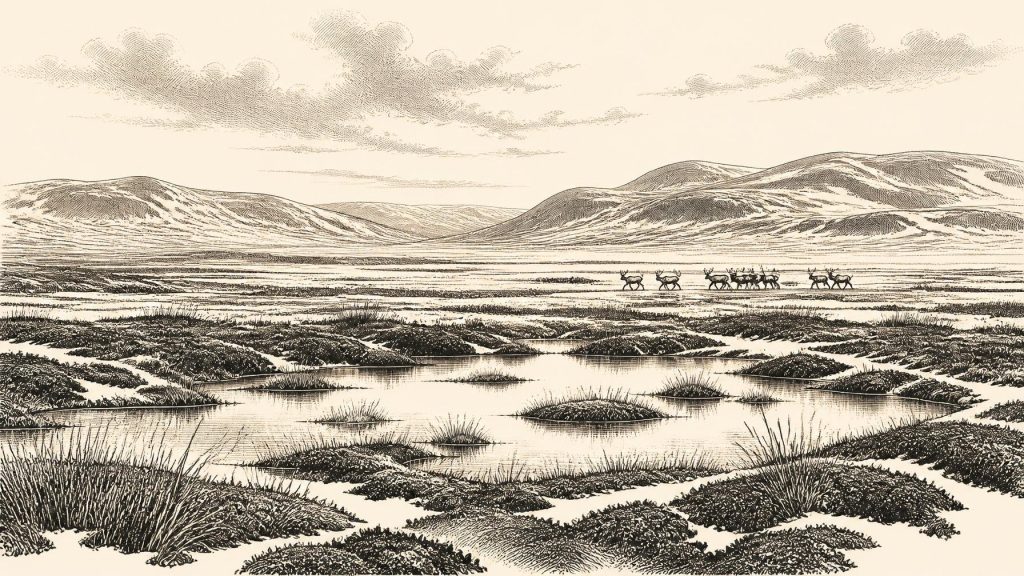
Around 30,646 BCE, Ireland lay within the unstable climate of Marine Isotope Stage 3, nearing the Last Glacial Maximum. Derryvree, County Fermanagh, preserves an ice-free freshwater wetland, later buried beneath till, whose sediments indicate treeless tundra-steppe, harsh winters and short growing seasons. Cave faunas, especially at Castlepook in County Cork, show large mammals including mammoth, reindeer and deer inhabited or visited parts of Ireland. A marked reindeer femur may record human butchery, but cannot prove settlement. No securely dated camps, tools or dwellings establish permanent occupation. Environmental evidence reveals a changing cold landscape, while human presence is still highly uncertain.
Dateline
30,646 BCE is not a date that people in Ireland could have named or recorded. It is a modern calendar label for a point deep in the Late Pleistocene. Archaeology cannot identify an event, ruler, community or season for this particular year. The responsible approach is therefore to place it within broader, dated evidence: Ireland was in Marine Isotope Stage 3, during the last glacial period, when climates and ice margins changed repeatedly over generations and centuries. The island’s physical geography, plants and animals can be investigated in places; its human history at this moment remains far less certain.
The nearest useful chronological language is calibrated radiocarbon dating, expressed as years before present (BP, where “present” conventionally means 1950). The nominal year 30,646 BCE lies about 32,595 years before 1950. Dates from Irish animal bones and freshwater deposits bracket this broad interval, but their uncertainties are substantial. They illuminate episodes and environments, not one precisely recoverable year. Above all, there is no evidence for an Irish polity, a settled nation, named peoples, or an uninterrupted population at this time.
A Cold, Uneven Ireland
Ireland was approaching the severe conditions associated with the Last Glacial Maximum, though it had not yet become the uniformly ice-covered landscape often imagined from simplified Ice Age maps. The growth, movement and merging of ice masses were regionally uneven. Some districts were glaciated or lay close to expanding ice; others retained exposed, intensely cold ground. Sea level was far lower than it is now, changing the outlines of coasts and shelves, but neither the exact configuration of shorelines nor a simple all-purpose “land bridge” can be assumed for every part of this long period.
The most important local environmental archive for this broad horizon is at Derryvree near Maguiresbridge, County Fermanagh. Road works in 1969 exposed freshwater silts and fine sands enclosed between two thick sheets of till in a drumlin. Organic material from this deposit, known by the laboratory determination BIRM-166, produced a conventional radiocarbon age of 30,500 years BP, with a large uncertainty of +1,170 and −1,030 years. That is not a calendar date, and it must be calibrated cautiously. Nevertheless, it securely places the deposit in the Middle Midlandian part of the last glacial cycle and demonstrates that this particular Fermanagh locality was ice-free long enough for freshwater sediments to form before later ice overrode and sealed them.
Derryvree does not provide an all-Ireland weather report. It does, however, provide unusually vivid evidence for the kind of landscape that could exist beyond the ice. Its pollen, plant macrofossils and insect remains indicate open tundra or tundra-steppe vegetation under periglacial conditions. Grasses and sedges, herbs and mosses mattered more than woodland. The evidence points to wet ground, pools and organic-rich mud alongside sparsely vegetated dry patches. Small shrubs such as willow or juniper may have occurred locally, but this was not a forested Ireland. Winters were harsh, soils repeatedly froze and thawed, and the growing season was short.
Wetlands Beneath Future Ice
The value of Derryvree lies partly in its preservation. Later ice deposited the upper till that covered the wetland sediments, creating a buried archive. This makes the site a warning against treating modern Irish scenery as a guide to the past. The familiar patchwork of fields, hedges, woods and peatlands did not exist. Nor did today’s lakes, rivers and coastlines. Around the time represented by the sediments, local waters supported cold-climate plant and insect communities while a wider glacial system was capable of erasing or burying their landscape.
There were no farms, crops, livestock or permanent villages evidenced in Ireland. If people entered the island, they would have encountered a landscape in which survival depended on mobility, detailed knowledge of seasonal animal movements, shelter, fuel and stone, and the ability to leave when conditions worsened. Yet those are general possibilities drawn from Upper Palaeolithic life elsewhere in north-west Europe, not demonstrated social facts for Ireland. Ireland’s archaeological record has not produced a camp, hearth, tool assemblage or dwelling securely dated to this point.
The Castlepook Question
The most provocative evidence comes from Castlepook Cave near Doneraile in north County Cork, long known as Mammoth Cave. Antiquarian excavations there produced a rich and difficult collection of Pleistocene animal bones, including mammoth, reindeer, red deer, wolf, brown bear and spotted hyaena. The cave is important because such bones show that parts of southern Ireland supported, or were visited by, large mammals during the last glacial period. But a cave bone collection is not a census of a living landscape. Carnivores could drag carcass parts into caves; deposits could be disturbed; and nineteenth- and early twentieth-century excavators did not record context to modern standards.
Modern radiocarbon programmes have improved this picture. Re-dating has shown that some Castlepook fauna belongs much earlier than formerly thought, within Marine Isotope Stage 3. Other Irish cave finds demonstrate that deer were present before the Last Glacial Maximum: calibrated ranges for two red-deer specimens from County Waterford include approximately 32,930–31,280 and 30,297–29,594 cal BP. These ranges matter because they overlap the broad chronological world represented by 30,646 BCE. They show that large herbivores could reach and survive in Ireland during parts of this period, although their distribution, numbers and year-round residence remain unknown.
A reindeer femur from Castlepook has attracted particular attention. It has been publicly presented as roughly 33,000 years old and bears a deep surface mark interpreted by zooarchaeologist Ruth Carden as damage made by a sharp stone tool during carcass processing. Cork County Council’s heritage publication dates the object broadly to about 31,000 BCE and identifies it as a possible Palaeolithic trace. If that interpretation is sustained, it would indicate that people handled a reindeer carcass in Ireland during the broad era under discussion, perhaps as mobile hunters following herds across the changing north-west European landscape.
That conclusion must remain qualified. The femur is a single modified bone, not a settlement. No associated stone tools, hearth, butchered-bone concentration or occupation surface has yet been recovered from Castlepook to establish a camp or a resident group. Furthermore, the cave’s deposits and old collections demand exacting taphonomic scrutiny: marks on bone must be distinguished from damage made by carnivores, excavation, sediment movement or later handling. The bone is therefore best described as important and potentially transformative evidence of human activity, rather than proof of a stable Irish population.
Animals, People and the Limits of Inference
Reindeer were well suited to open cold environments and, if hunters did reach Ireland, would have offered meat, fat, hide, sinew, bone and antler. A cut or chop mark could signal the removal of flesh or disarticulation of a limb. It cannot tell us whether a whole animal was hunted locally, scavenged, processed at the kill site, or brought into the cave by carnivores after people had taken what they wanted. The most economical interpretation is brief activity around an animal carcass; anything more elaborate would exceed the evidence.
There is likewise no direct evidence for political affairs, warfare, diplomacy, formal religion, artistic traditions, exchange networks or teaching in Ireland at this date. Such absences are historically meaningful. They do not show that Ice Age people elsewhere lacked rich social worlds, language, ritual or knowledge. Upper Palaeolithic communities on the European mainland certainly had sophisticated technologies and cultural practices. They show only that Ireland has not yielded material remains from which those matters can responsibly be reconstructed for 30,646 BCE.
Nor should the reindeer femur be turned into an origin story. Even if people briefly entered Ireland, later ice advance and environmental deterioration may have ended that presence, while subsequent sea-level change altered access routes and erased coastal evidence. The much later evidence for Mesolithic settlement cannot simply be treated as the continuation of a population living here thirty millennia earlier. The archaeological sequence contains large gaps.
An Archive Rather Than an Anniversary
The most defensible picture of Ireland around this nominal year is therefore a regional mosaic. In Fermanagh, a cold freshwater wetland lay in an open, treeless periglacial setting before being buried by ice-related deposits. In southern cave systems, large mammals left bones that testify to changing ecological connections with Britain and continental Europe. At Castlepook, one reindeer femur raises the serious possibility of human butchery, but does not yet reveal a household, a route, a season or a lasting settlement.
This is not an empty chapter of Irish history. It is a chapter written in silt, pollen, insect fragments, bones, cave deposits and radiocarbon measurements rather than in documents or monuments. Its central development was environmental instability: an Ireland capable, at times, of sustaining cold-adapted life, but increasingly shaped by the advance of ice. The enduring task for research is to recover better-dated deposits and undisturbed artefact contexts that can show whether the people suggested by the Castlepook bone were rare visitors, recurrent seasonal hunters, or something more.
Primary Sources
- A Middle Midlandian Freshwater Series at Derryvree, Maguiresbridge, County Fermanagh, Northern Ireland
- Palaeoecology: Field Guide 16
- The Irish Quaternary Fauna Project
- A Reconsideration of the Radiocarbon Dating of the Marine Isotope Stage 3 Fauna from Southern Ireland
- Phylogeographic, Ancient DNA, Fossil and Morphometric Analyses Reveal Ancient and Modern Introductions of a Large Mammal: The Complex Case of Red Deer (Cervus elaphus) in Ireland
- The Colonization of Ireland: A Human Ecology Perspective
- First Evidence of a Late Upper Palaeolithic Human Presence in Ireland
- New Insights on the Fauna of Ireland’s Younger Dryas and Early Holocene from Alice & Gwendoline Cave
- New Insights on the Fauna of Ireland’s Younger Dryas and Early Holocene from Alice & Gwendoline Cave
- Heritage Artefacts of County Cork
- Castlepook Cave Excavation, County Cork, 2022
- Late Pleistocene Chronostratigraphy and Ice Sheet Limits, Southern Ireland
- Early Deglaciation of the British-Irish Ice Sheet on the Atlantic Shelf Northwest of Ireland Driven by Glacioisostatic Depression and High Relative Sea Level
- Sedimentology and Chronology of the Advance and Retreat of the Last British-Irish Ice Sheet on the Continental Shelf West of Ireland
- Timing and Pace of Ice-Sheet Withdrawal Across the Marine-Terrestrial Transition West of Ireland During the Last Glaciation
- Cosmogenic 10Be Chronology of the Last Deglaciation of Western Ireland, and Implications for Sensitivity of the Irish Ice Sheet to Climate Change
- Dimensions and Chronology of the Last Ice Sheet in Western Ireland
- Deglaciation Chronology of the Donegal Ice Centre, North-West Ireland
- Ice Marginal Dynamics of the Last British-Irish Ice Sheet in the Southern North Sea: Ice Limits, Timing and the Influence of the Dogger Bank
- Radiocarbon Constraints on the History of the Western Irish Ice Sheet Prior to the Last Glacial Maximum